Should Coloradans have a constitutional right to cook with gas stoves? Voters will decide
Published in News & Features
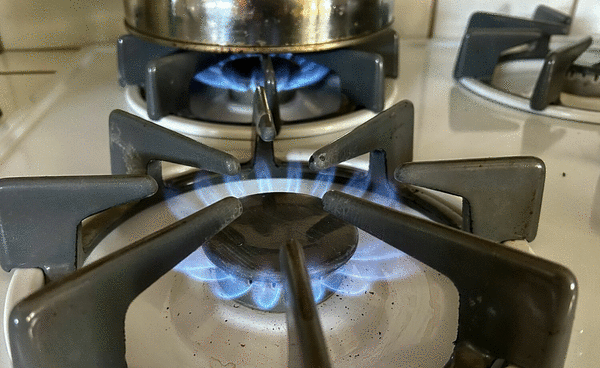
If Colorado voters approve Amendment 82 next month, cooking with a gas stove will become a state constitutional right alongside voting, owning guns and protesting in the streets.
Supporters of the ballot measure argue that natural gas is a more economical, reliable way to heat buildings and homes, and they contend that Colorado’s Democratic-controlled state government wants to ban its use.
Opponents say the state constitution should not be muddled with a provision that protects a single industry — especially one that pollutes the air, contributing to climate change and harming human health.
Amendment 82 would enshrine Coloradans’ right to use natural gas for heating and cooking in homes and businesses. It would also give oil and gas companies and utilities such as Xcel Energy the constitutional right to sell it.
Advance Colorado, a conservative political group funded by dark money, drove the effort to put the amendment on the Nov. 3 general election ballot.
Gas stoves became another salvo in the culture wars during the Biden administration after a political appointee suggested restrictions on the kitchen appliances might be warranted because they harm indoor air quality. In Colorado, where Democrats control state government, conservatives hoped Amendment 82 would appeal to the Republican base and motivate people to vote.
“This polled very well,” said Kristi Burton Brown, executive vice president of Advance Colorado. “It’s a sense you get in Colorado that voters are largely independent and they don’t want government to control their lives. This measure speaks to a very Colorado way of thinking.”
But the amendment has not gained traction. The oil and gas industry is staying out of the fray, choosing not to pick a side. Dozens of environmental groups and elected officials object, and the opposition has raised more money than the amendment’s supporters.
Carly West, executive director of the American Petroleum Institute Colorado, said in a statement to The Denver Post that her association has not taken a position.
“The measure was not proposed by API Colorado or our members, and we have not contributed to the campaign,” West said.
In 2024, lawmakers, oil and gas industry representatives and environmentalists reached an agreement to pause new legislation to regulate the industry. The truce was meant to give everyone time to see how the regulations passed in recent years play out, and industry insiders say they do not want to upset that agreement by supporting Amendment 82.
Colorado’s efforts to regulate natural gas
Supporters, however, say the state has gone too far in regulating natural gas. They point to a Colorado Public Utilities Commission rule that requires utility companies to file Clean Heat Plans that show how they will reduce greenhouse gas emissions.
The PUC created the Clean Heat Plans mandate after the Colorado General Assembly approved a bill that required utilities to reduce greenhouse gas emissions 4% by 2025 and 22% by 2030, from a 2015 baseline.
Utility companies would need to eliminate natural gas usage to meet those benchmarks, said Kit Pfeiffer, president of Energy Freedom Alliance of the Rockies, a political committee formed in June.
That would force homeowners to use electric ranges and heaters instead of natural gas, which costs less, he said. He cited studies that show household utility bills would increase by an average of $1,100 a year if people were forced to move away from natural gas.
“The state of Colorado is trying to take natural gas out of people’s homes,” Pfeiffer said.
But state legislators and local government officials say the constitutional amendment would take decision-making out of local hands, especially as technology develops. In early October, the Colorado Municipal League, which represents nearly 270 cities and towns, announced its opposition to Amendment 82, arguing that it would undermine local discretion to adopt and enforce energy-efficient building codes.
Emma Pinter, an Adams County commissioner, said in a news release from Vote No on 82 that buying and selling natural gas is already legal in Colorado.
“Amendment 82 could stick ratepayers with the bill for excess pipelines they never asked for,” Pinter said. “If it passes, we stand ready to hold these companies accountable and protect ratepayers from new costs.”
More than 20 organizations, including the League of Women Voters, Conservation Colorado, the Colorado Academy of Family Physicians and the Sierra Club, have either announced their opposition or donated to groups leading campaigns against the amendment. Fifty-two state legislators signed a letter to oppose it.
Sara Carpenter, executive director of Healthy Air and Water Colorado, said that science has proven that natural gas exposure causes childhood asthma and worsens lung problems such as chronic obstructive pulmonary disease.
“The air pollution has real consequences on human health,” Carpenter said.
Natural gas contributes to climate change, which also affects people’s health and causes more intense natural disasters such as wildfires and hailstorms.
“This amendment is completely counterproductive toward meeting climate change goals,” she said. “It makes no sense to me at all.”
Research has shown that gas stoves release benzene, methane and other pollutants that can cause respiratory diseases. Burning natural gas also releases carbon dioxide, a greenhouse gas, and it contributes to climate change when it mixes with other chemicals to form ground-level ozone pollution.
Natural gas hasn’t been banned in Colorado
So far, no elected body in Colorado has banned gas stoves or natural gas heaters in homes. Both are sold in stores across Colorado.
Denver Mayor Mike Johnston talked about banning natural gas hookups in new homes during his campaign. That has not happened.
Denver has adopted energy codes that encourage commercial buildings to move away from natural gas as a way to reduce carbon emissions. But natural gas boilers and other appliances are not prohibited in the city.
Colorado’s state government also wants commercial and residential buildings to use other forms of energy to heat and cool homes as part of its Greenhouse Gas Roadmap. The state seeks to reduce overall carbon emissions to net zero by 2050.
Advance Colorado does not expect any governmental body to outright ban natural gas, but said its use would be slowly eroded through regulations and rules passed by the Public Utilities Commission and the state legislature.
“The government does it in a sneaky way, little by little,” Burton Brown said.
Still, those who oppose the amendment say natural gas protections do not belong in the state constitution.
K.K. DuVivier, a professor at the University of Denver’s Sturm College of Law, said a constitutional protection for natural gas would pave the way for other special interests to be enshrined in the state’s governing document.
“It’s just crazy for every special interest to have a little nook in the constitution,” DuVivier said. “We don’t need to clutter it up with all of these special-interest privileges.”
_____
©2026 MediaNews Group, Inc. Visit at denverpost.com. Distributed by Tribune Content Agency, LLC.






Comments