Over utility resistance, Northern California fire survivors' bill signed into law
Published in News & Features
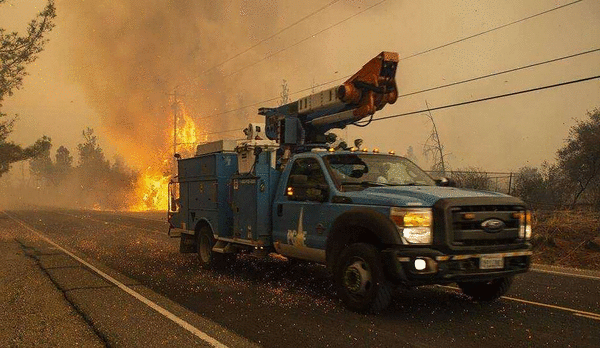
SACRAMENTO, Calif. — California Gov. Gavin Newsom signed legislation mandating the state look into whether electrical utility companies can be pushed to pay more money to victims of destructive wildfires caused by Pacific Gas & Electric Co. before the company declared bankruptcy in 2019.
Victims of those fires, which included the Camp fire that burned down the town of Paradise and killed 88 people and the also deadly 2017 North Bay wildfires that devastated Santa Rosa, were never made whole by the company because of the bankruptcy court. Most victims of the fires came out with roughly 30% of the damages they were entitled to unpaid, and the money they did receive came in installments over years, complicating and stunting people’s efforts to rebuild their lives.
The passage of Assembly Bill 2700 represented a victory for a grassroots group of wildfire survivors who pushed it without any significant organizational support. Behind the bill was a small group of everyday people who lost homes in Santa Rosa and Paradise who have over the years since — in bankruptcy court, in Washington, D.C., and in the Capitol — become determined advocates as they watched their claims repeatedly come in second to more powerful interests.
Their effort ultimately generated unanimous lawmaker support.
“AB 2700 changes the standard,” said Will Abrams, one of those advocates, Santa Rosa resident and Tubbs fire survivor in a statement. “Making victims whole means 100% compensation and not (about) 30% short after nearly 10 years of delay, and not forcing families, businesses and communities to absorb the financial consequences of utility-caused disasters.”
The legislation requires the California Public Utility Commission, which regulates PG&E, to provide by January 2028 a report with recommendations for how utility companies can put aside enough funding to make up the 30% shortfall. Those recommendations are not allowed to include raising the money through people’s electrical bills — in other words, the utilities will have to come up with the funding without passing it on to customers.
Instead, the CPUC would look to possible mechanisms such as ordering a reduction in payments to PG&E shareholders or even the utility’s issuing bonds to find money for the fire victims. The bill would not directly lead to the CPUC’s placing any requirements on the utility to pay out more money, however. Any proposals the CPUC comes up with would likely then have to go back to the Legislature, meaning any possible payments are conditional upon further political support and could be years away.
Newsom signed the bill without ceremony or a statement. PG&E and Southern California Edison had opposed it, telling lawmakers the legislation sought to undo the decisions of a federal bankruptcy court.
The utility companies warned in a letter to lawmakers they would likely sue if the bill becomes law, saying it “invites endless litigation” because it “attempts to rewrite the outcome of those long-settled federal proceedings.” The letter also stated that the bill would create more “uncertainty, risk, and costs,” for utility companies at a time when lawmakers and the governor say they want to stabilize the state’s electricity markets.
PG&E entered bankruptcy court in January 2019, with critics accusing the company of invoking federal bankruptcy laws to dodge its fire liabilities, though it didn’t truly face insolvency. As PG&E sought to exit bankruptcy, political pressure mounted on wildfire victims and their attorneys to accept a deal with the utility to create the Fire Victim Trust, which was composed of half cash and half company stock shares.
Fire Victim Trust administrators sold those stock shares off in chunks as the utility’s share price made a slow climb out of a bankruptcy bottoming out, leaving the survivors waiting years for payments. A final payment is scheduled for October, but represents a little more than a 1% increase.
The trust has paid out nearly $14 billion, roughly $5 billion to $6 billion short of the claims that have been evaluated. More than 70,000 people had claims on the trust.
_____
©2026 The Sacramento Bee. Visit sacbee.com. Distributed by Tribune Content Agency, LLC.






Comments