Trump set to name Jay Clayton as AI czar with safety fear rising
Published in News & Features
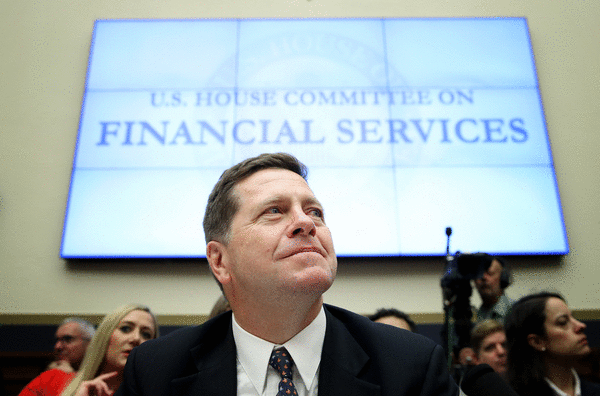
WASHINGTON — President Donald Trump is expected to name U.S. Director of National Intelligence Jay Clayton as his next artificial intelligence czar, according to people familiar with the matter, tasking him with spurring the technology’s development even as it faces backlash over safety risks.
The president may reveal Clayton’s appointment as soon as Friday, one of the people said, speaking on condition of anonymity before a formal announcement. The New York Times and other news organizations earlier reported on Clayton as Trump’s top choice.
A golf buddy of Trump, Clayton has served as director of national intelligence since July following his Senate confirmation to the position and now oversees the nation’s sprawling spy bureaucracy. It’s unclear whether he would do both jobs simultaneously, but other Cabinet officials including Secretary of State Marco Rubio juggle more than one key role in Trump’s second term.
Clayton’s selection as AI czar, if carried out by Trump, would signal that the the administration has no intention of shifting its hands-off approach to a technology that’s been a centerpiece of the president’s economic agenda. Since his return to office, Trump has hailed AI as an engine of economic growth and rejected calls for additional regulation to contain safety risks or slow data center construction to address concerns about rising utility prices.
Trump declared his intention to name a new AI czar last month, after growing public concerns about potentially catastrophic threats from AI became too hard for the administration to ignore. On Tuesday, the president hosted nearly two-dozen Silicon Valley executives including Nvidia Corp. Chief Executive Officer Jensen Huang and Anthropic PBC CEO Dario Amodei at the White House to discuss the technology’s risks.
Following the lunch meeting, the president dismissed the idea of new AI rules and reiterated his view that the industry should police itself while pressing ahead with development. In lieu of new rules, Trump and the executives agreed on a framework where they would partner with outside auditors to conduct safety assessments of models and implement stronger internal controls over their systems.
The agreement was signed by key attendees including Huang, Amodei, SpaceXAI’s Elon Musk, OpenAI President Greg Brockman, Meta Platforms Inc.’s Mark Zuckerberg, and Sundar Pichai, CEO of Google parent Alphabet Inc. Its provisions reflected Trump’s insistence on avoiding new rules, defying calls from lawmakers and some in the industry for more oversight.
Yet Trump’s enthusiasm for AI has faced growing backlash among voters who are concerned that new data centers will drive up power prices and that rapid adoption of the technology will significantly disrupt the workforce. Heading into the midterm elections, AI now ranks as a key issue in races that will help decide control of both chambers of Congress.
More recently, voters’ misgivings about AI’s economic disruption have been joined by growing concerns that it could pose a catastrophic risk, highlighted by a series of high-profile security breaches by rogue AI agents. Amodei accelerated the safety debate with a 3,800-word essay on Sept. 12 that called for pacing AI development and more government regulation.
A vast majority of American voters surveyed following the release of Amodei’s essay said they would favor requiring AI firms to meet independent safety benchmarks, even if it meant slowing development. The poll released Wednesday by Quinnipiac University found that 72% of those surveyed said they would oppose a new data center in their community, up from 65% when the question was posed in a March poll.
Trump has dismissed the safety fears cited by Amodei and other Silicon Valley leaders as “a hoax” and urged the nation to press ahead with data center construction. The president and his allies have insisted that existing liability laws offer enough protections and are abiding by their hands-off approach to preserve the U.S. lead over China in the technology.
On the day of the White House lunch, Trump called Clayton a “good man” when asked who he wants to be AI czar, according to Axios.
Before becoming director of national intelligence, Clayton served as U.S. attorney for the Southern District of New York, where he handled high-profile cases for the administration. Those included the case against former Venezuelan President Nicolás Maduro — after his capture by U.S. special forces — and the founders of First Brands and Tricolor.
If selected, Clayton would inherit a role vacated by David Sacks, Trump’s first AI czar who stepped down in March when his term as a special government employee expired. Sacks, a venture capitalist, has remained in contact with Trump and shared his view that AI development should be left largely free of regulation to allow innovation to flourish.
Sacks has criticized Amodei’s call for more regulation and slower AI development, saying the Anthropic chief wanted to make it harder for smaller companies to challenge larger players.
©2026 Bloomberg L.P. Visit bloomberg.com. Distributed by Tribune Content Agency, LLC.

Comments