Renee Good's family sues US over her death, Operation Metro Surge
Published in News & Features
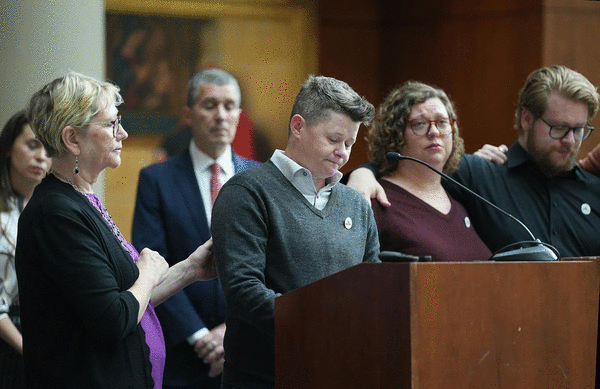
MINNEAPOLIS — The family of Renee Good, the 37-year-old Minneapolis woman whose killing at the hand of an ICE agent during Operation Metro Surge sparked global outrage, sued the United States of America, the federal agent who shot her and several high-ranking Trump administration officials on Thursday, accusing them of implementing a vast conspiracy that caused her death.
Good’s family filed two lawsuits in the U.S. District Court for Minnesota. They seek a jury trial to determine damages for the pain and suffering endured by Good and for the ongoing pain and suffering endured by her family.
At a news conference in downtown Minneapolis on Thursday, Antonio Romanucci, an attorney representing Good’s family, said the “day of accountability” had arrived.
Good’s family contends that her killing was a predictable outcome of Operation Metro Surge. The suits argue that Good was peaceful while interacting with Ross before he shot her three times and that the bullet that killed her was fired through an open driver’s side window, into Good’s temple, when her SUV was already past Ross and posed no threat to him.
Renee Good’s partner Becca Good addressed the media for the first time on Thursday, calling Renee “the love of my life.”
“She was pure love, and she was funny and she was smart and she was gorgeous and she never left anyone without feeling seen and cared for without a smile on their face,” Becca Good said. “She read all the time, and she found beauty in every moment. She was the center of my universe and living without her is like trying to live without the sun.”
Becca Good also said that Renee was an “incredible mother to her three children,” who nurtured their interests, read them books and talked about music and comics. Halloween is their son’s favorite holiday, she said, and “I’ll take him trick-or-treating without her hand in mine.”
“Every morning she’s my first thought, and I think about how the kids are growing up without their mama and how I’ll grow old without the love of my life,” Becca Good said. “I think about how we should have 40 or 60 more years together, but I also think a lot about what she would have wanted after all this.”
Renee Good’s brother, Brent Ganger, called his sister’s killing “completely senseless, and vowed that the family will not be quiet or go away.
“I deeply regret that it took the death of Renee to wake me up to the fact that no one in this country is untouchable,” he said. “I’m sure many people feel as though they are safe. My family had the unfortunate privilege of learning the hard way through the loss of our beloved Renee that no one is safe while ICE continues to terrorize us. It has taken far too long for white people like me to know what it feels like to not feel safe in this country. Our brothers and sisters of color have always had to fight to feel safe on the streets, and many, for good reason, still don’t.”
The personal nature of the lawsuit stood aside a broader claim that Operation Metro Surge was part of a vast conspiracy based off President Donald Trump’s “unmistakable animus toward people of Somali origin.”
The lawsuits allege that the conspiracy was part of a “carefully planned, coordinated effort” between senior administration officials to target “Minnesotans of Somali and Hispanic descent and origin” and “to silence, by intimidation, arrest and violence, the neighbors and allies of those targeted communities who observed, documented, and warned of that campaign.”
The first lawsuit was filed against the United States of America through the Department of Homeland Security, which oversees Immigrations and Customs Enforcement and Customs and Border Patrol. It alleges that Ross and other federal agents discussed in the lawsuit “were employees of the United States acting within the scope of their offices and employment as federal law enforcement officers.”
The second lawsuit was filed against Ross, White House Deputy Chief of Staff Stephen Miller, former United States Secretary of Homeland Security and current Special Envoy for the Shield of the Americas Kristi Noem, former Senior Advisor to the Secretary of Homeland Security Corey Lewandowski, White House Border czar Tom Homan, former Acting Director of ICE Todd Lyons, former Commander-at-large for U.S. Border Patrol Greg Bovino, and 10 federal agents who are identified as John Does because “the federal government has refused to disclose the names of the officers involved.”
Both lawsuits seek damages for Good’s killing, but the lawsuit against several individual entities seeks a jury trial to determine damages while another against the United States of America asks the U.S. District Court for Minnesota to have a judge make a determination on damages.
The Justice Department declined to comment on the pending lawsuit. A message was left with the Department of Homeland Security.
Operation Metro Surge, the largest immigration crackdown in the country’s history, lasted for part of three months from December of last year to February of this year.
It roiled Minnesota during a frigid stretch of winter.
Resistance to immigration enforcement in the Twin Cities had been percolating for months when Good stopped her Honda Pilot SUV on Portland Ave. on the morning of Jan. 7 as federal immigration agents converged on the area.
Good was parked sideways, blocking a bike lane, when agents approached her vehicle.
According to video and eyewitnesses, one agent grabbed the door handle and tried to open the driver’s-side door. As an agent told Good to “get out of the car,” Becca Good tried to enter the passenger door as Ross moved to the front of the vehicle. Good backed up the car a few feet and began to drive forward, turning the wheels away from the agents but briefly touching Ross. Ross then fired his handgun through the windshield and the open driver’s side window.
The lawsuit argues that every bullet Ross fired was in violation of Department of Homeland Security policy and that the only reason his hand briefly touched Good’s car was because he “intentionally leaned forward to position himself to shoot” and that he was never at risk of being run over by Good’s SUV.
The phone calls from family members informing them about the shooting remain vivid memories to Good’s brothers.
Luke Ganger recalled struggling to square the news of his sister’s violent death with the sister he remembered: The one with a laugh that could get “snorty at times,” and loved both Tina Fey’s hit comedy series “30 Rock” and foreign films.
“It just doesn’t make sense at all when you think about ‘Nae’,” he said, referring to her nickname. “You think about her like reading a book, watching something, laughing, singing, hanging out − it’s the only context I’ve ever seen her."
Hours after the shooting, Noem said Good tried to “weaponize” her vehicle in an act of domestic terrorism — an account that witnesses strongly disputed and criticized.
Scrutiny over the U.S. government’s handling of the shooting grew when federal officials removed the Minnesota Bureau of Criminal Apprehension from what had been a joint investigation with the FBI into Good’s killing.
In response, the state’s top prosecutors pursued their own review of the fatal shooting despite lacking access to evidence controlled by the FBI. The impasse appeared to end mid-July when federal prosecutors turned over the key evidence long sought by Minnesota’s investigators, including Good’s SUV.
Romanucci said he hopes the civil lawsuits lead to criminal charges against Ross.
“There should be accountability at all levels here and one of them being criminal,” Romanucci said. “If a crime was committed, then it deserves to be investigated and prosecuted and let a jury decide.”
Good’s killing was the first of Operation Metro Surge and massive protests broke out in the wake of it. Tributes extended from Minneapolis to Hollywood, where celebrities wore pins with the phrase “Be Good.”
Brent and Luke Ganger recalled standing with strangers at their sister’s memorial one day after the shooting, realizing they were all there for someone they didn’t know.
“It was a very surreal feeling,” Brent Ganger said. Both brothers think their sister would have been shocked about the global reaction to her death but upset that similar tragedies continued.
One week after Good was killed, federal agents shot Julio Cesar Sosa-Celis, a Venezuelan immigrant, in north Minneapolis. Ten days after that, federal agents shot and killed Alex Pretti, a Minneapolis resident and intensive care nurse for the Department of Veterans Affairs, on Jan. 24.
Sosa-Celis was shot by an agent after a car chase involving his roommate. Pretti was killed after being swarmed by several federal agents after he attempted to help an observer shoved to the ground on a frigid Saturday morning.
As residents took to the streets in acts of observation and civil disobedience, the working norms between Minnesota and the federal government teetered on complete collapse.
Joint investigations into the use of force that led to the killings of Good and Pretti and the shooting of Sosa-Celis fell apart under direction from the Trump administration, breaking historic norms. Romanucci said he and Good’s family still have yet to hear from anyone in the federal government.
Local law enforcement, including the Minneapolis and St. Paul Police Departments and the Hennepin and Ramsey County Sheriffs’ Offices, were asked to toe the line between the rights of federal agents to carry out their duties and the seething anger of residents who disagreed with their tactics and their goals.
Minnesota-based attorney Kevin Riach, part of the legal team for Good’s family, said the lawsuits are not just about Good’s death but about the search for peace in Minnesota amid “ICE’s rampage in our community.”
“The contrast between us and ICE could not be more stark,” he said, adding they had pepper spray and bullets, while residents had cellphones and their voices.
In many ways, he said of Good, “She is now us.”
______
(Paul Walsh of the Minnesota Star Tribune contributed to this report.)
©2026 The Minnesota Star Tribune. Visit at startribune.com. Distributed by Tribune Content Agency, LLC.




Comments