AG Campbell issues report on child clergy sex abuse across 3 Massachusetts dioceses
Published in News & Features
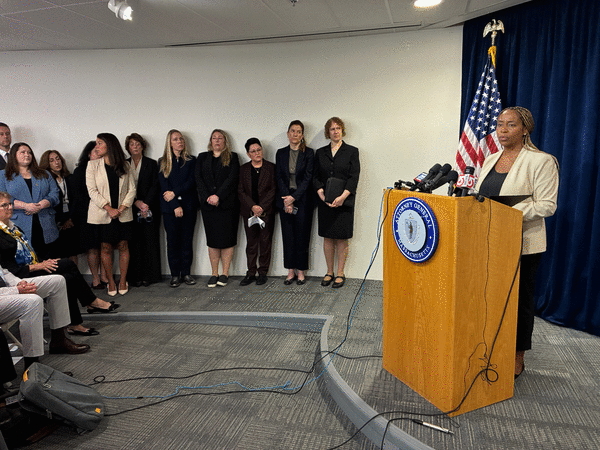
BOSTON — Massachusetts Attorney General Andrea Campbell has released a new report detailing nearly 1,000 cases of child sex abuse allegedly committed by 270 clergy across the Fall River, Worcester and Springfield dioceses, first publicly exposed in 2002, and the institutional failures that allowed the abuse to occur and continue.
The report highlighted several institutional failures within the three Catholic dioceses as well as the Boston Archdiocese that allowed “widespread abuse” to occur. It also identifies remaining gaps in oversight, accountability, and transparency across the three dioceses.
“For decades, survivors of clergy sexual abuse, including those who are no longer alive, have carried the devastating consequences of abuse, while the institutions entrusted with their care too often failed to protect them. This report provides for the first time a public accounting of the unimaginable harms afflicted on children in the Fall River, Springfield, and Worcester dioceses,” Campbell said.
“While important reforms have been made, the report documents decades of failures by diocesan leaders to adequately respond to allegations of child sexual abuse and protect children from further harm,” she said.
Campbell told reporters while headlines focused on the Boston Archdiocese when the abuse was originally exposed, that the Fall River, Springfield and Worcester dioceses were mostly ignored.
The investigation resulted in evidence of nearly 1,000 child victims of sexual abuse between the three dioceses by more than 270 Catholic clerics. This came by way of over 300,000 pages of records and interviews with more than 100 individuals that include survivors, advocates, clergy, diocesan officials and employees.
It details how diocesan leadership failed to properly respond to numerous allegations of sexual abuse and protect children over a decadeslong time frame. Specifically, it found instances where leadership failed to act on allegations and warning signs and simply transferred the accused clergy and offending priests to other parishes. The report found the dioceses even returned priests to ministry following treatment without adequate supervision; failed to meaningfully enforce restrictions; concealed the reasons priests were removed from ministry; and failed to consistently report allegations to law enforcement.
“All three (dioceses) were problematic and that is evident in this report. All three have the opportunity to adopt the meaningful reforms that I and this team have put forward,” Campbell said.
Attorney Mitchell Garabedian, who has represented several Catholic Church child sex abuse victims, says the church has not and will not change its ways, adding that it has failed and continues to fail to take proper accountability.
“Their business is about greed and money and self-image. The Catholic Church has shown time and time again that they don’t care about the evils of child sexual abuse. They only care about lining their pockets financially. It’s been shown time and time again across the world,” Garabediam said in a virtual news conference Wednesday.
The AG’s Office specifically criticized the Diocese of Worcester for being the only diocese in Massachusetts that has failed to provide a list of clergy with credible allegations of child sex abuse against them.
“We have engaged Worcester and all the dioceses. As we undertook this investigation there was active engagement with the dioceses and their lawyers throughout this entire process and up to this point,” Campbell told reporters. “And one of the recommendations that was made to the Worcester Diocese, in particular, was making this list publicly available as every other diocese in Massachusetts has. They refused to do that and we are calling on them today to do that.”
The Diocese of Worcester says it welcomes the AG’s report, while also issuing an apology to all of its child sex abuse victims.
“As your bishop, I am profoundly sorry for the abuse of minors by priests within this diocese since its founding in March 1950. I continue in my commitment with the help of many collaborators to do everything we can to ensure such abuse does not happen again,” said Bishop Robert Joseph McManus in a written statement.
The diocese went on to list three reasons as to why it welcomes the new report, but did not address the AG’s criticism for not sharing its list of credibly accused clergy.
“First, after an exhaustive investigation in which we were fully cooperative, there were no charges filed. It is also worth noting that any complaints of allegations received since 2002 have been immediately forwarded to the local District Attorney’s office,” the diocese said.
Secondly, the diocese points to a “vast majority of the cases” occurring 40 to 60 years ago, while pointing to the 2002 Charter for the Protection of Children and Minors, adopted by all U.S. dioceses, as its third reason.
The Diocese of Fall River issued a statement apologizing to victims of child sex abuse at the hands of the Catholic Church, also reaffirming the Fall River Diocese’s pledge to protect children and remain accountable.
“I am filled with sorrow over the historical account of incidents and practices reflecting the tragic failings to protect our most vulnerable, especially for the innocent victims who suffered, and continue to suffer, in so many ways. To all survivors of child sexual abuse, I am deeply sorry. We as a Church failed you when you were most vulnerable,” read a statement from Bishop Edgar da Cunha.
Bishop da Cunha went on to provide a list of steps the diocese has taken in the effort of preventing child abuse, including publishing its own list of clergy with credible allegations of childe sex abuse, reporting all accusations to law enforcement, and working with local district attorneys, among other protocols.
The Boston Herald has requested comment from the Diocese of Springfield.
Meanwhile, Campbell, Garabedian and a handful of state lawmakers are pushing legislation that would amend the civil statute of limitations for child sexual abuse claims to allow victims to come forward at any point in their lives.
Under current Massachusetts law, a victim can sue “within 35 years of when it happened, or within 7 years of when the victim knew — or should have known — it caused emotional or mental harm, whichever gives the victim more time. The time limit for filing suit begins to run when the child turns 18, according to the state’s official website.
The Catholic Church adopted national reforms as Massachusetts strengthened its laws governing child protection and reporting in the aftermath of the original reports out of the Boston Archdiocese in 2002. Subsequently, the three dioceses established offices dedicated to child protection and victim assistance, strengthened review processes, implemented safe environment training and background checks, and adopted new procedures for reporting and investigating allegations, the AG’s Office says.
The report can be found at https://www.mass.gov/doc/2026-fall-river-springfield-and-worcester-diocese-report/download.
_____
©2026 MediaNews Group, Inc. Visit at bostonherald.com. Distributed by Tribune Content Agency, LLC.






Comments