Michigan needs $85 billion in water, sewer infrastructure updates
Published in News & Features
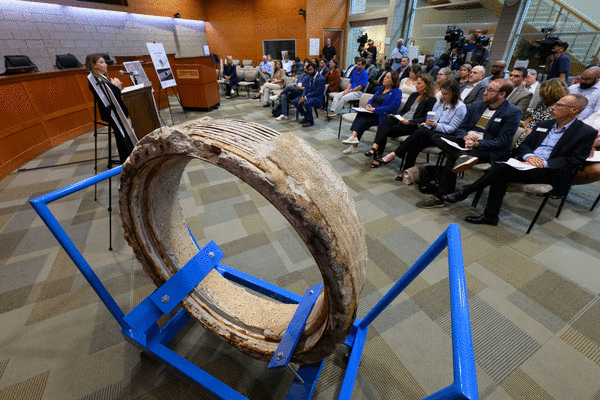
DETROIT — A new report commissioned by the Great Lakes Water Authority says that Michigan needs to invest as much as $85 billion in water and wastewater infrastructure over the next 20 years and calls on the state to create a funding strategy for those investments.
It's unclear how much of that total comes from the service area of the Great Lakes Water Authority, which is southeast Michigan's regional water authority, serving about 4 million customers in 112 communities. But GLWA said addressing its water pipes that have exceeded their useful life of 100 years would cost $1.2 billion. GLWA’s roughly 800 miles of transmission main average 72 years old.
Maggie Pallone, senior vice president at consulting firm Public Sector Consultants and the report's lead author, said the gap between current spending and the need is "huge" in Michigan.
"And if we don't do something now, it will continue to grow," she said.
The report, called "The Crisis Beneath Us," was released Sept. 23 and is the culmination of six months of research by the Water Funding Task Force, a coalition of financial, legal, engineering and public-policy experts convened by GLWA earlier this year.
It comes after a series of high-profile water main breaks in GLWA's system over the last year and a half in multiple cities, including Novi, Farmington Hills and Detroit. In some cases, the breaks flooded homes, canceled schools and forced residents to follow boil water advisories for days.
The Great Lakes Water Authority cites a 2025 report by the US Water Alliance, which found that Michigan’s estimated combined 20-year water and wastewater need is $85 billion.
The new report provides policymakers with funding and policy solutions that "will secure Michigan’s water infrastructure for the next generation," according to an executive summary of the report. Some of the potential options include the issuance of new state debt, pay-as-you-go funding and the use of sales taxes.
Suzanne Coffey, the chief executive officer of the Great Lakes Water Authority, said that when the authority talks with legislators, they often ask, "Well, how big is the problem, and ... what can we even do about it?"
"So our goal with the report," Coffey said, "is to answer those two questions to give us an opportunity to now have a more in-depth and detailed conversation about how we get to some solutions going forward."
The Water Funding Task Force that put together the report convened in January to "examine the funding gap and study how other states are addressing similar challenges," a GLWA press release said.
The scope of the problem
The report says that Michigan laid the bulk of its sewer and water pipe in the 1920s and the years following World War II. Pipes installed in those decades were expected to last 75 to 100 years, and "much of it is now approachingor past that mark," the report notes.
"When you put in pipes in the 20s and the 60s, it's inevitable that 100 years later, we're going to have to start needing to replace these pipes," said Pallone of Public Sector Consultants, the consulting firm that wrote the report.
The Environmental Protection Agency's most recent drinking water needs survey using data from 2021 puts Michigan’s 20-year need at $16.3 billion, the GLWA report said. The EPA's companion wastewater survey shows a 20-year wastewater need of $15.1 billion in 2022.
The US Water Alliance’s 2025 report finds "an even bigger need," the GLWA report said. It found that Michigan’s estimated 20-year need is $41 billion for water infrastructure and $44 billion for wastewater infrastructure. The US Water Alliance takes the EPA data and supplements it with estimates for lead service line replacement, stormwater upgrades, PFAS-related costs, and operations and maintenance expenses, according to the GLWA report.
The Great Lakes Water Authority has had several recent breaks in its system. A large water main break in Auburn Hills caused issues in five Oakland County communities in May, temporarily shutting down businesses, restaurants and some schools.
In February 2025, a massive water main break in southwest Detroit sent millions of gallons of water into the streets and homes, damaging cars and forcing more than 200 households to temporarily stay in hotels.
Pallone said raising water and sewer rates is "politically difficult." She said that local governments have to balance priorities, and she said it's difficult to raise rates to "the level that they need to be raised" in order to fund infrastructure to the degree that it needs.
The Great Lakes Water Authority faced pushback from residents over water and sewer rate hikes at public meetings this year and last year.
Utica Mayor Gus Calandrino said the rate increases his city gets annually from GLWA aren’t “sustainable.”
“There's no doubt that there are infrastructure needs that have to be addressed,” he said. “But it's going to be real hard to tie those directly to each individual municipality, and it makes sense that it should be a state issue.”
Calandrino said many residents of his Macomb County city are seniors or are on fixed incomes.
“Every time they get a rate increase that's over the rate of inflation, that's putting them behind, right?” he said. “That's costing them from making other life decisions that they need to make.”
Statewide funding options
The report provides policy options for funding infrastructure improvements, including issuing new state debt. One way to do that would be to issue a general obligation bond. General obligation debt is backed by the full faith and credit of the state, the report said.
Issuing such debt would require a two-thirds vote of the Michigan Legislature and then voters approving it on the ballot, said Jeff Guilfoyle, a senior strategist at Public Sector Consultants.
"When we've done this in the past, voters have overwhelmingly approved it," he said.
Michigan voters supported environment and water-related general obligation debt in 2002 ($1 billion) and 1998 ($675 million), the report said.
The report also lists other policy options, including pay-as-you-go funding and dedicated revenue sources, such as expanding the state sales tax base and withdrawing from the Rainy Day Fund.
-------------
©2026 www.detroitnews.com. Visit at detroitnews.com. Distributed by Tribune Content Agency, LLC.






Comments