Harborplace opponents regroup after setbacks, launch new fight over $900 million project in Baltimore
Published in News & Features
BALTIMORE — They lost at the ballot box. Their effort to put another question before voters failed. A planned lawsuit fizzled.
But opponents of Baltimore’s $900 million Harborplace redevelopment have kept fighting, regrouping after each setback and now joining forces again in a lawsuit challenging the project and proposed demolition of the landmark waterfront pavilions.
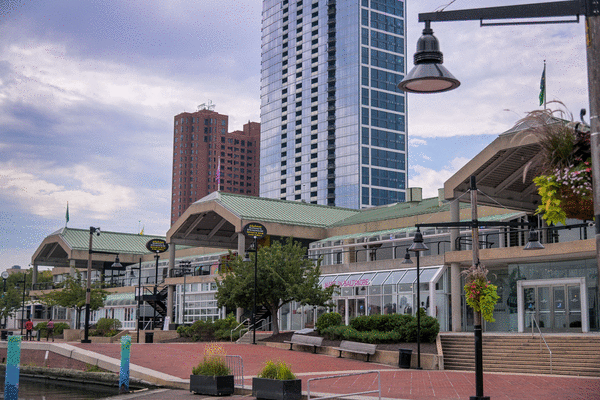
Several months ago, members of the Inner Harbor Coalition renewed their campaign, spurred by talk that the pavilions at Pratt and Light streets could be demolished this year. The 46-year-old, green-roofed structures have come to symbolize Baltimore’s waterfront revival, which inspired redevelopment efforts in other cities.
“We needed to get organized and figure out a way to stop the irreparable harm that would occur with demolition and taking all other options off the table,” said David Tufaro, a developer and plaintiff who describes himself as preservation-oriented, with Baltimore projects such as Montgomery Park and Mill No. 1, a former 19th-century cotton mill housing restaurants, apartments and offices.
On Monday, seven coalition members became plaintiffs in a lawsuit filed against the mayor and City Council and an arm of developer MCB Real Estate. Besides living downtown, some are well-known in their fields or have worked in historic preservation, including a developer, an architect, an attorney, an economist and a former city councilman.
Plaintiffs say redevelopment is needed but view the current plan as unlawful and ill-conceived. The lawsuit accuses city officials of violating city and state laws and regulations when they approved MCB’s vision and granted development rights in public parkland. MCB has proposed building four taller, mixed-use buildings, including a conjoined tower stretching 32 stories with 900 apartments.
On Tuesday, Mayor Brandon Scott’s office sent The Baltimore Sun an email saying that because of active litigation, “the City will reserve comment for the appropriate judicial forum.”
Scott has backed MCB’s vision from the start and has pointed to Bramble’s Baltimore roots as an asset after out-of-town developers neglected Harborplace for years.
The pavilions helped make the city and Inner Harbor a national destination more than four decades ago, but “it became clear that the future of Harborplace had to look, be and feel different,” Scott said during an October 2023 news conference to introduce MCB plans. “What we need to have in Baltimore is an Inner Harbor coming back with a new life, showcasing the best of Baltimore.”
A spokeswoman for City Council President Zeke Cohen, Jeanette Garcia Polansky, also declined comment on Tuesday.
MCB spokeswoman also declined comment on the lawsuit as well.
Besides Tufaro, the lawsuit’s plaintiffs include William John Pencek, economist Anirban Basu, attorney Eleanor M. Carey, former city councilman Anthony Ambridge, Barbara L. Valeri and architect David Benn.
Pencek, a former executive director of the Baltimore Heritage Area Association, recently became chair of the Inner Harbor Coalition.
The Inner Harbor, a public park, should remain primarily for public use, with height restrictions and a redevelopment process that considers a range of ideas, the coalition says on its website. Two years ago, members of the coalition lost a bid to defeat an election ballot question needed for the $900 million project. An effort to submit a separate question preserving Inner Harbor parkland failed. Another lawsuit was planned but fell through.
In a Baltimore Brew op-ed Pencek wrote earlier this month with Rebecca Hoffberger, founder of the American Visionary Art Museum, but not a plaintiff, he called for city officials to help redirect the project and halt pavilion demolition until MCB secures private funding.
“A city-led buyout of MCB’s interest would cost significantly less than the $400 million the developer expects from taxpayers,” the op-ed said, suggesting possibilities such as engaging a proven private operator, an entity such as the Maryland Stadium Authority or the not-for-profit Baltimore Public Markets Corp.
Besides needing about $400 million in public money for roads, parks and waterfront improvements, with nearly $100 million committed by the state, the project requires another $500 million in private financing.
P. David Bramble, MCB’s co-founder and managing partner, told The Sun in January that he was working to lock in $300 million in public funding, an effort he argued would pay off long term for downtown and the city as a whole thanks to long overdue improvements to the Harborplace promenade, surrounding streets and parks on city-owned land, including West Shore Park.
“There are major challenges with downtown, I think everyone knows that,” Bramble said at the time. “It’s time for us to make major investments downtown.”
Ambridge, who ran property management and development companies after serving on the City Council for 16 years, said concerns about maintaining public access at the Inner Harbor led him to a coalition meeting and to become active in the group. He said he remains concerned about the project’s ability to get financing and worries demolition could occur before that happens, leaving an empty lot.
“The purpose of the urban renewal ordinance was to keep [Harborplace] open — open space, sky, rather than towers,” he said. “We’re just doing what we think is right for the city in the long term.”
--------------
©2026 The Baltimore Sun. Visit at baltimoresun.com. Distributed by Tribune Content Agency, LLC.






Comments