Art Institute of Chicago will return painting looted during World War II to heirs of Jewish art collector
Published in News & Features
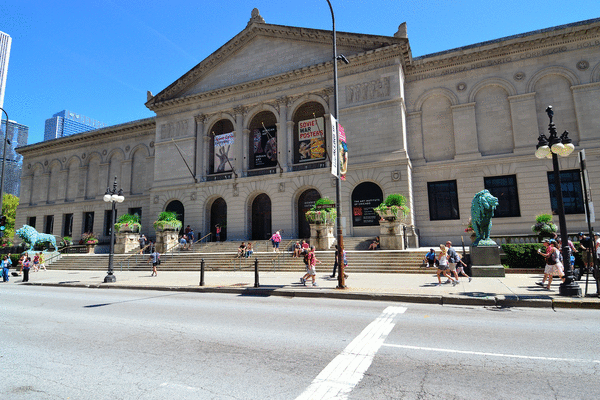
CHICAGO — For the past 30 years, descendants of Jewish art collectors whose works were looted by the Nazis during World War II have sought to reclaim stolen works of art.
On Tuesday, the Art Institute of Chicago announced it is returning a 1913 painting, “Woman with a Fan” by Jean Metzinger, to the heirs of its original owner.
“What is significant here is our research confirms the painting was owned by the Lewenstein family, a Jewish family who lived in Amsterdam, and that the painting was sold in a forced sale in 1940 in Nazi-occupied Amsterdam,” said Jacques Schuhmacher, executive director of provenance research at the museum.
The Art Institute conducted its research in collaboration with the Mondex Corp., a Canadian company founded in 1993 that specializes in the recovery of artworks and cultural artifacts. Mondex represents the heirs in this case.
According to information on the Mondex website, the Jewish art collector Emanuel Lewenstein had a passion for art and a family fortune derived from a sewing machine company. That wealth enabled him to collect paintings, drawings and prints, mostly by Dutch contemporary artists. His collection also contained the works of old masters, “including an impressive collection of Rembrandt prints, which he likely inherited from his father.”
Lewenstein died in 1930. When his wife died seven years later, the art collection went to their two adult children, Wilhelmine and Robert, who both eventually fled the country because of the Nazi invasion. The art remained behind and was then sold by an auction house “notorious for having organized the sales of artworks, which had been looted during the war,” per Mondex.
Provenance research is the work of unearthing the history of an artwork’s ownership, which can be “very challenging and difficult,” Schuhmacher said. “The information that you need to be able to tell these stories is often scattered across archives around the world. And in the past, people would sell artwork or buy artwork and they didn’t necessarily keep a record, or didn’t try to establish a paper trail of the full history of the artwork.”
The Art Institute has around 300,000 objects in its collection, some of which have provenance gaps. But a gap doesn’t automatically mean there is evidence the work was looted.
The museum acquired “Woman with a Fan” in 1959 and describes its painter, Metzinger, as “one of the most forward-thinking artists and advanced theorists of Cubism. The colorful, bust-length depiction of a woman displays the face and clothing as a succession of basic shapes set in distinct spatial planes.” The painting was on display until recently.
Schuhmacher said that attitudes about provenance began changing in the 1990s, “because of a major international conference that was organized by the U.S. State Department, and this put the issue of Nazi-era looting on the map for museums and the art world. And that really energized research into objects in museum collections. This is also when the Art Institute looked into the painting that we are now restituting, and we discovered that there were gaps in the provenance during the World War II period.”
Because of that gap, the museum listed the painting on its website as well as on a dedicated portal “in the hope that somebody would come forward and help us fill this gap,” said Schumacher. “And that is exactly what happened when Mondex contacted us and shared information about the family history that wasn’t previously known to us.”
The key to unraveling the mystery was not found in an archive, but on the back of the painting itself. “We discovered very, very faint handwriting in pencil. And thanks to the help from our conservators and technical imaging experts, we were able to take infrared photography, which allowed us to see a name: Paul Citroen.”
Citroen was Lewenstein’s cousin. According to Mondex, he had an “important influence” on the development of Emanuel’s collection. A native of Berlin, Citroen acquired a vast number of artworks from a gallery in Berlin, which he subsequently brought to the Netherlands “in about 1919, with the intention to sell them. Emanuel acquired several paintings from this fine selection of artworks, such as works by Jean Metzinger.”
Making this discovery, Schumacher said, “allowed us to connect our painting to the Lewenstein family. And then we have the same painting, which appears in the auction catalog, of a forced sale that took place in 1940 during the Nazi occupation.
This outcome is in contrast to that of a different work of art in dispute.
A 1916 drawing by Egon Schiele called “Russian War Prisoner” was acquired by the Art Institute in 1966. Recently, a panel of appellate judges in New York ruled that a lower court had incorrectly allowed seizure of the drawing — which had belonged to the cabaret artist Fritz Grünbaum, who was killed at Dachau in 1941 — by incorrectly relying on a criminal statute in the case.
According to reporting in The New York Times, “The judges took no stance on whether the work had been looted.”
The distinction, Schumacher said, is that in the case of the Metzinger painting, “there is clear evidence which shows that it was confiscated or that the family was forced to sell the painting during the Nazi occupation.
“In the case of the other artwork, ‘Russian War Prisoner,’ there is zero evidence that it was confiscated or that it was sold under duress under the Nazi period.”
The Art Institute said they have evidence that the drawing was passed through the family, and a family member eventually sold it to a gallerist 12 years after the war. The attorney representing a trust established to pursue the restitution of the Grünbaum works did not provide comment to The New York Times.
Schuhmacher has headed up provenance research at the Art Institute for two years and said that “it’s quite rare for museums to have a dedicated department for this highly specialized work.”
The museum is currently working on the logistics of how the painting will be returned to the heirs.
_____
©2026 Chicago Tribune. Visit chicagotribune.com. Distributed by Tribune Content Agency, LLC.





Comments