High-speed rail authority wasted money on first-class flights, trips to nightclub, report finds
Published in News & Features
California's High-Speed Rail Authority approved more than half a million dollars in wasteful and unexplained travel spending that included first-class and premium flights, international travel and rideshare trips to an escape room, a night club and a cigar lounge in Washington, D.C., according to a new report.
The authority spent more than $2 million in travel costs for four consulting firms from June 2024 to April 2026, according to the report released this week by the agency's inspector general. In addition, the authority failed to comply with state law requiring it to consider the business need for travel before approving it, the report said.
"Paying for travel when it is not necessary or when it exceeds what is allowed by state regulations or the contract terms is waste of public funds and is behavior inconsistent with the Authority's role as the steward of public resources," the inspector general's report said. "The Authority improperly reimbursed consultants for travel expenses that appeared unallowable under regulations intended to ensure economy to the State."
The inspector general said it reviewed about half of the travel costs incurred by the consulting firms and found that roughly $680,500 of those expenses didn't receive prior approval — and that $543,000 in travel costs were outright prohibited.
In response to a query from the Los Angeles Times, the inspector general's office identified the consultants as financial advisor KPMG, legal services contractor Nossaman, program delivery support AECOM-Fluor Joint Venture and track and system design group SYSTRA/TYPSA Joint Venture.
KPMG declined to comment. Nossaman also declined comment, referring questions to the rail authority. AECOM-Fluor and SYSTRA/TYPSA didn't immediately respond to requests for comment.
Reimbursement for travel can be granted under state regulation if there's a reasonable explanation that an in-person appointment is needed. The inspector general found that explanation wasn't always clear and that the person approving travel often operated under the assumption that an executive had requested it.
In one instance, the report said, a consultant pushed back against staff's questioning of an expense and said that he didn't need to justify in-person travel since the high-speed rail authority's chief executive had made the request. He said it would be inappropriate to second-guess the CEO's direction "as other consultants in other Authority offices are learning the hard way."
The expense was nonetheless approved.
In another instance, a consultant flew from Washington, D.C., to Sacramento on his private jet and was reimbursed the cost of a premium flight. The report also found that nearly $130,000 was paid for 30 trips from Denver to Sacramento for one individual, despite a finding of only five travel requests.
And roughly $118,000 was spent on international travel that was not allowed. The contract manager disputed the claim that the travel was prohibited; the inspector general disagreed.
The authority also approved rideshare trips to private residences, Planet Fitness gyms in Sacramento, a tiki bar, a sushi restaurant in Denver and a cigar lounge in Washington, D.C., without a business purpose explanation.
The inspector general recommended the high-speed rail authority update its travel policy to get advance written approval for trips, clarify expectations with staff and seek reimbursement for "unallowable expenses paid" from the consulting firms.
An authority spokesperson said the agency "takes these findings seriously" and will take corrective action.
"The Authority will strengthen internal controls around consultant travel, implement more rigorous documentation and approval requirements, and recover any improper costs identified," the spokesperson said.
The inspector general's office was created in 2022 to oversee the authority as spending ballooned past its original budget. It launched its recent investigation following claims of improper travel spending.
The train project is years beyond its proposed deadline to connect the state via high-speed rail and more than $100 billion over its original $33-billion budget. There's also been turnover at the top, most recently when CEO Ian Choudri took over in 2024 following former Brian Kelly's resignation after six years.
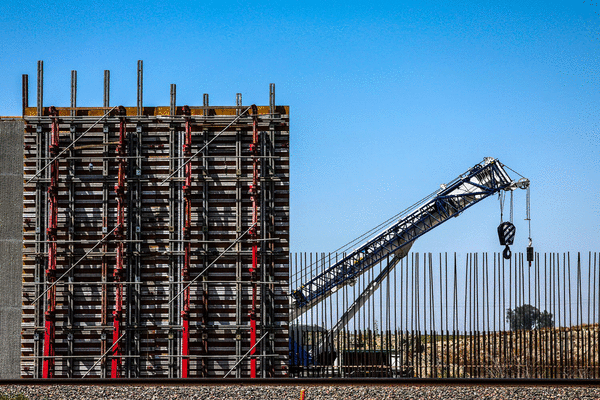
The project has created thousand of jobs and intends to one day shuttle travelers to and from Southern and Northern California. But construction has been confined to the Central Valley and nowhere is the line operable.
The train has come under immense scrutiny in recent years from the federal government, which pulled billions of dollars in funding last year, and state lawmakers. Authority board members and an outside peer review group also have questioned decisions and expenditures.
State Sen. Tony Strickland (R-Huntington Beach), who is the vice chair for the Senate Transportation Committee, said that report came as no surprise.
"More than $600,000 in consultant travel expenses were flagged as questionable, while California families are struggling with the high cost of living and deserve answers and accountability for how their taxpayer dollars are being spent on this project," Strickland said in a statement to The Times. "It's time to pull the plug and put those taxpayer dollars toward the needs of Californians today."
©2026 Los Angeles Times. Visit at latimes.com. Distributed by Tribune Content Agency, LLC.





Comments