Supreme Court asked to enter voter verification system fight
Published in News & Features
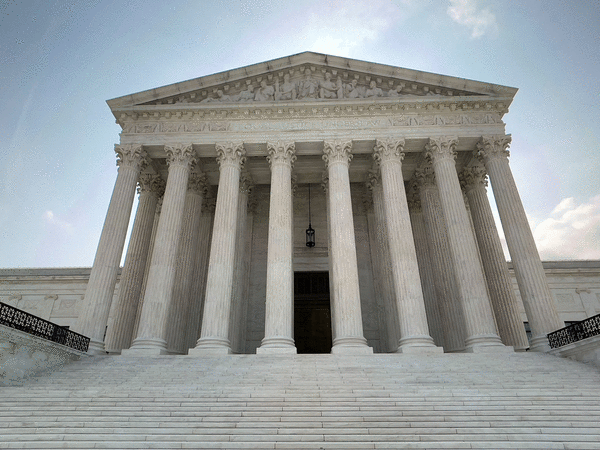
WASHINGTON — The Justice Department has asked the U.S. Supreme Court to allow the Trump administration to resume expansion of an internal government database available to states to verify the citizenship of voters.
The application submitted to the court on Tuesday marks the latest high-stakes, election-related fight to reach the justices recently with less than two months until the November midterm elections to decide control of Congress.
The case involves what’s known as the Systematic Alien Verification Entitlements, or SAVE, database. The Trump administration has sought to expand it to pull in information from the Social Security Administration as well as immigration records, a move that challengers argued would put Americans’ sensitive data at risk in violation of U.S. law and potentially lead to cancellation of voter registrations of citizens by mistake.
The Supreme Court ordered the voting rights and privacy advocacy groups that sued to respond to the government by Sept. 15. The justices separately are weighing a request by the Justice Department to lift a Boston federal judge’s injunction barring the Postal Service from enforcing new rules for mail ballots ahead of the Nov. 3 elections.
A federal appeals court in Washington refused to lift a U.S. district judge’s block on the SAVE database plan on Sept. 4. The Justice Department asked the Supreme Court to restore the expanded database plan, which also permitted states and federal agencies that use the system to run bulk searches, while the legal fight is pending.
‘Quiet period’
The Justice Department’s application to the Supreme Court comes as the U.S. enters a “quiet period” before the midterms, which is a federal prohibition on states making a push to “systematically” remove individuals from voter rolls 90 days before an election.
Solicitor General D. John Sauer acknowledged in Tuesday’s filing that states are in the 90-day window, but wrote that allowing the Department of Homeland Security to revive the expanded SAVE database could still aid election officials. He said the law didn’t bar them from making “individualized decisions” about whether to cancel registrations for noncitizens who are wrongly on voter lists.
The lower court’s “indefensible order” halting the administration from implementing the database plan “threatens the integrity of upcoming elections by vacating the federal government’s authority to internally use Social Security data when fulfilling its duty to respond to requests by states to verify the citizenship of individuals for voting and other purposes,” Sauer wrote.
Trump and U.S. officials have cited concerns about noncitizen voting as the foundation for a number of controversial election policies over the past year. Studies have repeatedly found that incidents of noncitizens voting in U.S. elections are rare.
Skye Perryman, president of Democracy Forward, which represents challengers in the case, said in a statement that “after failing to get its way in the lower courts, the administration is asking the U.S. Supreme Court to intervene, despite the law being clear that DHS’s actions cannot continue.”
The Justice Department is challenging a June ruling from U.S. District Judge Sparkle Sooknanan in Washington, who found that administration officials “haphazardly combined and repurposed the private information of millions of Americans, including citizenship data that they knew to be unreliable.” The judge cited evidence provided by challengers that some states were already taking steps to wrongly cancel voter registrations based on bad information.
“All in all, the federal government has knowingly trampled on the privacy rights of American citizens in a manner that threatens the sacred right to vote,” Sooknanan wrote at the time. “This Court cannot stand idly by while that happens.”
Last week, the U.S. Court of Appeals for the D.C. Circuit in a 2-1 order denied the Justice Department’s request to halt Sooknanan’s order while the litigation goes forward. The majority found that the government relied on arguments they forfeited in the lower court about the parameters of privacy requirements under the Social Security Act, and that even if the appellate panel considered them along with other defenses of the plan, the administration was likely to lose.
Chief Judge Sri Srinivasan and Judge Robert Wilkins, both appointed by former president Barack Obama, wrote in the jointly authored opinion that the earlier version of the database would remain available to state election officials who needed it to verify an individual voter’s citizenship status.
Judge Gregory Katsas, appointed to the court by Trump during his first term, dissented, providing a judicial foundation for the Justice Department’s move to take the fight to the Supreme Court. Katsas wrote that Sooknanan’s order conflicted with a Florida federal judge’s order enforcing a settlement the Trump administration reached with Republican state officials regarding access to the expanded SAVE database. He also found that the government was likely to win the case and that any individuals at risk of being disenfranchised “simply have to provide proof of citizenship.”
The case is Department of Homeland Security v. League of Women Voters, 26A308, U.S. Supreme Court.
_____
©2026 Bloomberg L.P. Visit bloomberg.com. Distributed by Tribune Content Agency, LLC.






Comments