US launches new Iran strikes as Hormuz tensions grow
Published in News & Features
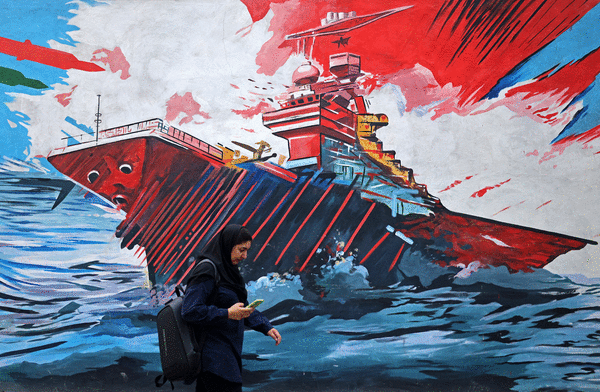
WASHINGTON — The United States launched a fresh wave of strikes against targets in Iran, extending a back-and-forth of fighting with neither side prepared to cede control over the Strait of Hormuz.
U.S. Central Command said it began strikes on Islamic Revolutionary Guard Corps targets following Iran’s attacks on commercial shipping and American forces in the region. Explosions were heard in Bandar Abbas and Chabahar in southern Iran, state-run Nour news reported Tuesday.
Oil prices rose further on the news, with WTI crude jumping to near $90 a barrel as the U.S. and Iran exchanged attacks for the first time in about a month on Monday.
The exchanges followed weeks of relative calm, during which U.S. President Donald Trump’s administration said it was pivoting from military action to applying economic measures to pressure Tehran. Oil shipments through Hormuz recovered to roughly half of prewar levels as a result of the dip in attacks, thanks in part to clandestine shuttle runs from major Middle East producers.
Any sustained return to fighting risks driving up energy costs and inflation, which would unnerve global investors and complicate Republicans’ efforts to retain control of the U.S. Congress in November’s midterm elections.
For Iran, a resumption in near prewar shipping volumes risks undermining its leverage in any future peace negotiations.
The latest U.S. strikes came a day after two oil supertankers attempting to exit the strait were hit in quick succession by projectiles, maritime security consultant Marisks said. While no one claimed responsibility for the tanker attacks, the reports followed a resumption of tit-for-tat strikes between the United States and Iran over control of the chokepoint.
On Monday, the U.S. said it targeted Iranian rocket launchers that were preparing to send mines into the strait, and Iran retaliated with attacks on the United Arab Emirates and Jordan.
Amid the escalation, U.S. Treasury Secretary Scott Bessent sought to play down the importance of Hormuz on Tuesday, saying the strait would eventually become irrelevant due to the increased use of oil pipelines. The comment appeared not to take into account the time needed to effect such a major switch in energy supply routes, while other key commodities, including aluminum and fertilizer, would still need to use the strait.
On Monday, Trump called the conflict a “little war.” Even so, there’s no sign of an imminent resolution, and oil is up more than 45% since the start of the year.
The United States and Iran have shown little appetite to resume negotiations since the collapse of an interim peace agreement signed more than two months ago.
Speaking at the Shanghai Cooperation Organization summit in Kyrgyzstan, Iran President Masoud Pezeshkian was downbeat about the prospect of a resumption in formal talks.
“Repeated U.S. violations of commitments under the Islamabad memorandum showed that even when the parties reach a political framework to stop the conflict and begin negotiations, the lack of effective enforcement mechanisms and a return to a policy of pressure and threats can cause diplomacy to fail,” he said in comments carried by the state-run IRNA.
Qatar said Tuesday that mediation efforts to break the impasse are ongoing, while Pakistani Prime Minister Shehbaz Sharif told leaders of the SCO he “firmly believes” the peace framework agreed upon in Islamabad in June offers the best prospect for peace.
Qatar and Pakistan are the main mediators between the two sides.
Pezeshkian’s appearance at the SCO came over a week after the U.S. launched a campaign to further isolate Iran, warning countries not to engage with the Islamic Republic or face punishment from Washington. There’s been little sign of Iran’s business or trade partners responding to the threat so far, and India’s Prime Minister Narendra Modi was among SCO attendees saying they wanted to strengthen relations.
The U.S. and Iran have issued conflicting reports on safety of navigation in the strait, with a top U.S. commander declaring “international shipping lanes are open” after American forces had cleared Iranian mines. That statement, which followed similar claims from Trump, has been privately doubted by U.S. allies, Bloomberg reported last week.
_____
(With assistance from Weilun Soon.)
_____
©2026 Bloomberg L.P. Visit bloomberg.com. Distributed by Tribune Content Agency, LLC.






Comments