Group asks court to put voter proof of citizenship question on ballot
Published in News & Features
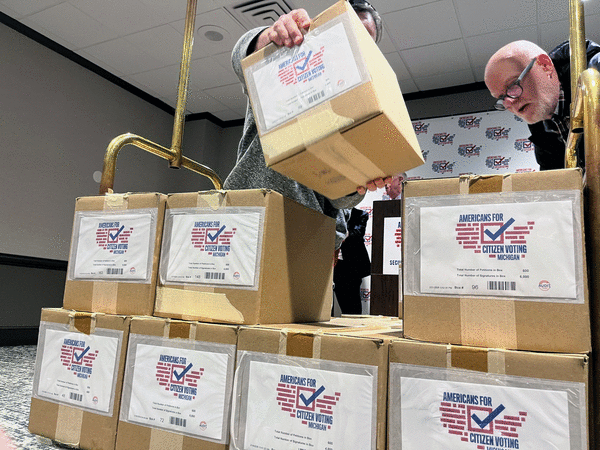
DETROIT — A group seeking to require proof of citizenship and photo ID to vote has asked the Michigan Supreme Court to overrule a state panel that found it was short the required signatures to appear on the November ballot.
Americans for Citizen Voting argued in a filing Thursday, Aug. 27, that the Board of State Canvassers’ signature sampling process was flawed and that the bipartisan board should have accepted affidavits related to questioned signatures.
The board deadlocked 2-2 earlier this week on whether the proposal met the 446,198-signature threshold to advance to the statewide ballot. The stalemate means the proposed constitutional amendment cannot move forward.
The deadline to finalize the November ballot is 60 days before the election, or Sept. 4, so the group's lawsuit challenging the canvassers' decision has asked for a speedy ruling.
“It’s not every day that Michigan’s bureaucracy violates state and federal law while disenfranchising more than 700,000 Michigan voters,” the filing said. “But that’s what happened this week. This court should act immediately and restore those voters’ voices.”
The canvassers’ decision was based on officials’ review of a 1,000 signature sample from more than 700,000 signatures the group submitted. Americans for Citizen Voting needed 629 valid signatures in order to be certified for the ballot, but fell a handful of signatures short of that total.
The two Republicans on the board, Richard Houskamp and Paul Cordes, voted to qualify the proposal for the ballot. But the Democratic members, Mary Ellen Gurewitz and Heather Cummings, voted against certification.
Much of the debate at the Aug. 24 canvassing board meeting focused on five signatures that were deemed invalid. Supporters of the ballot proposal turned in affidavits from the people behind the signatures, saying they had signed the petition and were qualified to do so, but they were turned in after the deadline for challenges.
In its Aug. 27 lawsuit, Americans for Citizen Voting argued special exceptions should be made to the deadline for the petition-sponsoring group and for the type of evidence the group was providing with the affidavits.
“The affidavits were also not mere information; they were testimony, and the board routinely takes live testimony at its meetings,” the lawsuit said. “In addition, by running out the clock with their 5½-month review process, the bureau and board gave ACVM a mere five days to identify the individuals whose signatures were disregarded and obtain affidavits from them.”
The group urged the Supreme Court to overrule the board’s decision, which the Americans for Citizen Voting argued would disenfranchise Michigan voters.
“Left uncorrected, the decision is an open invitation to future boards to reject ballot measures for any arbitrary reason or no reason at all,” the lawsuit said.
The canvassers' Aug. 24 decision set off such upset in conservative circles that House Republicans this week voted to create a select committee to examine the Bureau of Elections and Board of State Canvassers processes and procedures over the coming months.
Americans for Citizen Voting reported spending $9.1 million on its campaign as of July 20, according to a disclosure.
The ballot initiative advanced by Americans for Citizen Voting would amend the constitution to require the secretary of state to verify the citizenship of all registered voters, document it and remove non-citizens, if found, from the registered voter file. The language also would prohibit clerks from counting ballots from voters whose citizenship has not been verified unless those voters show records documenting their citizenship within six days of an election.
Individuals could verify their citizenship by showing a passport, birth certificate or other documents.
The constitutional amendment would require photo ID to vote and eliminate the option for a voter to sign an affidavit attesting to their identity in place of a photo ID. The amendment would establish a state-funded hardship program that would be available to those unable to pay for a photo ID.
Currently, under state and federal law, all voters must be U.S. citizens. Voters usually prove as much when they sign an affidavit at the time of registration attesting they are citizens.
But in recent years, groups have called for more checks on that process, including requiring the secretary of state to verify citizenship before completing registration.
_________
(Staff Writer Craig Mauger contributed.)
©2026 www.detroitnews.com. Visit at detroitnews.com. Distributed by Tribune Content Agency, LLC.





Comments