After Seattle Center shooting, Washington gun reform up against rifts, fatigue
Published in News & Features
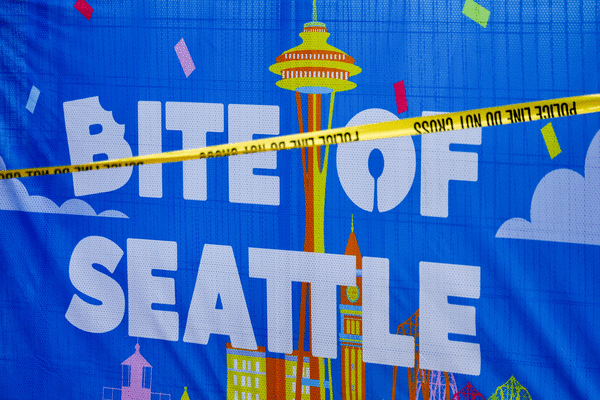
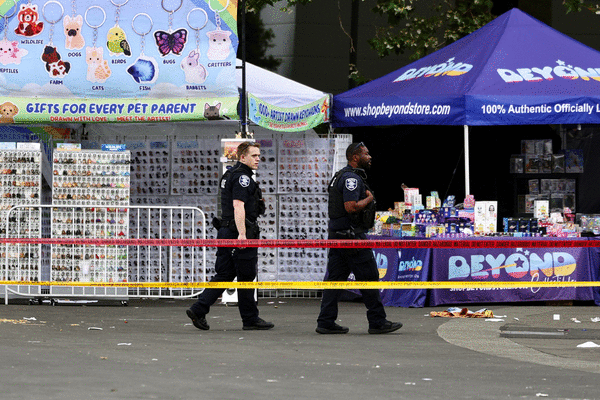


SEATTLE — As Washington state Rep. Liz Berry stood near Seattle Center’s International Fountain at a vigil for the Bite of Seattle shooting victims one month ago, she took stock of what’s next for lawmakers’ efforts to reduce gun violence.
The Democrat from Seattle has worked on several firearms-related proposals in the state Legislature, including a permit-to-purchase law that passed and will take effect next year: “I’ve already started thinking about what the plan’s going to be.”
But in interviews, Democratic lawmakers described disagreements within their ranks over how to tackle gun violence and bewilderment that a safe-storage bill never advanced to a House floor vote in the past two years. One Democratic lawmaker described his frustration that the party won’t make it easier to lock up juveniles with multiple convictions for illegal possession of a gun.
To Berry, lawmakers must move on multiple fronts. In an interview, she vowed to restore funding for community violence-prevention grants that got slashed in recent years amid a state budget shortfall. She and other lawmakers are reviving proposals that have not advanced in the Legislature, including a safe-storage law to prevent gun thefts and another seeking to make it impossible to manufacture “ghost guns” via 3D printers.
Meanwhile, the shooting during the annual Bite of Seattle festival illustrates how difficult it is for policymakers to stop every nightmare scenario in a nation awash in firearms.
Legislation to make it harder to obtain ghost guns might have kept a gun out of the hands of the 15-year-old arrested at the scene. Ballistics evidence has shown that ghost gun didn’t kill two bystanders, and it isn’t yet known whether it was produced in Washington. Also unknown is whether any of the firearms were stolen, which a safe-storage law might have prevented. Another gun recovered after the shooting had a switch that turned it into an automatic weapon, which is already illegal. And so few juveniles are convicted of firearms charges now that a proposal to give judges more leeway to confine repeat offenders might not affect many people.
Rep. Jim Walsh, R-Aberdeen, said the shooting at the Bite of Seattle proves the arguments he and other lawmakers have been making against restricting access to firearms for law-abiding people — it doesn’t prevent bad actors from disobeying the laws.
Republicans tried to run bills to strengthen sentencing standards for gun-related crimes, including property crimes, “and we can’t,” he said, adding that crimes should be prosecuted more effectively and that penalties should be stiffened for those who use guns to commit crimes.
“All we need to do is make the sentencing guidelines apply, regardless of the age of the perpetrator,” Walsh added.
Walsh called it “insane” that Democratic lawmakers have lightened penalties when a firearm is used in a crime, such as legislation passed in 2023 that barred most juvenile convictions to be counted in any subsequent convictions as an adult.
That critique isn’t coming only from Republicans.
State Rep. David Hackney, D-Tukwila, has sponsored a bill that would reduce the number of gun possession convictions needed before a juvenile can be confined by a judge for longer than 30 days. Five convictions for illegal gun possession now are needed before a judge can take those measures; Hackney’s bill would reduce that to three. But his party hasn’t scheduled House Bill 1536 for a legislative hearing in either of the last two sessions, much less push it forward for the votes necessary to send it to the governor’s desk for signature.
Hackney, in an interview, described the divisions within the Democratic majority.
“South King County has some of the worst crime in the state, violent crime and property crime,” said Hackney, a former prosecutor, who is Black in one of Washington’s most diverse voting districts. “And I’ve got colleagues who represent South King County districts who are, in my opinion, anti-police.”
He said a number of his colleagues oppose sterner criminal penalties, and “anything that makes it easier for the police to do their job, they will oppose.”
“It’s just a real split in the Democratic caucus,” Hackney added.
Safe gun storage
The latest firearms debate comes as a conservative-leaning U.S. Supreme Court has loosened firearms regulations nationally. Next year, the court will hear a challenge to state-level bans of semiautomatic rifles, which could strike down such laws across the nation, including Washington’s ban.
Renée Hopkins, CEO of the Alliance for Gun Responsibility, said the national political dynamics make organizing for local and state firearms restrictions more important than ever.
“We have a captive Supreme Court, we have a White House and federal agencies that have been infiltrated by the gun lobby, we have a Congress that continues to both actively push policies that enrich the gun lobby and to undo laws that help keep our communities safe,” she said last month.
For the coming legislative session beginning in January, Hopkins said the alliance is prioritizing the safe storage bill. House Bill 1152, sponsored by Rep. Beth Doglio the past two years, would require people storing handguns in their vehicles to secure them unloaded in a locked, hard-sided container. Rifles or shotguns could be kept in a soft-sided container, but they must have a trigger lock on them.
The bill requires firearms in homes to be secured with trigger locks or in locked containers or gun safes when they are not being carried or controlled by the owner or an authorized user.
Violations set out in the bill range up to a class C felony, in instances where “the violation allows a prohibited person to take possession of a firearm and use that firearm to cause personal injury or death to a third party,” according to an analysis of the bill.
“If you have a gun in your car, you have to keep it in a safe storage box,” said Doglio, a Democrat from Olympia. “It’s a pretty simple bill.”
But it stalled each of the past two years without getting a vote on the House floor. When asked why, Doglio said: “Good question, I wish I knew the answer to that.”
Berry acknowledged the toll that Republicans in the minority have extracted by loading up proposed bills with amendments that slow down debate and eat up precious time in the legislative session.
“What I think happened is we ran out of time and people were tired,” Berry said. “I think there’s a fatigue about passing more gun laws, because they take a long time to pass.”
One reason the bill stalled was over concerns that the law could disproportionately affect marginalized communities, said Rep. Amy Walen, D-Kirkland. One solution lawmakers discussed was a funding mechanism to pay for locked safes for low-income gun owners.
Asked if she thinks the bill would be brought back and had a chance of passing in future sessions, especially during a budget shortfall, Walen said “there are always ways” lawmakers get things done. One solution, she suggested, might be to add a surcharge to ammo to help pay for gun storage for those who can’t afford it.
Finding ways to use money from the budget to fund safe storage gun safe programs for people in low-income communities is “just a matter of political will,” she said.
Walsh, who is also the Republican state party chairman, criticized the bill, calling it an Orwellian “transfer of liability.” He added that lawmakers in both parties talked about the concerns around the law affecting marginalized communities “explicitly.”
‘They are going to get shot’
Next year, the city of Seattle will make another lobbying push at the Legislature on firearms, said Jonah Spangenthal-Lee, a spokesperson for Mayor Katie Wilson, in an email.
Among other things, Seattle will push for “restrictions on firearms in sensitive locations — such as city buildings, parks, and community centers — and requiring secure firearm storage in vehicles and homes,” Spangenthal-Lee wrote.
Meanwhile, the state Office of Firearm Safety and Violence Prevention fell victim to the state’s budget shortfall. The office lost 25% of its community violence prevention funding in this year’s supplemental operating budget, bringing it to about $6.5 million in annual grant funding, according to the state Office of Financial Management. That reduction came after a 10% cut in the 2025-27 state operating budget, when the office was at its peak funding for such grants.
“There were programs set up that were doing great, successful work, that have lost funding from the state because of what’s going on,” Berry said.
Rep. Osman Salahuddin, D-Redmond, sponsored a bill earlier this year making illegal the possession and distribution of ghost gun blueprints. That bill passed on party-line votes in the House and Senate, and Gov. Bob Ferguson signed it into law in March. He said he intends to sponsor his other ghost gun proposal again. HB 2321 would require 3D printers sold in Washington to have technology that scans for blueprints of firearms and blocks them from being printed.
That technology exists, and Salahuddin said he’s been in touch with companies that manufacture it. Salahuddin acknowledged he doesn’t yet know whether the ghost gun recovered after the Bite of Seattle shooting was 3D-printed.
But “getting these unlicensed, un-serialized weapons, whether 3D-printed or not, is a top priority for many folks to make sure that our communities are safer,” he said.
Hackney, the Democrat from Tukwila, said he plans to reintroduce HB 1536, and he may even lower the threshold to two convictions for illegal gun possession.
His proposal has a rare thing in the firearms debate: a bipartisan co-sponsor.
Rep. Andrew Barkis, R-Olympia, said he signed on to the bill because of the harm caused by juvenile violence, like at the Bite of Seattle shooting.
“We’ve spent too many years going the opposite way,” by reducing criminal penalties, including for juveniles, Barkis said.
“Of course, changing anything in the Washington state Legislature that has anything to do with increasing penalties … is more of a challenge,” he added.
Data from the Washington State Caseload Forecast Council, however, shows how few firearms convictions there are among juveniles.
For fiscal year 2025, only 17 juveniles had one prior conviction for unlawful gun possession, five who had two prior convictions, and one who had four prior convictions. None had five or more convictions, according to the forecast council.
For Hackney, confining a juvenile who has illegal gun convictions is an effort to ultimately spare them a long prison sentence down the road. Or worse.
“If they use the weapon, then they’re going to be charged as an adult with murder, attempted murder and aggravated assault … and then they’re going to get an adult sentence for decades,” he said. “Or they are going to get shot themselves, because if you’re shooting at people, people are shooting at you.”
Staff reporter Lauren Girgis contributed to this article.
_____
©2026 The Seattle Times. Visit seattletimes.com. Distributed by Tribune Content Agency, LLC.






Comments