Minneapolis looks at making it easier for felons to own large dogs
Published in News & Features
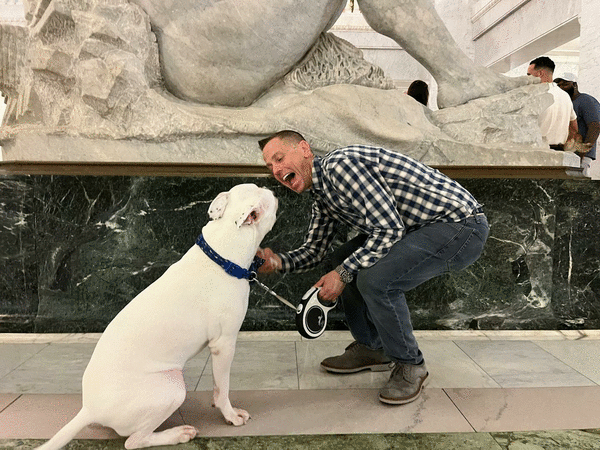
Mike McHaney adopted a 73-pound American bulldog named Houdini from the city shelter, and learned he’d have to pay $250 for a special permit due to his felony conviction.
That’s because a Minneapolis ordinance since 2008 requires people convicted of certain felonies — including drug charges, murder, assault, burglary and domestic assault — to get a permit to own an animal that weighs more than 20 pounds or could pose a danger to the public.
On Thursday, the City Council will vote on whether to change the rule through what authors call the “Bark Down Barriers” ordinance, which they say “removes barriers for certain justice-impacted people to adopt and own dogs.”
How it works
People convicted of certain violent felonies must apply for a $250 “prohibited animal” permit to have a pet that weighs more than 20 pounds or could pose a danger to the public if misused.
The proposed amendment, if approved Thursday, would strike that language, but give the city the authority to deny permits to those who have been convicted of animal cruelty or who used an animal to commit assault. No changes would be made regarding the city’s ability to restrict the ownership for those who fail to comply with ordinances over potentially dangerous or dangerous animals.
By the numbers
Since 2020, 18 people have applied for the permit, of which 11 were approved and seven denied. Often, the permits were denied because the animal was a risk to public safety, said Tony Schendel, director of Minneapolis Animal Care and Control. He supports the change, saying the ordinance is “unnecessarily restrictive.”
The conversation
The debate is about whether the ordinance does anything to help improve public safety.
Schendel said the city rarely finds cause to deny an application, and the ordinance is more of a burden than a tool to increase public safety.
“This ordinance we feel prohibits justice-impacted residents from owning a pet who really are, we found, good animal owners,” he recently told the council. “They’re often looking to help get their life back on track.”
McHaney said he’s worked hard to “redeem” himself, raising dogs for the blind while incarcerated. McHaney was surprised to learn that he’d have to jump through special hurdles to adopt Houdini, who’s “afraid of the vacuum,” sleeps splayed out with his legs in the air, “likes belly rubs” and “has better health insurance than I do.”
“I thought, ‘This is a lot of work to have a dog,’” he told the City Council during a public hearing on the proposal. “I’m not here to play the victim: I have a felony conviction. I own that. I’ve worked to build a different life but I feel my dog doesn’t answer for my past.”
JohnTaye Hudson of Minneapolis served 21 years after being incarcerated at age 16, and he told the council a pet is like family for those without kids. Under the ordinance, “you gotta pay to have family.”
“If I did my time, I should be treated as a part of my community,” he said. “But yet when it comes to my dog, I’m not.”
A man who identified himself only as Daniel urged the council to proceed with caution, saying the fact that few people are denied a permit doesn’t show that the safeguard has no purpose. He noted it’s not a ban, but a temporary permit and review process.
“If the current law is too broad, narrow it. If the fee is to high, lower it, but please do not eliminate the preventive safeguard entirely,” he said.
The council appears inclined to pass the measure.
“Nothing we’ve done in our life should stop us from loving pets,” Council Member LaTrisha Vetaw said. “You certainly should not be penalized for having a furry family member.”
The City Council will vote on the proposal on Thursday. The council’s Public Health, Safety, and Equity Committee unanimously endorsed the measure last week.
_____
©2026 The Minnesota Star Tribune. Visit startribune.com. Distributed by Tribune Content Agency, LLC






Comments