Kennedy Center's future takes center stage amid demolition threat
Published in News & Features
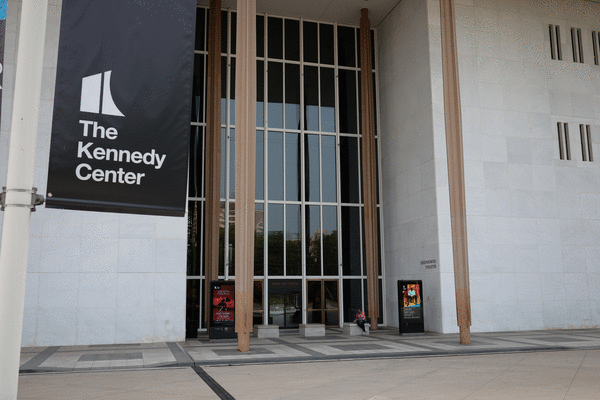
WASHINGTON — Lawmakers are decrying the Trump administration’s threat to demolish the Kennedy Center if a federal judge doesn’t rule in favor of adding the president’s name and closing the building for two years for major renovations.
It sets the stage for a high-stakes court hearing on Thursday as President Donald Trump continues his efforts to reshape the nation’s cultural and historical institutions.
“No one is going to be allowed to demolish the Kennedy Center,” said Rep. Rick Larsen, D-Wash., ranking member of the House Transportation and Infrastructure Committee, in a statement. “We should leave the Kennedy Center theatrics to the performers.”
On Monday, the Department of Justice warned in a legal filing that the 55-year-old building may be demolished if the administration isn’t able “to rebuild and renovate.”
“Without those efforts, the Center will deteriorate further into an unsafe, decrepit structure that will be required to be taken down, with a determination to follow on what to build on the site, such as a large outdoor amphitheater overlooking the Potomac River that has been proposed, by some, for many years,” DOJ attorney Brantley Mayers wrote.
The first attempt to affix “Donald J. Trump” on the building’s exterior was halted by the court in May, following a lawsuit from Rep. Joyce Beatty, D-Ohio, an ex-officio member of the center’s board. Judge Christopher R. Cooper of the U.S. District Court for the District of Columbia blocked that attempt, saying the “organic statute makes crystal clear that the Center is to be named for President Kennedy.”
“Congress gave the Kennedy Center its name, and only Congress can change it,” Cooper wrote at the time.
But the center’s board of trustees — which is now largely made up of Trump appointees and allies and is chaired by Trump himself — voted earlier in August to find other ways to add Trump’s name to the building and grounds. Under the proposal, the building’s existing “John F. Kennedy Memorial Center for the Performing Arts” inscription would be followed by the words “Renovated and Restored by President Donald J. Trump,” while the plaza around the center would be renamed after Trump. That plan could happen as early as Sept. 8, according to legal filings.
Beatty asked the court to again block those additions with an emergency hearing, her lawyers describing it as “déjà vu all over again.” That hearing is expected Thursday with Cooper, an Obama appointee, overseeing the litigation.
Larsen, who also sits on the center’s board as an ex officio member, said he agrees the center needs work to “safely entertain its guests” but the issues should be kept separate.
“Yes, the John F. Kennedy Center for the Performing Arts needs structural renovations. No, the administration cannot use that need to strong-arm the board into putting the president’s name on the facade; the courts already ruled against that,” he said in his statement.
Mayers argued Monday that opposing adding Trump’s name would cause “donors to flee, financial contributions to dry up, and structural rehabilitation to stop.”
“The Trump Administration, and President Trump, have also committed an enormous amount of time and energy in planning for the forthcoming renovation and restoration of this building, a task which President Trump, given his unrivaled expertise and experience in real estate and construction, and prominence as President, is uniquely qualified to accomplish,” he wrote in opposition to Beatty’s motion.
But a recent report from the Washington Post, reviewing budget and meeting documents, found that ticket sales for events at the Kennedy Center have plummeted since Trump fired the board of trustees and named himself chairman.
Several touring productions have canceled their scheduled performances, including the musical “Hamilton,” and the Washington National Opera withdrew its residency. Earlier this month, the National Symphony Orchestra announced it would split its upcoming season among six venues across the region in anticipation of the Kennedy Center’s renovation closure.
While not the main focus of Thursday’s hearing, the tarp that has remained over the Kennedy Center’s marble exterior since workers removed Trump’s name in June may also come up. DOJ lawyers say the scaffolding is needed for “water testing and structural repairs to the roof overhang of the Center’s front portico.”
Beatty’s team argues the board is “maintaining scaffolding and a tarp to cover the Kennedy Center’s façade to frustrate the intent of the Court’s order that the Center be returned to a memorial exclusively honoring President Kennedy.”
Sen. Chris Van Hollen, D-Md., who previously served on the board of trustees, said in a statement, “We are dealing with a narcissist who, if he can’t have his name on the Kennedy Center, wants to destroy it.”
He unveiled legislation on the topic earlier this year alongside fellow Maryland Democratic Sen. Angela Alsobrooks, Sen. Bernie Sanders, I-Vt. and others. Dubbed the Stop Executive Renaming for Vanity and Ego (SERVE) Act, it would prohibit naming federal buildings, land or assets after sitting presidents. But with GOP majorities in both chambers of Congress, it is unlikely to advance.
“It is a metaphor for his presidency — if Trump can’t have his way, the American people will pay the price,” he said. “The Kennedy Center & every monument across America belong to the people, not to any one person — and we must keep fighting back against this Administration’s disturbing attempts to undermine that.”
_____
(John T. Bennett and Michael Macagnone contributed to this report.)
_____
©2026 CQ-Roll Call, Inc., All Rights Reserved. Visit cqrollcall.com. Distributed by Tribune Content Agency, LLC.






Comments