Death toll in Haiti gang massacre remains unclear as UN condemns attacks
Published in News & Features
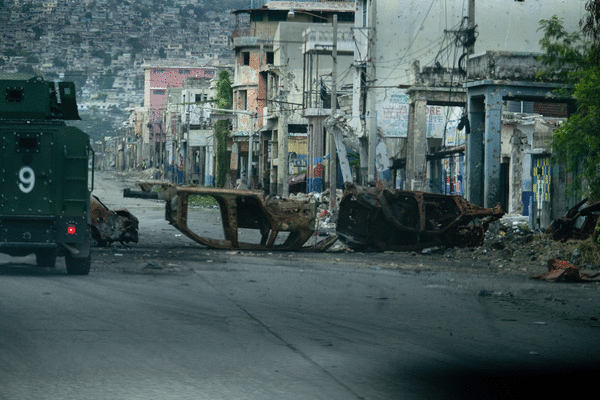
A day after armed gangs launched a deadly middle-of-the-night assault in the hills overlooking Port-au-Prince, torching homes, killing livestock and abducting dozens of individuals, the extent of the massacre remained unclear with estimates of the numbers killed ranging from 25 to as many as 47.
Part of the discrepancy may lie in how Haitian authorities are counting the dead.
Fritz Patterson Dorval, the chief prosecutor for Port-au-Prince, told the Miami Herald that he confirmed 26 deaths after visiting two morgues where he counted 15 bodies at one morgue and 11 at another.
Kenscoff Mayor Massillon Jean, meanwhile, told the Herald that a justice of the peace, accompanied by Dorval, had confirmed 25 dead while determining that 15 people remained missing after Sunday night’s bloody attack by members of the powerful Viv Ansanm gang coalition.
Either way, the Haitian government tally is lower than the 47 deaths reported by some media in the immediate aftermath or by the United Nations, whose Secretary-General António Guterres in a statement on Tuesday condemned the violence. In addition to those killed in the once peaceful mountainside community, armed gangs also kidnapped 52 people, including infants, the U.N. Integrated Office in Port-au-Prince said.
“This attack reportedly killed at least 47 people during the night of August 23, including 22 who were reportedly executed in a church compound where they had sought safety,” Stéphane Dujarric, spokesman for the secretary-general, said in New York during a media briefing. “The relentless attacks on communities and the loss of lives underscore the alarming security conditions in Haiti and reinforce the urgent need to intensify Haitian and international security efforts to counter these ruthless gangs.”
Asked about the conflicting death numbers, Dujarric said, “Sadly it’s not surprising that in the immediate aftermath there are some discrepancies of numbers given the difficulties in access, at least for us, to this site. As we see in many of these horrific tragedies and mass murder it takes a few days for the numbers to stabilize.”
Dorval said by the time he arrived in Kenscoff around noon on Monday, he found no bodies at the church. Nor did he see any along the roadway, despite widely shared images by journalists and others of the dead in those locations covered with white sheets or lying in pools.
“What they say, I can’t confirm or say it’s not the case; I didn’t see them,” he said, adding that he had video of the corpses he documented.
Dorval also said he could not confirm how many residents had been wounded or are missing because no one has filed a missing person’s report with his office. He also declined to give a figure for the number of people who were abducted, saying only that “they are a lot.”
A video circulating after the assault showed dozens of men, women and children being held hostage. The abductions were carried out by a gang leader who calls himself Izo 2, also known as “Didi.” In the video, he threatened to kill the hostages if security forces kill even one of his soldiers in the commune.
The gang leader is also accused of carrying out the June 11 abduction of James Boyard, a Haitian police officer and security expert who serves as the chief of staff to the minister of defense. Boyard was kidnapped along with his wife and their 6-year-old daughter, who is a U.S. citizen. Despite the payment of several ransoms, Boyard and his daughter remain in captivity.
Jean renewed his call for the Haitian police and other security forces to protect the rural community and its residents, which was echoed by the U.N. secretary-general.
At least 25 homes and other structures were destroyed after gangs set them ablaze, he said. Among them was the Church of the New Covenant Age in Kenscoff, located in the town center near the cemetery, and the home of prominent physician and HIV/AIDS pioneering researcher Dr. Jean William “Bill” Pape. A video showed that the home was set ablaze from inside.
“The secretary-general reiterates his call for the Haitian authorities to ensure that those responsible for the attacks are held to account, including through specialized judicial units recently created with international support to investigate mass crimes,” Dujarric said, adding that humanitarian staffers in Haiti are working with local communities and authorities to verify the information and assess what people need following the horrendous violence.
The attack on Kenscoff was the latest assault on the administrative district, which is similar to a county and occupies a strategic position overlooking affluent Petion-Ville, one of the last enclaves in metropolitan Port-au-Prince not under gang control. Once known as one of the safest places in the capital, the region has increasingly become a killing ground for armed gangs.
Deaths rise in second quarter
On Tuesday, the United Nations Integrated Office in Haiti reported that during the second quarter of this year, between April and June, at least 1,408 people were killed, and 656 others injured in Haiti as a result of gang violence. Gangs attacked accounted for more than half of all killings and injuries recorded during the quarter, which also included at least 81 documented kidnappings for ransom.
“These figures show that the population continues to bear an unacceptable toll from violence. Their protection must remain at the heart of all efforts to restore security, particularly for children, women and other people exposed to heightened risks,” said Carlos Ruiz Massieu, the head of the U.N. political office and the special representative of the secretary-general in Haiti.
While security operations helped stem gang activities in some neighborhoods of the capital such as Delmas and Tabarre, others saw a surge in violence, particularly as a result of clashes between gangs in areas under their influence, including Cité Soleil and La Plaine du Cul-de-Sac, the report said.
The clashes left a trail of deaths and injuries and at least 176 survivors of rapes, a level of violence not documented in those areas of the capital since at least early 2024, the U.N. said. Overall, between April and June, 754 incidents of sexual violence perpetrated by gang members against at least 796 victims — 772 women, 23 girls, and one man — were documented, the U.N. said. The youngest victim was 10 years old, the oldest 71.
“Sexual violence, particularly gang-related sexual violence, nevertheless remains largely underreported due to fear of reprisals, social stigma and lack of trust in the police and the judicial system,” the report said, adding that 98% of the incidents were reported in the West region where Port-au-Prince and Kenscoff are located.
Outside the capital, gang violence remained particularly concerning. In the Artibonite, gangs continued their territorial expansion through indiscriminate attacks on localities, targeting members of self-defense groups and residents inside their homes or in the streets, as well as farmers working in their fields. The situation remained tense in the Center region as well, notably in Mirebalais and Saut-d’Eau, where gangs continued to have a foothold. Gang violence also reached the Southeast, where armed raids were documented for the first time in Séguin.
Gang attacks raise questions
The attacks, including the Sunday night gang raid on Kenscoff, come as Haiti prepares for its first general elections in a decade and awaits the full deployment of the U.N.-authorized, Washington-backed Gang Suppression Force. The violence has renewed questions about whether elections can be held when security forces, even with international support, cannot protect the population or consolidate the gains against gangs.
“Even with more foreign troops on Haitian soil than at any point in a decade, when gangs decide to attack, they attack, and they succeed,” said Romain Le Cour Grandmaison, director of Haiti and Caribbean Observatory run by Global Initiative Against Transnational Organized Crime, a civil-society organization based in Geneva.
In the aftermath of the Kenscoff attack, people have asked about the lack of security forces, given that gangs reached the city center, carrying out their assault not far from the mayor’s office and a police substation. During a radio interview on Monday Jean said that prior to the attack, gang members had been flying surveillance drones for two weeks over Kenscoff.
Haiti National Police Chief André Jonas Vladimir and chief prosecutor Fritz Patterson Dorval defended the police response as they visited Kenscoff Monday, iut did not address reporters’ questions about the security breach.
Dorval said the area “has eight armored vehicles for the moment,” while adding that “there are technical questions” that only the director general of the police and mayor can answer.
Since 2024, gang violence has moved outward, further away from the center of Port-au-Prince. Criminal groups are pushing conflict away from the metropolitan core into areas that the Haitian government has never effectively administered, and they are doing so deliberately, Le Cour Grandmaison notes.
“The constraint is arithmetic before it is political,” he said. “The forces available cannot hold simultaneous fronts, and the terrain is mountainous, isolated, and sometimes hundreds of kilometers from where those forces are concentrated.”
For over 18 months armed groups have established themselves across Kenscoff, struck its periphery while leaving the center under pressure. Several massacres occurred in surrounding villages during that period.
“The assault on the town center two days ago is evidence of accumulated capacity,” Le Cour Grandmaison said, “and how Kenscoff develops from here will show whether the underlying calculation is shifting.”
_____
©2026 Miami Herald. Visit miamiherald.com. Distributed by Tribune Content Agency, LLC.





Comments