Canada sees long trade war with US that may last beyond midterms
Published in News & Features
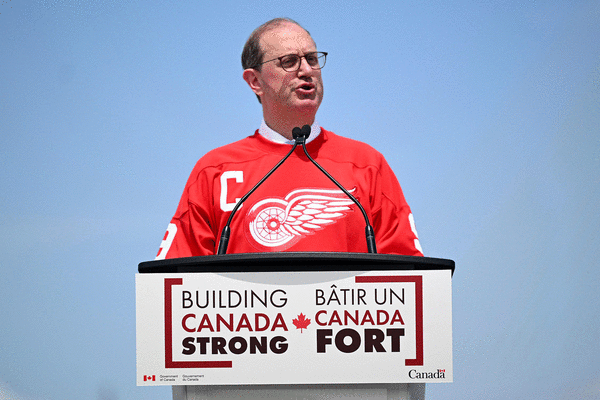
Prime Minister Mark Carney’s government sees little chance of resuming talks with President Donald Trump before the midterm elections after trade negotiations collapsed, according to people familiar with the matter.
The Canadian leader, who said he will prepare a domestic aid package to help businesses hurt by U.S. tariffs, is designing those measures to ride out the balance of Trump’s term if necessary, added the people, who were granted anonymity to discuss sensitive deliberations.
The preparations from Carney signal the gravity of the breakdown in talks late Friday, which led Trump to impose new tariffs and Carney to announce retaliation, risking a spiraling trade fight between the two closely integrated economies.
While Carney’s government sees no sign of new talks in the near future — and only a dim chance before the midterms — some of the people cautioned the situation remains fluid and the U.S. has not ruled out a restart.
The sudden collapse of talks has left Carney bracing for the risk of a long winter. He announced Saturday that he’d roll out a domestic aid package, and told premiers over the weekend that the support would remain in place for the duration of the conflict and throughout the rest of Trump’s term if need be, one of the people said.
“We will support these businesses for as long as it takes, in other words, beyond the life of this U.S. administration,” Carney told reporters. “So there’s various mechanisms that we’ve worked up. We’ll give all the details in a few days.”
Carney’s office didn’t immediately reply to a request for comment Sunday evening. In an interview earlier in the day, his ambassador to Washington, Mark Wiseman, said Carney’s decision to enact his retaliation on Sept. 8 is not a sign of an anticipated last-minute return to talks. “I don’t think it should be viewed that way,” he said.
The U.S. has said the path for talks is unclear. “It’s hard to say. We don’t have new talks planned with the Canadians. We’re moving forward with measures that respond to Canadian retaliation,” U.S. Trade Representative Jamieson Greer told Fox News on Saturday.
Wiseman also signaled that the two countries remain in constant contact on a range of files, while sidestepping a question on whether they’ve discussed trade since Friday’s eruption.
“We talk to the Americans every day,” he said. “We will continue to talk to all kinds of members of the U.S. administration because we have to because we’re neighbors, we’re friends, we’re allies, and that’s the way we’ve always operated.”
The breakdown Friday night cast a cloud over U.S.-Canadian ties and sowed confusion throughout the weekend. Carney announced counter-tariffs but hasn’t specified them, leaving it unclear how far he will go to target swing states in November’s midterm vote. Meanwhile, top U.S. officials needled Canada — Trump said it wanted the benefits of statehood, Transportation Secretary Sean Duffy called Canada “foolish” — but the response has been, by Trump’s standard, relatively muted so far.
Carney’s speech Saturday, which drew widespread support across Canada’s political spectrum, appeared to cement his political footing for the risk of a prolonged conflict. Trump’s constant threats to Canada have made him deeply unpopular there.
In a poll taken since talks collapsed, three in four Canadians endorsed Carney’s decision to walk away from negotiations, despite many in the same poll expressing anxiety about the economic impact to come.
It’s not yet clear what the domestic aid package will include, and it’s also not clear how far the tariff war could escalate. A U.S. official said late Friday that if Carney goes ahead with his tariffs, Trump will be given options to escalate again.
____
(With assistance from Thomas Seal and Brian Platt.)
©2026 Bloomberg L.P. Visit bloomberg.com. Distributed by Tribune Content Agency, LLC.





Comments