A look at the 4 incumbent Alaska House lawmakers trailing challengers in the primary
Published in News & Features
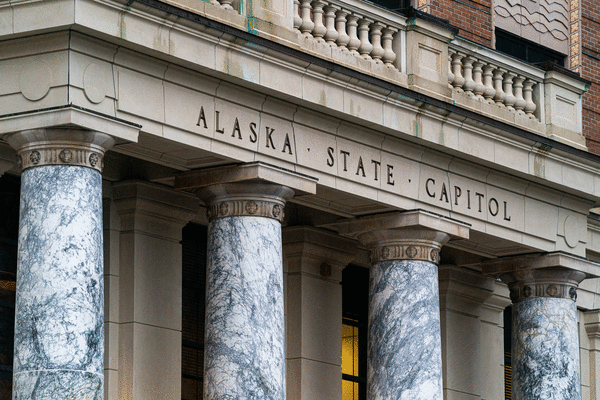
With initial primary election results still taking shape, four incumbent members of the Alaska House of Representatives are trailing their challengers.
Of the 50 state legislative seats up for election this year, early results indicate that all incumbent candidates will have the votes to advance to the November general election. Under Alaska's open primary system, the top four vote-getters in the primary advance to the general election, regardless of party affiliation.
In all but five of the races, there are no more than four candidates on the ballot — meaning no candidates will be eliminated from contention.
But even without any eliminations, the primary can boost, or dampen, momentum leading into the November election and spur underperforming candidates to drop out and consolidate support behind others on the ballot.
Two Republican incumbents are trailing challengers to their left in races on the Kenai Peninsula and in West Anchorage. In Western Alaska, one incumbent is narrowly behind a former lawmaker she unseated last election cycle. And an incumbent appointed to his position by Gov. Mike Dunleavy in December is trailing by more than 15 points.
Incumbents have faced a unique campaign season leading up to the primary. For the past few months, lawmakers have periodically returned to Juneau during three consecutive special sessions since the regular session ended in May. Dunleavy called the special sessions to ask the Legislature to consider tax-break legislation for the long-proposed Alaska LNG project, with the goal of facilitating construction of the natural gas pipeline.
Alaska law prohibits legislators who are running for office from soliciting or accepting campaign contributions while they are in the capital city during legislative sessions. One incumbent who trailed in the primary says these restrictions have curbed his ability to fundraise and reach voters.
With more than 133,000 votes tallied as of Friday afternoon, thousands of ballots remain to be counted, including by-mail ballots that have not yet been received by the Division of Elections and early-voting ballots cast in the four or so days leading up to Election Day.
Primary elections can be an important indicator of voter sentiment, but the results do not necessarily predict the outcome of the November general election. Turnout, for example, is generally much lower in the primary. In the 2022 midterm election, about 192,000 Alaskans voted in the primary — which also included a high-profile special U.S. House election — compared with 267,000 in the general election.
Two challengers outperforming 2024 efforts to oust incumbents
Repeat matchups in two legislative districts show challengers gaining ground over more conservative incumbents since the last election cycle.
Initial results show independent Brent Johnson leading Homer Republican Rep. Sarah Vance by fewer than 600 votes in a head-to-head contest. In the race for the district that includes Homer, Ninilchik and Seldovia, Johnson had 2,940 votes, or about 55%, while Vance had about 45% as of Thursday.
This is Johnson's second attempt to unseat Vance. In 2024, Johnson advanced from the primary in second place — among a field with an independent and another Republican also on the ballot — with 33.9% of the vote, compared with Vance's 43.2%. Vance then defeated Johnson and the rest of the field in the general election with 52.3% of the vote, receiving 5,638 votes to Johnson's 5,150.
Johnson, a commercial fisherman and former Kenai Peninsula Borough Assembly member, said the biggest change he hopes to bring to the Legislature is increased funding for education. Vance voted to sustain Gov. Mike Dunleavy's vetoes of additional education funding in 2025.
Johnson said he would also seek to join a bipartisan majority coalition, in contrast with Vance, who was part of the Republican minority caucus during the last legislative session.
Vance is also among the House's more socially conservative lawmakers. Johnson said that he is "certainly more liberal" than Vance, but that he believes bread-and-butter issues matter more to voters than social issues.
"What people really care about is economics and free elections and education and fisheries," Johnson said.
Vance did not respond to interview requests about the early results.
Johnson has raised about $45,000 since February and spent about $20,000 on his campaign, according to campaign finance reports. Vance has raised more than $22,000 during the same period, in addition to about $32,000 cash on hand from previous fundraising. She has spent about $11,277 in her reelection campaign so far.
In the race to represent Sand Lake and Campbell Lake in Anchorage, another repeat challenger has a narrower lead over the incumbent.
Three-term Rep. Mia Costello, a Republican, trailed her sole opponent, Democrat Denny Wells, by 57 votes. Wells had 50.8% of the vote, compared with Costello's 49.2%.
Wells, a small-business owner, has previously run two unsuccessful campaigns for the House seat. In the 2024 primary, he trailed Costello in a three-way contest for the seat by 137 votes. Costello improved her margin in the general election to more than 500 votes, or six points.
The 2024 race also included perennial candidate Dustin Darden, running as a Democrat, who picked up 242 votes in the general election.
Wells said this year's campaign for the House District 15 seat feels different. In conversations with voters, he said he sees an "undercurrent" of support for disrupting the political "status quo." Wells said he would also favor joining a bipartisan caucus, in contrast with Costello, who is a member of the Republican minority caucus.
Still, Wells said many of the concerns he is hearing from voters are the same as in his previous campaigns.
"I've heard, in the last two election cycles, really concerns about our education funding and class sizes and closing schools, and concerns about not investing in ourselves," Wells said.
Costello said she is confident heading into the general election and expects a "healthier" voter turnout in November, with more Republicans going to the polls. She said she does not see changing the political status quo being as important to voters as a candidate's reputation.
"I think experience matters, and I've brought a lot of projects to the district to improve the district, and I listen to my constituents and work hard for them. And so, if I return to Juneau, I would continue to work hard for them," Costello said.
Wells has raised about $26,000 and spent $7,600 since February. Costello has raised about $15,000 during the same period, in addition to about $4,300 in cash on hand from previous campaigning. She has spent about $10,000 on her campaign since February.
Former legislator seeks to reclaim his seat
A former legislator from the Lower Kuskokwim and Yukon-Kuskokwim Delta is seeking a return to Juneau.
With about 92% of precincts reporting preliminary results, former Rep. CJ McCormick, a Bethel Democrat, was slightly ahead of incumbent Rep. Nellie Jimmie, a Democrat from Toksook Bay, in the race for a Western Alaska House seat.
McCormick had 30.8% of the vote while Jimmie followed with 29.1%, a margin of 25 votes. Two other candidates, Republican Willy Keppel and independent Joseph Amik, trailed with 24.7% and 15.4%, respectively.
This is a contrast to the 2024 primary when Jimmie led McCormick comfortably in a four-way race. The field also included Keppel running as a Republican and another Democrat, with Jimmie earning 42.8% of the vote. McCormick trailed behind with 28.3%.
In the general election, he closed the gap, but still lost to Jimmie by just 58 votes.
McCormick said the cost of living is central to his campaign this year. He wants to see larger Permanent Fund dividends to help offset the high cost of living in rural communities. He also criticized Jimmie for not being more communicative with voters on where she stands on important issues.
"I wish there was more platform for us to kind of hash out ideas. That's why I kind of feel at a loss a little bit being able to answer where we differ on issues of affordability and things like that — I don't really know what Nellie's running on," McCormick said.
Jimmie said she was not available for an interview about the preliminary results due to her travel schedule and poor cell reception.
McCormick has raised about $10,000 for his campaign and spent roughly $3,400 since February.
Jimmie fell behind McCormick in campaign fundraising and spending, only taking in $5,000 over the past month after posting no contributions for the reporting period between February and mid-July. She has only spent around $300 on her campaign leading up to the primary.
Appointed representative falls far behind
The race for a House district that includes Sutton, Palmer and Valdez is one of only five legislative races with more than four candidates. That means two contenders in the six-candidate field will not advance to the general election.
Republican Steve Menard led with 40.5% of the vote, ahead of incumbent Republican Rep. Garret Nelson of Sutton, who had 23.7%. Menard had 1,524 votes to Nelson's 890.
Democrat Kimberly Slone had 21.6% of the vote while independent Jessica Kusner-Kalarchik had 7.7%, Libertarian Candice Frisby had 4.5% and independent Amber Hansen had 2.1%.
This is Menard's fourth bid for a seat in the state House. In the most recent 2024 general election for a neighboring Mat-Su House district, he came in second both in the primary and the general election, ultimately losing by 134 votes to Rep. Elexie Moore, a Wasilla Republican.
Menard said a commitment to public service has kept him motivated to run. Although campaigning can be demanding, he said he saw Nelson's appointment to the seat long held by now-Sen. George Rauscher, a Sutton Republican, as an opportunity to enter the race.
"I knew there was going to be a lot of people jumping in when I put my name in. And so to see where I stand at the end of (election day) is very encouraging," Menard said.
Dunleavy appointed Nelson to the seat after Wasilla Republican Sen. Mike Shower's resignation in 2025 to run for lieutenant governor opened a vacancy in the Senate. The governor filled the Senate vacancy with Rauscher, who formerly represented Nelson's district, leaving a vacancy in the House. Nelson was sworn in as a representative in December 2025.
Nelson said his appointment just weeks before beginning his first term left him with little time to build a campaign war chest.
Leading up to the primary election, Menard raised $650 and spent over $3,200 on his campaign, leaving him with a deficit. Nelson has raised shy of $950 for his campaign since February. So far, he has not reported any spending on his campaign.
Nelson said he has spent weeks, cumulatively, in Juneau this summer, attending floor sessions and waiting for action on a gas line tax bill. He said he is aware of the provision in campaign finance law that allows him to fundraise in the three months leading up to an election while session is convened, as long as he is not in Juneau at the time.
But he said he wanted to err on the side of caution in raising funds, as he does not feel confident in his understanding of campaign finance law and fears a violation.
"It's been an incredibly difficult environment to even attempt to campaign in," Nelson said, with the gas line still being his "main focus."
The current special session is officially scheduled to adjourn Tuesday, but both the governor and lawmakers have discussed abandoning the effort as the two branches remain at an impasse over the proposed tax-break legislation.
Nelson said his campaign is far from over despite the limited attention he has given it so far.
"I really look forward to focusing more on the campaign side of it instead of some of the drama that comes along with these last three special sessions," Nelson said.
©2026 Anchorage Daily News. Visit at adn.com. Distributed by Tribune Content Agency, LLC.






Comments