Zelenskyy says Putin rejected Black Sea shipping truce offer
Published in News & Features
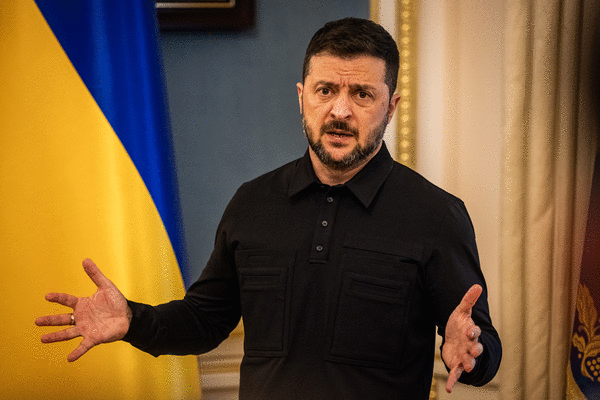
Ukraine offered Russia a truce on attacks against ships carrying agricultural commodities through the Black Sea, but Moscow rejected the deal because it wanted guarantees against strikes on its energy infrastructure, Ukrainian President Volodymyr Zelenskyy said.
“It looks like their position is that they will not attack our grain corridor only if we stop attacking their energy sector,” Zelenskyy said Saturday at his office in Kyiv.
Zelenskyy also ruled out holding wartime elections, an idea advocated last week by the popular former Defense Minister Mykhailo Fedorov. “If we want to tear the country apart, then we can move toward elections in the middle of a war like this,” the president said, describing it as a “tsunami” for Ukraine.
Ukraine’s constitution doesn’t permit elections under martial law, which were introduced in response to Russia’s full-scale invasion in February 2022. It last held presidential and parliamentary elections in 2019.
Fedorov’s ouster as defense minister last month triggered protests in Kyiv and other major cities, which have since subsided. His call for elections met a mostly negative public response in Ukraine, where critics highlighted the threat from Russian attacks and the difficulties of ensuring participation in the vote for millions of people displaced by the war.
Russia and Ukraine have stepped up attacks on each other’s commercial ships and ports in the Black Sea area, raising fears about the impact on grain supplies to world markets. The two countries account for more than a quarter of global wheat exports, and the attacks come in the middle of this year’s harvest.
Ports in Ukraine’s Greater Odesa region handle about 90% of its grain shipments. The country has exported only about 500,000 tons of grain since the start of August, or about a fifth of its potential shipments, Agriculture Minister Taras Vysotskyi said on Thursday.
Earlier this month, three of Russia’s largest grain terminals in the Black Sea port of Novorossiysk halted operations after sustaining damage. The Agriculture Ministry is mulling alternative routes for exports as a result of the disruptions to shipping.
President Vladimir Putin acknowledged economic damage from Ukrainian drone attacks, which have also hit targets including oil refineries deep within Russian territory, but said on Saturday that he’d rejected ceasefire proposals from Kyiv as “unacceptable” and, in some cases, “exotic,” without elaborating.
“We are always open to dialogue about peace, but only on the basis of the realities on the ground,” Putin told a Russian state TV reporter, reiterating his long-held position.
Zelenskyy said Kyiv was ready to discuss an energy ceasefire with Russia but only on a reciprocal basis.
“If you are ready to talk on equal terms, then let’s talk,” he said. “If it’s about agriculture, then agriculture; if it’s about energy, then energy. If it’s about a full ceasefire, then a full ceasefire.”
Russia’s Defense Ministry said its forces struck Ukraine’s Yuzhny port in the Odesa region overnight, hitting five fuel tanks and infrastructure for loading and unloading of cargoes.
Zelenskyy said he’d proposed to several foreign leaders, whom he didn’t identify, that their countries’ vessels be used to export both Ukrainian and Russian agricultural commodities, though he added that he knew “Russia isn’t ready for that.”
The president also told reporters that Ukraine is seeking 300 Patriot missiles for its air defenses this winter. He has repeatedly highlighted shortages of interceptors in recent weeks as Russia has stepped up air attacks on Kyiv and other major cities in Ukraine.
Zelenskyy on Sunday highlighted what he said was a $27 billion shortfall in funding for Ukraine’s military needs, at a news conference in Kyiv with leaders from Nordic and Baltic countries.
As much as $10 billion is needed “right now so that in January and February our army has the appropriate weapons and protection,” Zelenskyy said, adding that frozen Russian assets in the European Union were one potential source of funding that he planned to discuss with Kyiv’s partners.
_____
(With assistance from Olesia Safronova.)
_____
©2026 Bloomberg L.P. Visit bloomberg.com. Distributed by Tribune Content Agency, LLC.






Comments