The rap world's two biggest murders: How Biggie Smalls brought major break in Tupac Shakur killing
Published in News & Features
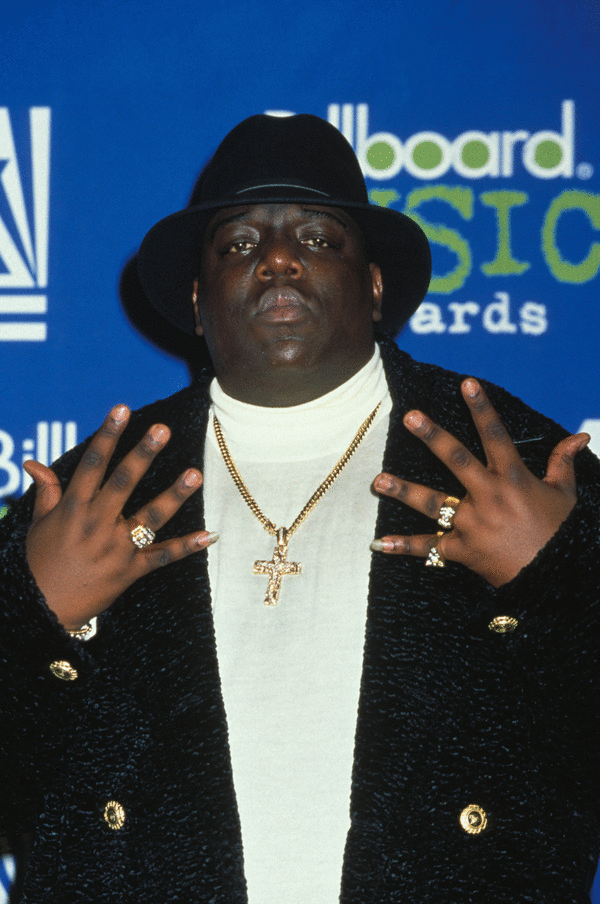
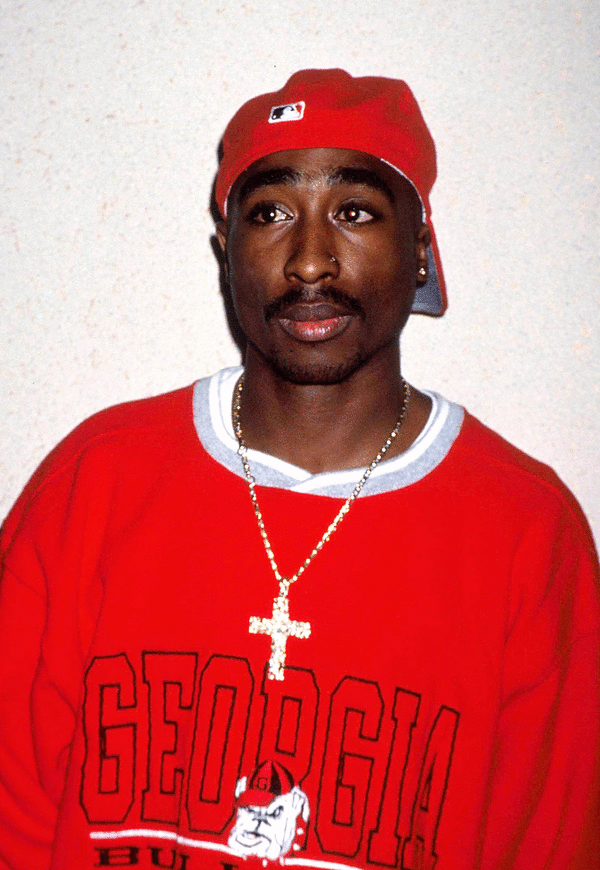
LOS ANGELES — In 1996, Tupac Shakur was gunned down off the Las Vegas Strip. Then, less than a year later, Christopher Wallace, a.k.a. Biggie Smalls or the Notorious B.I.G., was killed in a drive-by shooting in front of the Petersen Automotive Museum on Wilshire Boulevard.
The two killings have long been tied together in popular culture.
Now, a detective says the investigation into Wallace’s death helped lead police to the suspect on trial in Las Vegas in Shakur’s slaying.
Duane “Keffe D” Davis, a onetime Compton gang member, is accused of orchestrating the Sept. 7, 1996, killing of Shakur. Prosecutors say the killing was rooted in a war between Southside Crips-Burris Street, led by Davis, and Mob Piru, a gang long associated with Death Row Records. Shakur was closely affiliated with the record company.
Authorities say Davis was in the car with his nephew, who grabbed the murder weapon and fired the fatal bullet.
On Wednesday, former LAPD Homicide Detective Daryn Dupree said Davis set out his role in Shakur’s killing in detail in 2008 to a joint LAPD federal task force that was formed to investigate Wallace’s murder.
To force Davis’ cooperation, Dupree said investigators gathered evidence that Davis, now 63, had sold a large quantity of PCP through his home, exposing him to a potential life sentence and leaving his family open to charges.
The task force questioned Davis about a car he owned that was similar to the one used in Wallace’s L.A. killing. Davis was given a proffer agreement, according to Dupree, meaning he agreed to provide information in exchange for possible benefit.
Davis said he knew about the Smalls shooting and then indicated, “we did the other one,” Dupree testified. That statement, he said, shifted investigators’ focus to the Shakur killing.
“We were talking about Christopher Wallace,” Dupree said. “We didn’t ask him any questions about Tupac. He offered that on his own.”
In a second interview, Dupree testified Davis stated that his nephew Orlando Anderson had been jumped, spurring Davis and cohorts on a hunt for revenge against Shakur.
The attack on Anderson occurred at a Mike Tyson fight earlier on the night of Sept. 7 in Las Vegas, according to Clark County prosecutors. Earlier in the trial, video was shown of Shakur’s entourage attacking Anderson, allegedly in retaliation over a chain that Anderson had previously stolen.
“They went looking for Tupac, Suge and anybody who was involved basically in the beatdown of Mr. Anderson,” Dupree said. Death Row Records boss Marion “Suge” Knight was in the car with Shakur the night he was killed.
When they found Shakur, the former detective testified, Davis “had the gun at first, but they came up on the passenger side,” where Knight was seated, “so he could not shoot across the driver. So he handed a gun to Dre in the back seat.” Deandre “Big Dre” Smith was among those in the white Cadillac in addition to Davis and Anderson.
“Davis said Deandre Smith was afraid to shoot,” Dupree testified, so “Anderson grabbed the gun and shot across Mr. Smith into Mr. Knight’s car.”
Davis told the task force they used a .40-caliber handgun, according to testimony.
Prosecutors said Thursday they would play all five hours of the interviews to jurors.
Dupree said Davis was signed up as a confidential informant in March 2009. He said Las Vegas police were not aware of the secret conversations at the time.
Dupree testified that Davis told investigators that former rapper and music mogul Sean “Diddy” Combs had been involved in targeting Shakur and Knight through East Coast drug dealer Eric “Von Zip” Martin.
He testified that Davis pledged to rekindle his relationship with Martin to gather evidence. But Martin had cancer, and that was not possible, Dupree said. Martin died in 2012.
Combs was never connected to the Shakur case and has denied ever being involved. Others have questioned Davis’ credibility on this and other points.
The Los Angeles Times in 2008 published a story suggesting a Combs link to Shakur’s killing. But it later retracted the story, saying it was based on documents that appeared to have been forged.
Prosecutors in Davis’ trial say the motive was straight revenge for the beating of Anderson, and that Martin allegedly gave Davis a gun. But they have made no allegations against Combs, who has long denied any role or connection to Shakur’s killing.
Michael Sanft, Davis’ defense attorney, told jurors in opening statements there would be no evidence linking his client to the shooting. Sanft noted that previous investigations did not take his client’s statements seriously because they were not credible. The defense attorney, in an unusual move, repeatedly undermined his own client’s credibility, saying Davis’ memoir, “Compton Street Legend,” where he talks about the Shakur killing, was a work of fiction for money and his client wasn’t in Las Vegas.
Under cross-examination, Dupree said Davis faced a life sentence in the PCP case and that his wife and family were in jeopardy because of it, so he needed to help authorities.
He said that LAPD Detective Greg Kading, the task force leader, left the department after investigating the Shakur and Smalls cases and published a book in 2011 that revealed Davis’ interview.
Dupree said the task force was trying to determine if money was really offered to kill Shakur. He said they were trying to build a racketeering case. “This is trying to solidify that Death Row Records was built on narcotics and Bad Boy Records.”
Dupree said he personally did not doubt Davis when he talked about Anderson killing Shakur.
“I knew he loved his nephew.”
For all the notoriety of the rapper killings, neither has yet led to convictions.
Wallace was leaving a music industry party at the Petersen Automotive Museum on March 9, 1997, sitting in the front passenger seat of a Chevrolet Suburban, when his killer pulled up alongside in a dark Chevy Impala.
As the SUV idled at a stoplight, the gunman opened fire, hitting the 24-year-old four times. He was rushed to Cedars-Sinai Medical Center, where he was pronounced dead shortly after 1 a.m.
From the beginning, police said they struggled to get leads and cooperation.
As the Times reported back in 1997, “although more than 1,000 people were said to be at the party, police said they had few eyewitnesses and even fewer solid leads ... Detectives said they are investigating whether Wallace’s death is linked to bicoastal tensions within the rap world, but had nothing solid to go on.”
Despite many theories and a long LAPD investigation, the case remains unsolved.
There have been numerous books, documentaries and civil litigation that make allegations, but police said they could never build a case.
In 2017, an LAPD detective told the Times: “The shooter is most likely dead. You cannot ask him who paid him.”
©2026 Los Angeles Times. Visit at latimes.com. Distributed by Tribune Content Agency, LLC.




Comments