US readies Iran penalties as Trump downplays midterms impact
Published in News & Features
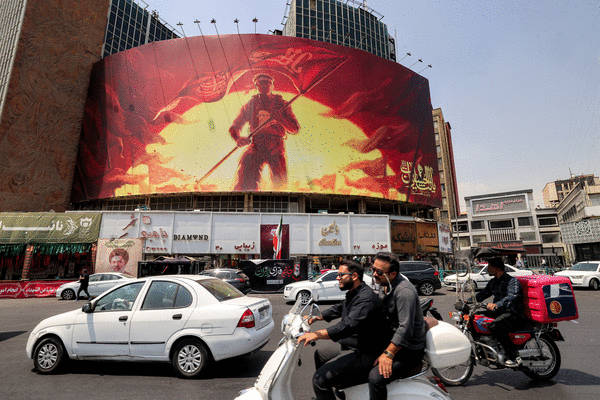
WASHINGTON — The U.S. is readying unprecedented economic measures against Iran, as President Donald Trump seeks to intensify efforts to force Tehran to capitulate after almost six months of war.
The president said in a brief interview with Fox News that the U.S. is planning to hit Iran’s economy hard, and that he didn’t care if the conflict ends before the November U.S. midterm elections, which will hinge on voter perceptions of the economy. Trump has struggled to find an off-ramp to the war, which has spiked the price of oil and gasoline.
Talks between the U.S. and Iran aimed at bringing about a lasting peace have stalled and intermittent clashes have continued, disrupting the flow of oil and other key commodities through the crucial Strait of Hormuz. The two sides have accused each other of being untrustworthy negotiators, and Iran has taken steps to maintain control the strait.
At a speech on Long Island Friday, Trump boasted that the U.S. blockade of Iranian ports was a “wall of steel” that allowed Washington to effectively govern the waterway. Iran says it is managing traffic in the strait.
“Pretty soon I’ll be declaring the Hormuz Strait a territory of the United States,” Trump said with a chuckle.
Treasury Secretary Scott Bessent said in a Newsmax interview Thursday that there would be “more announcements coming next week” on new economic measures aimed at Iran that “have never been seen in the history of economic isolation on a country,” without specifying them.
Iran’s economy has taken a major hit, with much of its industrial capacity damaged and crude exports severely curtailed by the U.S. blockade. But the Islamic Republic has weathered waves of sanctions that have failed to force it to bend on its nuclear program or relinquish control over the strait.
Trump in recent days has renewed his administration’s push for economic pressure on Iran as the U.S. faces a shortfall of necessary munitions and appears wary of expanding a military campaign that faces mounting domestic opposition heading into midterm elections in November.
Trump told Axios over the weekend that he is “low-keying it” with Iran. “We are just watching Iran with its huge inflation and the fact they have no money,” he said.
However, after decades of sanctions and a renewed pressure campaign that’s included a full naval blockade of Iran’s ports, it’s unclear exactly what meaningful economic measures the U.S. could implement without resorting to secondary sanctions on buyers of Iranian oil, such as China. That would likely spark retaliatory measures from Beijing and cause more global energy price uncertainty.
At the same time, Trump and other senior officials have often made strident threats against Iran — and not followed through — as part of an effort to pressure Tehran into talks to end what many analysts are now calling a stalemate.
The U.S. has already added some 2,200 sanctions on Tehran since 2018, according to Jeremy Paner, a partner at Hughes Hubbard & Reed, who tracks designations on Iran’s oil and petrochemical sectors.
“If 47 years of sanctions haven’t broken Tehran’s will, more of the same is unlikely to produce any changes,” according to a Bloomberg Economics report led by Jennifer Welch. She sees the most likely scenario as Trump staying on the same path as before, maintaining sanctions and the blockade, alongside limited strikes and diplomatic efforts.
Iran, for its part, has reorganized its military to be more aggressive abroad as talks on ending the war remain mired in stalemate, a sign that Tehran is preparing for the possibility of a protracted era of regional conflict.
The Strait of Hormuz has been a key sticking point. Both sides claim control of the waterway, through which one-fifth of the world’s oil and gas transited prior to the war, and are demanding concessions that are unlikely to be met.
Iran and Oman have been locked in lengthy talks about establishing a shipping route through the strait, but the U.S. isn’t party to those discussions. Mohsen Rezaee, the newly appointed secretary of Iran’s Supreme National Security Council, said any deal would remain separate from a full reopening.
_____
©2026 Bloomberg L.P. Visit bloomberg.com. Distributed by Tribune Content Agency, LLC.





Comments