American investors poised to gain stake in Cuban mines confiscated 6 decades ago
Published in News & Features
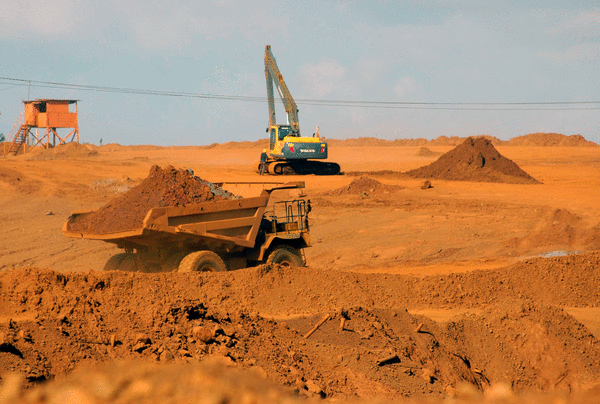
U.S. investors appear poised to gain a significant stake in Cuba’s largest nickel and cobalt mining operation — in land that Cuba’s government confiscated from U.S. and Cuban owners more than 60 years ago — in what would be the first American-backed mining venture on the island in six decades.
Two rival U.S. bids are now competing for control of Sherritt International Corporation, the Toronto-based company that mines nickel and cobalt in Moa, in eastern Cuba’s Holguín province.
The first to make a move was Gillon Capital, LLC, a company tied to Ray Washburne, a Texas businessman who ran a U.S. government development bank for overseas investment during President Donald Trump’s first term. Gillon reached a preliminary, non-binding agreement in May to acquire 55% of Sherritt, according to the U.S.-Cuba Trade and Economic Council, a nonprofit that tracks U.S.-Cuba commercial relations.
Then, on Aug. 10, a second U.S. group announced it had quietly submitted a rival offer to Sherritt’s board back in late June. That consortium includes an unnamed “prominent” U.S. investor, London-based Kyma Capital, hedge fund investor Trifon Natsis and global commodities trader Glencore. Unlike Gillon’s offer, this one comes with cash up front. The offer also implies the creation of a U.S. entity that would control at least 55% of the company, the same amount Gillon is after.
If one of the offers succeeds, an American-led buyer will take control of half of Cuba’s most significant mining asset while also giving the U.S. a new source of nickel and cobalt — metals used in electric-vehicle batteries and defense manufacturing.
Sherritt’s mining operation in Moa is a 50-50 partnership with Cuba’s state-owned General Nickel Company, meaning Havana would remain an equal owner regardless of who controls Sherritt.
Under Cuba’s constitution, the state remains the ultimate owner of the land. Cuban authorities themselves have said they’re open to U.S. investments on the island as part of a package of economic changes they recently announced, though Cuban government officials remain hostile in their rhetoric against the Trump administration.
Sherritt’s troubles trace back to a new round of U.S. sanctions. On May 1, Trump signed an executive order giving Washington broad new powers to penalize foreign companies doing business in Cuba’s mining and energy sectors. Six days later, the State Department used that authority for the first time to sanction Moa Nickel S.A. — the joint venture Sherritt runs with Cuba’s state mining company.
Though Sherritt itself wasn’t directly sanctioned, it said it had no choice but to suspend its direct role in the Moa operation and withdraw its staff from Cuba. Sherritt’s chief financial officer, its auditor and three directors have since resigned. Its refinery in Fort Saskatchewan, Alberta, which processes the nickel and cobalt shipped from Moa, halted production in June. The company warned it may not have enough money to keep operating without new investment.
But before American capital can return to mining in Cuba, the bid winner needs to secure authorization from several U.S. agencies, including the departments of State and the Treasury, and reach settlements with those holding claims tied to the early 1960s confiscation of the mining properties.
Both Gillon Capital and the consortium have said the U.S. State Department has not objected to negotiations with Sherritt. The State Department did not reply to a request for comment on Gillon’s preliminary deal with Sherritt.
Decades-old property claims
Sherritt’s partnership with the Cuban government has long made it a target of criticism from Cuban-American exiles and claimants, who argue the company built its Cuba business on property taken from its rightful owners without compensation. Sherritt executives have previously been barred from entering the United States under the Helms-Burton Act, a 1996 law that penalizes companies that “traffic” in property confiscated by the Cuban government.
A U.S. firm, Moa Bay Mining Company, originally owned most of the mines that Sherritt later exploited. When Cuba’s government seized U.S. properties after Fidel Castro took power in 1959, Moa Bay filed a claim with the U.S. government seeking compensation.
That claim — valued at $88 million — was later certified by the U.S. Foreign Claims Settlement Commission as the third-largest of the 5,913 certified claims by Americans whose property was taken by Cuba’s government, according to the U.S.-Cuba Trade and Economic Council. The council reports Citigroup now holds the claim.
Adding another layer of complications is a lawsuit targeting another of Sherritt’s businesses on the island, filed under the Helms-Burton Act, which also lets Americans sue companies profiting from confiscated property in Cuba.
In late July, another U.S. firm, the Cuban Electric Company, sued Cuba’s state-run electric utility and Energas S.A., a Cuban power-generation joint venture in which Sherritt owns a one-third stake. Energas is key for electricity generation for western Cuba, especially under current fuel-shortage conditions.
The Cuban Electric Company is owned by Atlas Holdings, a Connecticut investment firm that also owns Office Depot. Its certified claim of $267.6 million, plus decades of accumulated interest, is the largest of all the certified Cuba claims, according to the council.
Because Sherritt has a stake in Energas, the council suggests the electric company’s lawsuit could either slow a takeover of Sherritt or create an opportunity to settle two certified claims at once — the mining claim and part of the electric company’s claim — by including both in whichever deal ultimately goes through.
That might not be all.
William Pitt, a retired engineer living in Miami, said Sherritt had expanded its mining operations in Moa, outside the property originally owned by the Moa Bay Mining Company, to include mines his father owned. His father was a dual British and Cuban citizen and could not file a claim with the U.S. Foreign Claims Settlement Commission in the 1960s.
But the prospect of American investors taking over Sherritt opens other legal avenues for obtaining compensation, Pitt told the Miami Herald.
Title III of the Helms-Burton Act allows Cuban Americans to sue companies “trafficking” in confiscated property. Every president had suspended the provision since the law passed in 1996 until Trump reinstated it in 2019.
Pitt said he had sent copies of the maps of his father’s mines to Sherritt. Still, he said the company’s lawyers had defeated his efforts to obtain compensation, claiming Canadian law protected them from a Helms-Burton lawsuit and that the company does not have assets in the United States that could be seized to pay damages.
“They just didn’t want to handle it,” Pitt said. “ Their answer to me was that you can’t do anything with this because we are Canadians and therefore you can’t touch us because we have laws that protect us. And in addition to that, those mines were given to us by the Cuban government, and we have every right to use them.”
But if Gillion or the consortium close the deal with Sherritt, Pitt said he could sue under the Helms-Burton Act.
“I have already written to Gillon, and I have explained that we own those mines that border Sherritt’s, and that Sherritt has been mining, and that when they buy 55% of Sherritt, then Gillon will be subject to our suing them,” he said. “I haven’t done it for the consortium because that’s very recent. But I probably will be doing that too.”
_____
©2026 Miami Herald. Visit at miamiherald.com. Distributed by Tribune Content Agency, LLC.





Comments