North Carolina pastor in ICE custody received little medication before stroke, daughter says
Published in News & Features
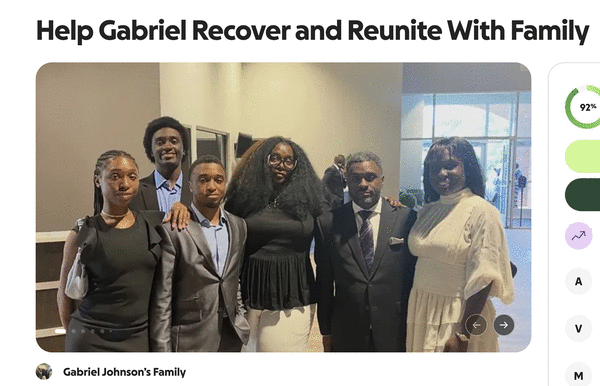
RALEIGH, N.C. — Gabri Johnson and her family had spent 15 days trying to stop the U.S. from deporting her father after ICE agents had taken him into custody outside his house on July 15. They needed a break.
So Johnson and her siblings went to see “Spider-Man: Brand New Day” in Cary on July 30. While watching the movie, she got a call. It was a nurse from a Dallas hospital.
Her father, Gabriel Johnson III, had suffered another stroke, this time in ICE custody in Texas.
Two days later, Aug. 1, Gabri, 30, and her family flew to the Dallas area, where their father was hospitalized. Not to visit him, necessarily, but to create a health plan and make sure ICE didn’t remove him from the hospital before he recovered, she said.
Gabri had her reasons to worry about Johnson’s treatment. She posted a video to her social media July 31 alleging her father, a 55-year-old Cary pastor, had been denied food, water and his stroke medication for weeks before the stroke that paralyzed the left side of his body.
Her video has roughly 6.3 million views across Instagram and TikTok as of Friday. Her family started a GoFundMe to cover Johnson’s legal and medical costs that had raised over $8,000 as of Friday.
U.S. House Rep. Joaquin Castro, a Democrat from Texas, reposted Gabri’s video on his social media platforms on Aug. 1 and called for ICE to immediately release Johnson.
The American Civil Liberties Union of North Carolina also called for Johnson’s release in a Friday statement, linking his case with that of Durham resident Prisciliano Trejo Ricano, who died July 24, after he was diagnosed with leukemia in ICE custody. Two weeks before his death, Trejo Ricano said ICE officers had failed to treat his symptoms, The News & Observer reported.
“Mr. Johnson’s medical crisis and the death of Mr. Trejo Ricano are not isolated incidents — they are the predictable consequences of an immigration detention system marked by neglect, abuse, and a disregard for human life,” the ACLU of North Carolina wrote.
The Department of Homeland Security denied any wrongdoing in the case of Trejo Ricano. The N&O is awaiting a response from DHS and ICE to questions about Johnson’s treatment in custody.
Gabriel Johnson, who shares four children with his wife of 30 years, has legal status to stay in the U.S., his daughter said. At 16, he came to the U.S. from Liberia during the 1980s — a decade that started with a coup d’etat and ended with the onset of civil war in the west African country.
Johnson graduated from N.C. Central University in 2002. He has been a pastor for 20 years, traveling across North Carolina to provide what he calls a “ministry without walls” — from preaching at churches and funerals to praying with the sick.
At the hospital, Johnson’s family tried speaking with the charge nurse. They tried the patient advocate, too. Then, four security guards surrounded the family.
“You’re not supposed to know he’s here,” Gabri said the guard told her family.
The guards denied Johnson was there. So Gabri and her family waited in the lobby for hours.
Allegations of mistreatment
ICE agents detained Johnson around 8:30 a.m. on July 15, Gabri said, and he arrived at the Cary ICE detention center at 9:30 a.m. He soon had a blood pressure crisis — stage 2 hypertension — and was admitted to WakeMed around noon.
An hour and a half before, Johnson’s family delivered a Ziploc bag of blood pressure and stroke medications to the Cary facility because Johnson had yet to take his prescriptions that day, Gabri said. Since suffering brain damage from a series of strokes in 2020, Johnson takes six to eight pills a day to prevent another stroke.
Johnson was released from WakeMed at 5 p.m. and stayed at the ICE detention center in Cary until the evening of July 16, Gabri said.
The morning of July 17, Johnson’s ICE detainee locator refreshed and showed he was at Stewart Detention Center in Lumpkin, Georgia, Gabri said. Later that day, Johnson called his daughter. Stewart would not allow him to use the medications from the Ziploc bag his family had given him, he told her, saying they had the drugs on site.
But doctors at Stewart did not provide him medications every day, Gabri said her dad told her. On days a doctor gave Johnson medicine, he only got one or two pills and was unsure if the pills were the same each day, Gabri said. He tried asking the attending doctor, but they would not answer his questions, Gabri said.
The Stewart Detention Center is operated by CoreCivic. CoreCivic spokesperson Ryan Gustin wrote in a Friday statement that Johnson “was regularly monitored by facility medical staff, with all known medical issues being addressed.”
“Medication that is prescribed to detainees is either managed by our health services team or by the detainees themselves, depending on the type of medication,” Gustin wrote. “Our pharmacy nurses review the medication orders and promptly inform the ordering physician when renewals are required.”
During Johnson’s detention at Stewart from July 15-28, it was not uncommon for agents to drive him to a different facility to speed up his deportation, Gabri said her father told her.
One time, agents allegedly took Johnson to a military base and pressured him to sign deportation papers and board a plane — two days before a hearing to temporarily halt deportation proceedings. On those days, he would not get food or water, Gabri said her father told her.
The last time Gabri spoke to her father before his stroke was a phone call on the morning of July 29. Johnson was at a holding facility in Atlanta. Gabri read him Bible verses and sang his favorite gospel songs like “Lord Prepare Me To Be A Sanctuary” and “There Is Power In The Blood.”
“He sounded so weak and tired,” she said.
Family prayer is of grave importance to him, Gabri said — and he will let you know.
“Sometimes you’ll tell him ‘Good job with your prayer,’ and he’ll get very serious and be like, ‘It’s not a job — it’s a duty,” she said, chuckling.
‘There is time to be better’
Agents boarded Johnson onto a plane from Georgia to Texas on July 29, Gabri said. He ended up at Prairieland Detention Center in Alvarado, roughly 40 miles south of Dallas.
On July 30, around 6:45 a.m., Gabri recalled, Johnson called to tell her and the family he loved them.
He wasn’t feeling well, Gabri recalled. He hadn’t received food or medication in the 24 hours since he was flown from Georgia to Texas.
Around 11 a.m. on July 30, Johnson was admitted into a Dallas hospital, Gabri said. She declined to name the hospital, concerned that it might impact her father’s care.
Her family went to the hospital on Aug. 1 to advocate for Johnson. After security guards turned them away, the family waited several hours in the lobby before they were allowed to visit him for one hour, Gabri said.
Johnson had just begun speech therapy the day the family visited, Gabri said. So he wasn’t able to say much. Just that he missed his family and loved them so much. Gabri held his hand and read Psalm 23. She told him millions had seen his story and were praying for him.
Based on her conversations with nurses at the hospital, Gabri said Johnson’s physical therapy is “minuscule.”
Johnson has an ankle cuff on his right leg that is cuffed to his bed, Gabri said, so he rarely leaves his bed. Nurses told Gabri that, with her father on anticoagulation medicine, the ankle cuff increases the risk of another stroke, Gabri said.
The hospital planned to send Johnson to a rehab facility, Gabri said. But ICE requires its agents to accompany detainees to any facility. The rehab facility did not want ICE agents there, so ICE canceled the treatment plan and informed the hospital Johnston would stay in its care, Gabri said.
In the ACLU of North Carolina’s Friday statement, Gabri said no one should experience what her father is going through “no matter your views on immigration.”
“When someone suffers from a life-altering medical crisis in government custody, the answer cannot be to block their family from seeing them in the hospital, put them on a plane, and send them out of the country,” Gabri said.
“The United States can be better than that. There is time to be better.”
_____
©2026 Raleigh News & Observer. Visit newsobserver.com. Distributed by Tribune Content Agency, LLC.






Comments