Washington childhood vaccine rules not changing, state health leaders say
Published in News & Features
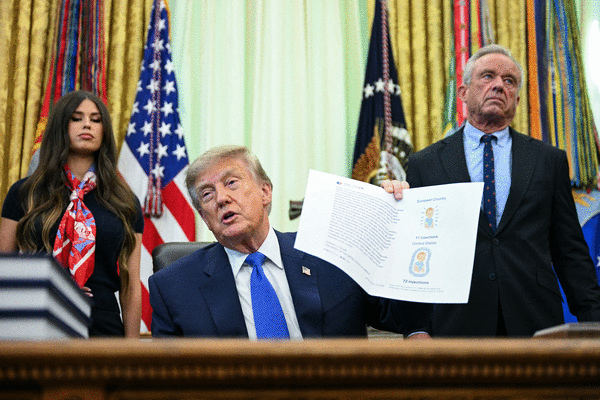
SEATTLE — Washington's school requirements around childhood vaccines have not changed, state health officials said Monday in response to President Donald Trump's latest efforts to revamp immunization practices in the country.
In a new executive order, Trump calls for scaling back the number of childhood shots recommended by the federal government, and separating the measles, mumps and rubella (MMR) vaccine into three different immunizations. Both moves — which come less than a month before the start of the new school year — have been widely criticized by public health experts, including in the Pacific Northwest, who point to years of research backing the MMR shots and timing of the current childhood vaccine schedule.
States have the authority to require vaccinations for K-12 students, not the federal government. In Washington, requirements and guidance will stay the same for the coming academic year, and are informed by recommendations from "trusted medical and public health experts," the state Department of Health said in a statement Monday, following the president's order.
"As DOH reviews today’s announcement, we encourage people to continue following existing Washington state vaccine guidance to protect themselves and their children, and to go to their health care providers with questions and concerns," the state health department said.
Mike Faulk, spokesperson for state Attorney General Nick Brown, wrote in an email that the office plans to review the order for Washington impacts, but he declined to say whether the state might pursue legal action.
Washington state law requires any child attending school, preschool or childcare to have documentation of immunity (through vaccination or proof of acquired immunity) against 11 diseases, ranging from chickenpox to whooping cough.
In January, when the CDC reduced the number of routine vaccines recommended to all U.S. children, Washington and other states in the West Coast Health Alliance endorsed the American Academy of Pediatrics' recommended immunization schedule instead.
Per that schedule, the state health department says children in Washington should get their first MMR dose when they're between 12 and 15 months old, and the second between 4 and 6 years old.
Parents or guardians must fill out a state-approved Certification of Immunization Status form for their child to attend school or childcare.
State law allows parents or guardians to exempt their child from vaccine requirements for personal/philosophical, religious or medical reasons (students may not use a personal exemption for an MMR vaccine in Washington, following a 2019 change).
During the 2025-26 school year, about 95% of K-12 students received their MMR shot — slightly more than last year, according to state health department data. About 90% of kindergartners got their MMR vaccine, roughly the same as the year prior, below the herd-immunity threshold of 95% for measles.
About 2.8% of all children, meanwhile, received exemptions from the MMR shot, a figure that's crept up almost every year since 2019. Among kindergartners, about 4.5% claimed measles, mumps and rubella exemptions.
Trump has repeatedly suggested a link between childhood vaccines and rising rates of autism spectrum disorder, which he did again as he signed the executive order in the Oval Office on Monday. This connection has been widely discredited by public health researchers and scientists who have shown evidence that there is no link between vaccines and autism.
_____
© 2026 The Seattle Times. Visit www.seattletimes.com. Distributed by Tribune Content Agency, LLC.





Comments