Florida Gov. DeSantis embraces 'flying car' tech despite shunning other EV programs
Published in News & Features
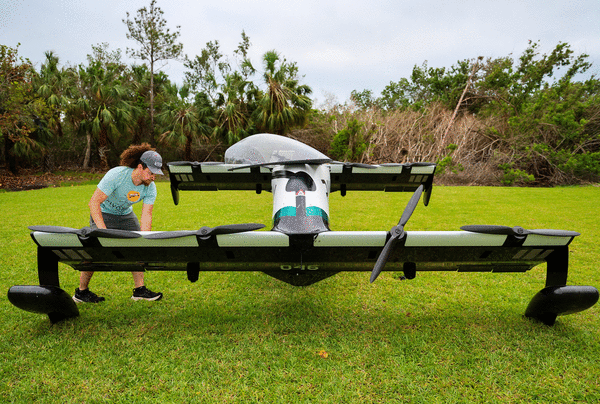
In a news conference loaded with “Back to the Future” and “The Jetsons” references, Gov. Ron DeSantis announced Monday that Florida would become a national hub for testing ultralight electric aircraft, generally considered the next frontier of electric vehicles.
Although many people call them “flying cars,” without wheels or landing gear, they’re more like human-sized drones that can take off or land without a runway. The industry refers to them as electric vertical takeoff and landing aircraft, or eVTOLs.
A Florida Department of Transportation property in Polk County will now serve as the nation’s first dedicated test track for these types of aircraft, officials said. Standing next to a vehicle with propellers at that track, DeSantis told a small crowd that he can envision people flying over Interstate 4 to skip the traffic between Tampa and Orlando.
“I don’t know how long the flight would be — not very long,” he said. “That is going to happen here in the state of Florida, and we’re excited for that.”
DeSantis predicted that companies will be “actively testing” the aircraft in Florida by the end of the year. (Companies like Tesla and Waymo are also using the track to research self-driving technology.)
The announcement was striking for the governor, who once supported conventional electric vehicles but then turned on them, becoming increasingly hostile to policies designed to encourage EV adoption.
In 2023, DeSantis issued a surprise veto of a bipartisan bill that would have led the state fleet to purchase more EVs and save taxpayers money. The next year, while he was running for president, his administration created a website at roadsarenotforpolitics.com, which bashed what it called “The War Against the American Automobile.”
“While the federal government’s obsession with electric vehicles is increasingly becoming an obsession that (helps) China,” the website read, “Florida continues its all-hands-on-deck approach to fight back.”
In recent years, Florida has sat on a pot of nearly $200 million it received from the federal government to add more EV chargers near highways. Even as most other states moved ahead with the program created by the bipartisan infrastructure law Congress passed in 2021, Florida lagged behind, frustrating EV advocates and gas stations that wanted to help build the chargers.
Now, the state is using that money for eVTOL projects, like an “Aerial Highway Network” that includes ports for the aircraft to charge, take off and land, according to documents obtained by the Miami Herald. It’s unclear if that’s the same project as the test track advancements DeSantis touted Monday.
“The Florida Department of Transportation will not waste taxpayer dollars and spend it on everyday passenger vehicles,” the transportation department document reads, according to the Herald. “Instead, FDOT’s proposal ... takes an innovative and strategic approach to offer the greatest benefits to Floridians by supporting a new emerging mode of transportation.”
But Bruce Edelston, policy chairperson for Drive Electric Florida, an EV advocacy group, said Florida’s diversion of the money is wrong. For one, the technology for flying vehicles is much farther behind the EVs that hundreds of thousands of Floridians are already driving on the road, he told the Tampa Bay Times.
“There are five counties in Florida that don’t have any EV charging at all,” Edelston said. “So the rationale Florida uses that the interstates are fully built out doesn’t really hold any water.”
“Advanced aviation, while a nice idea, is only going to benefit a few Floridians, particularly in the next decade or two,” he added.
Asked for comment, the governor’s office referred questions to the Florida Department of Transportation. The agency did not immediately respond to emails from the Times.
_____
©2026 Tampa Bay Times. Visit tampabay.com. Distributed by Tribune Content Agency, LLC.






Comments