Colombia's new president launches offensive; 6 members of illegal armed groups killed
Published in News & Features
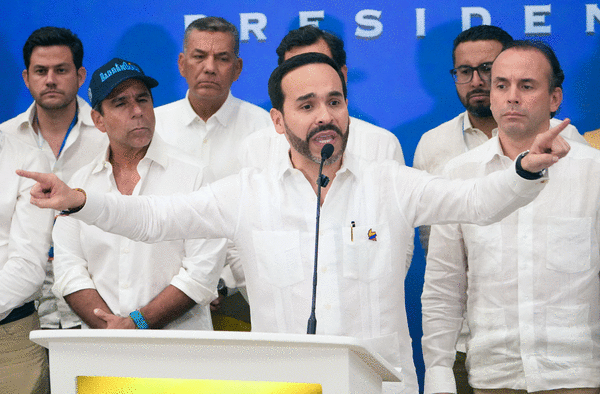
Colombian forces killed six members of illegal armed groups in two military operations over the weekend, President Abelardo de la Espriella said, marking the first major results of a security offensive launched just days after he took office promising an aggressive crackdown on guerrillas and drug-trafficking organizations.
Four members of a dissident faction of the former Revolutionary Armed Forces of Colombia, or FARC, were killed in an operation in the central department of Meta, while two members of the Clan del Golfo, Colombia’s largest drug-trafficking organization, were killed in a separate operation in the northwestern department of Antioquia, according to the government.
Among those killed in Meta was a commander known by the aliases Ruso and Alemán, who headed Front 28, a unit belonging to the FARC dissident organization led by Néstor Gregorio Vera, better known as Iván Mordisco, one of Colombia’s most wanted guerrilla commanders.
The operation, conducted by the army and the Colombian Aerospace Force in the municipality of Mapiripán, also killed three other members of the dissident group, de la Espriella said Sunday.
A second operation in Anorí, Antioquia, involving the military, police and attorney general’s office, resulted in the deaths of two members of the Clan del Golfo, one of whom authorities identified as a commander.
Security forces seized six rifles and other military equipment during the operation, de la Espriella said.
“This criminal structure is the same one that in 2024 murdered four Colombian soldiers who were carrying out operations in that region,” the president said.
Four other alleged members of the Clan del Golfo’s Gabriel Poveda Ramos structure were arrested in Necoclí, Antioquia, in an operation involving the army and navy.
“These operational results achieved by our security forces are a clear and forceful message to all the criminals in Colombia,” De la Espriella said. “There is nowhere they can hide when the state decides to act.”
The operations provided an early test of the security policies of de la Espriella, who took office Friday after campaigning on a promise to confront what he calls “narcoterrorism without truce.”
The new president has pledged to intensify military operations and airstrikes against guerrilla, drug-trafficking and paramilitary groups, while ending peace negotiations begun under his predecessor, leftist President Gustavo Petro. De la Espriella has also proposed building large maximum-security prisons modeled after those constructed in El Salvador under President Nayib Bukele.
His first days in office have coincided with a new wave of violence across Colombia. Two attacks involving explosives Saturday left at least one police officer dead and several people wounded.
In Cauca department, FARC dissidents used explosives to destroy a tollbooth under construction along the Pan-American Highway near Santander de Quilichao, according to the army. Two security guards suffered minor injuries.
The army blamed the attack on forces linked to Iván Mordisco, who broke with the landmark 2016 peace agreement between the Colombian government and the FARC.
In a separate attack in the northern department of Cesar, a police officer was killed when drones carrying explosives targeted a police station. Authorities had not identified the group responsible.
De la Espriella responded to the attacks by signaling that his government would pursue a tougher approach than the previous administration.
“Attacking the country’s infrastructure is attacking progress,” he wrote Saturday on X, warning there would be “no leniency” for those responsible.
Violence continued Sunday when the municipal government building in Rioblanco, in the central department of Tolima, was attacked with drones and gunfire. No casualties were reported because the attack occurred on a non-working day, regional Gov. Adriana Magali Matiz said.
Video published by the governor showed smoke coming from part of the municipal building, while gunfire could be heard in other recordings.
Matiz called for an increased security presence and said authorities should consider imposing a curfew until the situation is brought under control. FARC dissident groups operate in the area.
The violence has spread across numerous regions of Colombia. The country’s human-rights ombudsman said attacks, harassment and incidents involving explosives were reported Friday and Saturday in Cauca, Nariño, Cesar, Antioquia, Tolima, Huila, Arauca, Caldas, Bolívar, Meta and Guaviare.
The most serious incident identified by the agency occurred in San Roque, Cesar, where explosives dropped from drones struck a police post, killing 43-year-old police officer Argemiro Rodelo Canchila, who had served on the force for 18 years.
The escalating violence comes as Colombia confronts its worst security crisis in a decade, with armed organizations competing for control of territory and the lucrative drug trade following the demobilization of the main FARC guerrilla organization under the 2016 peace accord.
De la Espriella has blamed his predecessor’s security and peace policies for allowing armed groups to expand and has ordered security forces to resume operations he says were restricted under the Petro administration.
“I have given specific instructions to law enforcement agencies to carry out all necessary operations that were held back by the previous administration,” de la Espriella said.
_____
©2026 Miami Herald. Visit miamiherald.com. Distributed by Tribune Content Agency, LLC.






Comments