Federal judge rejects competing bankruptcy plans in Baltimore Archdiocese case
Published in News & Features
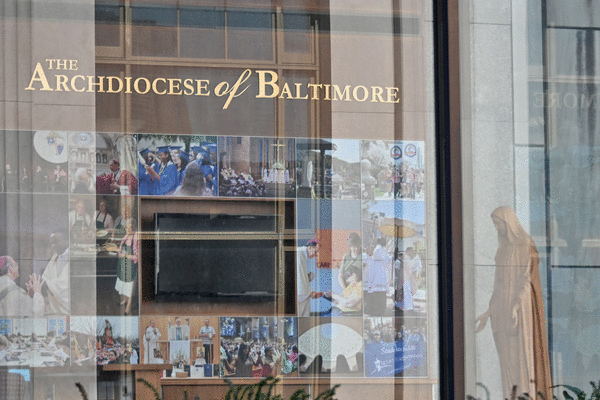
BALTIMORE — A federal bankruptcy judge has rejected competing reorganization plans proposed by the Archdiocese of Baltimore and a committee representing survivors of child sexual abuse, saying both proposals were confusing, lacked important information, and contained provisions that could not be confirmed under bankruptcy law.
U.S. Bankruptcy Judge Michelle M. Harner on Tuesday denied approval of the disclosure statements accompanying both plans. The denials were issued without prejudice, allowing both sides to revise and resubmit their proposals.
The ruling marks another major delay in the Archdiocese’s nearly three-year effort to resolve between 900 and 1,000 claims from people who say they were sexually abused as children by clergy or others connected to the Catholic Church. It also throws into doubt a September confirmation hearing that had been expected to determine whether creditors could vote on a final settlement plan.
The Archdiocese did not immediately respond Friday to a request for comment.
Creditors should not need translators
Harner said Tuesday that the competing disclosure statements contained so much information that creditors could have difficulty understanding how the plans would work or what rights they would have. She wrote that creditors should not need lawyers or “translators” to understand a proposed plan.
The judge also said portions of both proposed plans were legally flawed and could not be confirmed under the Bankruptcy Code.
The case has been complicated by disagreements among the Archdiocese, the official committee of unsecured creditors and insurance companies. The parties have participated in mediation but have not reached a global agreement, according to the court.
The court said the current timetable for moving toward confirmation must be reconsidered. A confirmation hearing had been scheduled to begin Sept. 14, with solicitation packages due to be mailed Aug. 10. Harner said there was not enough time to consider amended disclosure statements before that deadline because of the deficiencies in the current proposals.
The judge said she wants the case to move toward a resolution but would not do so in a way that is reckless or prejudicial to the bankruptcy estate and its creditors.
The Archdiocese has operated under Chapter 11 protection since September 2023. The bankruptcy filing came as the church faced a wave of potential litigation following passage of the Child Victims Act, which opened a new window for survivors to bring civil claims.
Detailing the case history
The Archdiocese filed for Chapter 11 bankruptcy in September 2023, two days before Maryland’s Child Victims Act took effect and eliminated the statute of limitations for civil lawsuits involving child sexual abuse.
In May, the Archdiocese submitted a 175-page reorganization plan that proposed channeling settled abuse claims into a trust system. The proposal called for one trust to distribute compensation to survivors using contributions from the church, parishes, schools and insurance settlements, while a second trust would pursue litigation and insurance claims involving insurers that had not agreed to settlements.
The Archdiocese estimated its contribution to survivors at about $43.9 million, while insurance carriers that had reached settlements would contribute at least $125 million. The proposal also allowed parishes, schools and other affiliated entities to join the bankruptcy process as additional debtors, although their contributions had not been determined.
‘The survivors continue to suffer’
Teresa Lancaster represents 34 survivors. She said Judge Harner’s ruling “wasn’t necessarily a bad thing,” since the plans can be reworked and resubmitted. But her clients want this to end.
“The survivors continue to suffer,” she said. “They’ve waited so long.”
Frank Schindler is a survivor and cofounder of the Abuse Survivors Coalition, an organization representing mostly survivors of child sexual abuse in the Catholic church.
“We weren’t surprised at the dismissal,” Schindler said. “We regard that as a victory for our side.”
Schindler said the Archdiocese’s position has barely moved in the three years since it declared bankruptcy.
“It’s clear they don’t want to give money to survivors. They’d rather give the money to their lawyers,” he said.
But the judge also rejected the creditors’ attempt to include parish property as part of the Archdiocese’s assets.
“Our position all along has been that regardless of what legal maneuverings the church has done in order to shelter these assets, the assets should be part of any settlement,” Shindler said.
“They are looking for any way to keep as much money for themselves as they possibly can, rather than demonstrating true responsibility and accountability for their actions.”
Schindler and Lancaster both said the church needed to be more realistic with its settlement.
“We need to bring the church into a more realistic ballpark,” Lancaster said.
---------------
©2026 The Baltimore Sun. Visit at baltimoresun.com. Distributed by Tribune Content Agency, LLC.






Comments