Hundreds of Chicago police officers barred from testifying as discipline slowdown drags on
Published in News & Features
CHICAGO -- For three years, Chicago police officers accused of serious misconduct have had to sit and wait for the Illinois Supreme Court to decide the future of officer discipline.
Bad cops are not being fired, and good cops who may be wrongfully accused are stuck in professional purgatory.
And as the city and the Fraternal Order of Police await resolution in the yearslong legal fight, records reviewed by the Tribune show local prosecutors have disqualified dozens of current Chicago Police Department officers from testifying in criminal cases, even as their disciplinary matters remain pending.
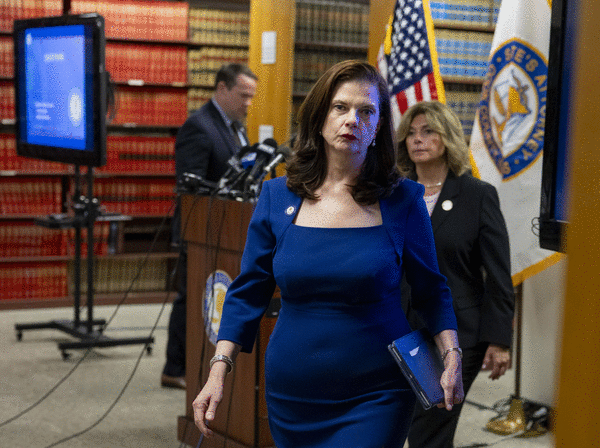
In response to a Freedom of Information Act request, the state’s attorney’s office disclosed that 254 law enforcement officers in Cook County will not be called as witnesses for the prosecution following changes to office policy enacted last year. Of those, 240 work or have worked for CPD.
The Police Department has moved to fire 27 of the officers, records show. Most of those cases remain on hold pending a ruling from the Illinois Supreme Court, expected later this year, and those 27 officers were placed on no-pay status after the administrative charges were filed.
The list of officers barred from testifying ballooned from just 66 in March 2023 to 290 in October 2024, shortly before then-Cook County State’s Attorney Kim Foxx left office. Meanwhile, city employment records show at least 87 officers — ranging from blue-shirt beat cops to detectives to supervisors — have either retired or resigned from the department “under inquiry” since 2024.
The following year, in December 2025, State’s Attorney Eileen O’Neill Burke’s office updated the policy to add an officer to the list after receiving a notification that the officer was stripped of police powers. A CPD spokesperson said the state’s attorney’s office is notified every month of officers who are in that category.
Witnesses for the prosecution also are required to fill out a questionnaire, disclosing “to the best of (the officer’s) knowledge and recollection” any sustained misconduct allegations in their work history.
In a statement to the Tribune, a state’s attorney’s office spokesperson said the list of officers relieved of police powers “is just one component of the CCSAO’s comprehensive Brady/Giglio policy, which requires prosecutors to disclose any information that could affect a witnesses’ credibility to the defense.”
“In addition to that list, the CCSAO’s Chief Ethics Officer gathers and maintains information related to potential police misconduct, which prosecutors must always review and share with defense when relevant,” the statement reads. “This multi-level system for disclosure is based on clear and consistent methodology that balances prosecutors’ ability to present the strongest case on behalf of victims while also meeting our discovery obligations and acknowledging the potential impact of police misconduct.”
Every month, the prosecutors’ office will receive updates from police departments across the county that detail which officers are stripped of police powers. When an officer sees their police powers restored, they are removed from the list, according to a state’s attorney’s office spokesperson.
For many CPD officers, it’s unclear how long that could take as the state’s high court prepares to consider whether an officer’s disciplinary case can be reviewed by a third party.
Officers who believe they are included on the list in error may ask to be removed. However, even after an officer is taken off the list, prosecutors still maintain those potentially exculpatory records.
The list of officers who won’t be called to testify has been a concern of both the union representing rank-and-file CPD officers and the Cook County public defender’s office, which represents most defendants in Cook County Circuit Court.
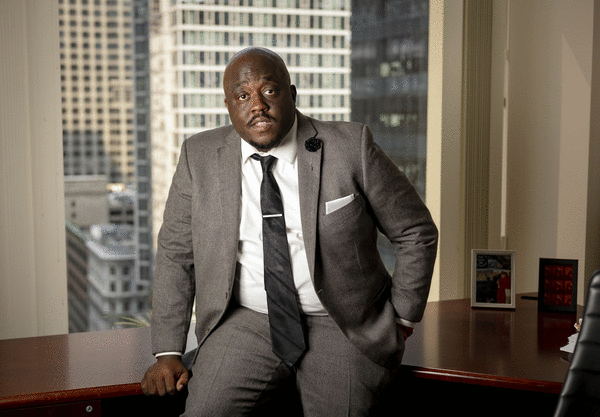
In June 2025, Cook County Public Defender Sharone Mitchell wrote to O’Neill Burke to commend some of her office’s proposed changes to the do-not-call policy — the questionnaire requirement and a recommitment to the “as soon as practicable” standard for disclosures.
Mitchell cautioned, though, that “It has been our attorneys’ experience that failure to provide affirmative disclosures regarding a law enforcement witness is common in individual cases.”
“When the previous ‘Do Not Call’ list was posted publicly, it allowed our attorneys to identify and request disclosures regarding specific, named officers,” Mitchell wrote. “The publication of the ‘Do Not Call’ list partially served as an essential backstop for the protection of our clients’ Constitutional rights. The current lack of a public list has resulted in an unfortunate lack of transparency for the community as well as a barrier to our attorneys’ ability to efficiently and vigorously represent our clients.”
John Catanzara, president of the Fraternal Order of Police Lodge 7, said the union has had serious problems with the list and how it’s compiled.
“We’ve been battling that list since Kim Foxx created it out of thin, blue air and just arbitrarily started throwing everybody’s name on there,” Catanzara told the Tribune. “We’ve made our stance pretty clear, and State’s Attorney O’Neill Burke certainly knew we had major issues with that list, and they pledged to take a look at it, they didn’t pledge to do anything beyond that. I’m happy they’re kind of starting from scratch.”
Several notable CPD figures remain on the list of officers who won’t be called to the witness stand. Among them are Kendall Waller, the son of interim Superintendent Fred Waller; Dana Hillard, son of former Superintendent Terry Hillard; Eric Stillman, the officer who fatally shot Adam Toledo in 2021; and Carlos Baker, the officer who fatally shot fellow officer Krystal Rivera in 2025.
The majority of CPD’s most serious misconduct cases have gone unadjudicated over the last three years amid a protracted legal fight between the city and FOP that stems from the last round of collective bargaining negotiations.
The arbitrator who oversaw those talks ruled that CPD officers, as public employees in a collective bargaining unit, have the right to have their misconduct cases heard and ruled on by a third party out of public view. That award upended 60 years of precedent in the city’s police discipline apparatus and severely curtailed the work of the Chicago Police Board, which, in the meantime, has continued to meet and decide a small sliver of cases.
The city filed a lawsuit to fight the arbitrator’s ruling, and a circuit court judge later ruled that officers indeed do have the right to have cases heard by an arbitrator, but those hearings must be publicly accessible. The FOP then appealed that ruling, but in August 2025 a panel of Illinois Appellate Court judges found those discipline hearings should remain accessible to the public.
“There was no consideration of effective law enforcement or the policy of public accountability and transparency in the arbitrator’s award,” the judges wrote. “There was no consideration of the 60-year policy of open hearings for serious police misconduct. More importantly, there was no finding that such open hearings violated the officers’ due process or otherwise negatively impacted the officers. Law enforcement is charged with the duty of exposing crime, not concealing it.”
Although the Appellate Court panel sided with the city on public access to proceedings, the judges also ruled partly in favor of the FOP and ordered that officers accused of serious misconduct can still be paid while their cases move forward.
©2026 Chicago Tribune. Visit at chicagotribune.com. Distributed by Tribune Content Agency, LLC.





Comments