Gordie Howe Bridge path opens to big crowds of bikers, hikers
Published in News & Features
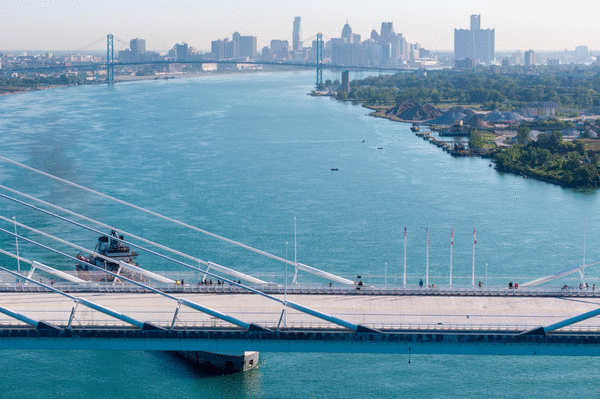

DETROIT — A week after the Gordie Howe International Bridge welcomed its first vehicle traffic, hundreds of hikers and bikers got their turn Wednesday as the span's multi-use path opened to crowds of eager users on both sides of the Detroit River.
Some exercisers lined up hours ahead of the 8 a.m. opening to try the new way to cross the Detroit River between Detroit and Windsor on foot or by cycle.
The $4.54 billion, 1.5-mile span opened to cars and trucks July 27, ending eight years of construction and weeks of political tension that disrupted opening festivities.
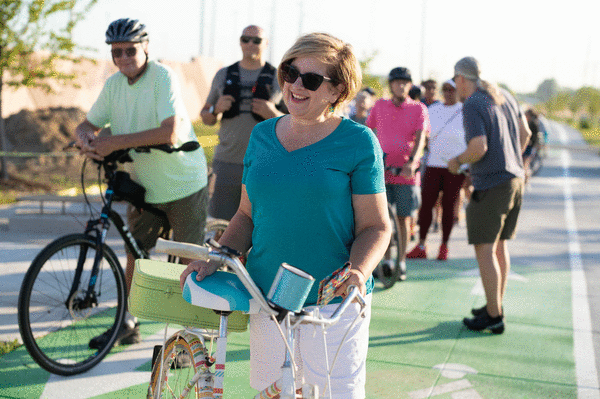
The mood was celebratory as people walked, jogged, bicycled and walked bikes across the bridge, many dressed in U.S. and Canadian memorabilia. Wearing big smiles, they chatted with each other and took selfies in the bright sunshine, the sparkling Detroit River and city skylines visible through the span's white slats. Some pumped their fists up and down, prompting truck drivers passing them to honk their horns.
“It was so cool that so many people are coming out to support this. They’re staying in line to do that, and that's really amazing," said Denise Giovannini of Livonia, who started a walk across the bridge with a group of friends late Wednesday morning.
Marcel Murray, 31, of Detroit was first in line on the Detroit side of the bridge, having arrived at 4:30 a.m. Murray, clad in a red USA T-shirt with a Miles Morales Spider-Man plushie attached to his back, planned to run a less-than-6-minute mile across the bridge.
"It's a very exciting moment for a lot of people," Murray said. "It's empowering for all of us, but especially people of color. I identify as African American, and today I will be the first man of color ever to run across the Gordie Howe International Bridge. It's a historic moment for my community here today."
In addition to representing his community, Murray also planned to run for his 7-year-old son.
"The plush toy on my back is actually my son's," Murray said. "I just wanted to motivate myself and inspire myself along the run. I want him to know anything is possible with dedication. I want to motivate him to do something quite similar in the future."
70-year-old Clifton Sharpe lined up second, arriving an hour after Murray at 5:30 a.m. in an attempt to carry on the family legacy.
"My great-grandfather was one of the first African Americans to walk across the Ambassador Bridge," Sharpe said. "That's why I figured I would come here and walk across the Gordie Howe bridge to keep the tradition. He walked across from the Canada side, and I will be walking across from the U.S. side."
Rick Williams, celebrating his 37th wedding anniversary with his wife, Debra, from Pennsylvania, was the first biker in line. Williams was in town visiting family and decided he had to come for the historic event.
"I had my bike anyways; I go nowhere without it," Williams said.
Kelli Cook, 55, of Wyandotte, said she decided to ride across the bridge on the new path in honor of her late father, an ironworker who did repair work on the Ambassador Bridge, and her uncle, who worked on construction of the Mackinac Bridge.
"My dad would have come out of retirement to help build this bridge," Cook said.
Daniel Oriet, 39, of Windsor was the third crosser from the Canadian side.
“It was an amazing experience being able to do it on day one," he said. "It was quite a bit of an incline. I haven’t ridden my bike kind of consistently in a couple years, so it was more of a challenge than maybe what it used to have been. It was pretty tough at first. But the adrenaline is going, and you kind of just power through it.”
The new path didn't just attract two-wheeled cyclists. James Abbott, 25, of Waterford Township, claimed the distinction of being the first rider to cross on the new path on one wheel.
“There was another unicyclist about 40 people behind me in line on the U.S. (side), and he was a little heartbroken that he wasn't the first," Abbott said. "But we each got a picture actually with each other on the bridge. I was screaming so loud. I think people down on the river could even hear me.”
Want to cross the Gordie Howe on foot or bike?
Here's what to know before you go.
The Gordie Howe Bridge's multi-use path is separated from vehicle traffic by a concrete barrier, is free to use and connects pathgoers to regional trail networks on both sides of the border.
On the U.S. side, the entrance is located across from Historic Fort Wayne, just to the right when exiting Delray Park, near Rademacher Street and West Jefferson Avenue in Detroit. The path will connect with existing, in-progress and future regional trail networks, including the Joe Louis Greenway, Michigan's Iron Belle Trail and Great Lakes Way.
Some connections, including the future Clark Park trailhead, have not yet been constructed. There is no dedicated parking lot for the multi-use path, though free daytime parking is available at Delray Park, just a few minutes from the point of entry.
In Windsor, the Gordie Howe Bridge's multi-use path entrance is located along the Sandwich Street multi-use path.
Cyclists and pedestrians approaching from Broadway Street will pass under and around the bridge's vehicle entrance before reaching the path. There is no dedicated parking lot at the bridge entrance, though free but limited options farther out include Malden Park and Black Oak Heritage Park.
The Sandwich Street path will connect users to the Trans Canada Trail, Great Lakes Waterfront Trail and other regional cycling routes.
The path will be open from 8 a.m. to 8 p.m. daily from Wednesday's opening through Oct. 31. From Nov. 1 through March 31, hours will be reduced to 8 a.m. to 4 p.m. daily. Entry will close one hour before the path closes each day to allow users enough time to complete their crossing.
Officials estimate the one-way trip takes about 20 minutes by bicycle or 45 minutes on foot, not including customs processing. The path is about 1.8 miles from one inspection facility to the other and includes an approximately 5% incline.
Rules and necessary items for crossing
Everyone using the path must clear customs and immigration. Travelers should carry a valid passport, NEXUS card, Michigan Enhanced Driver's License or Michigan Enhanced ID, along with proper identification for any children traveling with them. There is no toll fee for crossing the multi-use path.
Besides no toll requirement, standard border rules apply. Travelers should avoid restricted items, including cannabis, fresh fruits and vegetables, certain meat products and self-defense items such as pepper spray, which is prohibited in Canada. Backpacks may be inspected by customs officers.
The speed limit on the path is 12 mph or 20 km/h, and pedestrians have the right-of-way against cyclists.
For the first few weeks after opening, pedal-assist e-bikes will not be permitted as officials manage the expected larger crowds. After that temporary restriction is lifted, only pedal-assist models that provide power while the rider is actively pedaling and automatically stop assisting at 19 mph or 32 km/h will be allowed.
Throttle-equipped e-bikes and other motorized devices, including electric scooters, hoverboards, one-wheels and electric skateboards, will remain prohibited. Mobility devices used by persons with disabilities, including motorized wheelchairs and mobility scooters, will be allowed.
Pets are not permitted, though leashed service animals are allowed. Smoking, alcohol, cannabis, drones, protests, banners, loudspeakers and throwing objects from the bridge are also prohibited. The path is protected from traffic by concrete barriers and features emergency call stations, security cameras and overhead lighting along the route.
©2026 www.detroitnews.com. Visit at detroitnews.com. Distributed by Tribune Content Agency, LLC.


Comments