How children selling flowers have become synonymous with Chicago's popular corridors: 'It's dangerous'
Published in News & Features

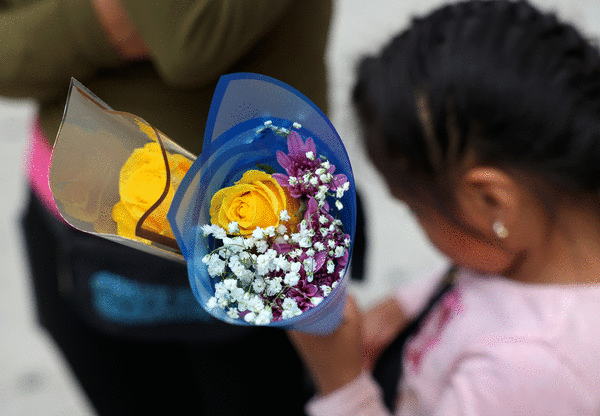
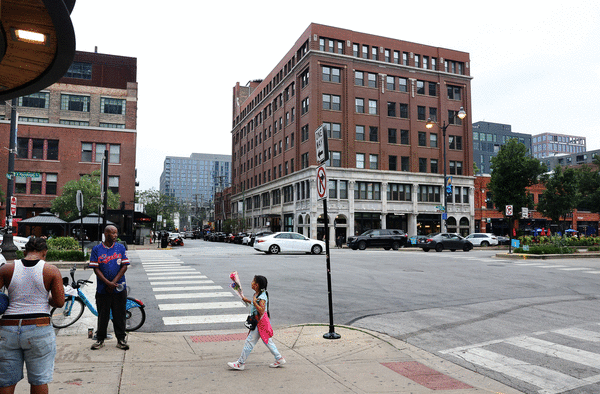
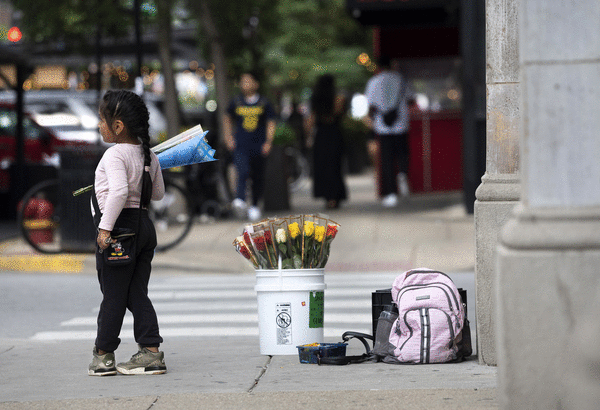




CHICAGO -- On a recent summer Saturday evening, María and her 6-year-old daughter sat at a bustling intersection in the West Loop with a large bucket filled with flowers wrapped in ribbon and decorative wrap. While María stayed on the street corner, the young girl wandered solo a short distance away.
As diners rushed to reservations at the trendy restaurants along West Randolph Street, the girl walked up and down the sidewalk. Without a word, but a facial expression that could tell 1,000 stories, she lifted up her flowers to those who her passed her by. Hoping one would stop.
It was a scene unfolding at nearly every nearby intersection at nearly the same time. The working children slipping between crowded street corners, extending a flower upward, making just $5 or $10 at a time for each stem sold. Only sometimes an adult present, following the child or staying at a fixed location nearby.
María, a 30-year-old single mother from Ecuador, has been selling flowers for two months in the West Loop to support her daughter.
“My cousin told me that we are going to sell because I don’t have a job and I have to pay the rent,” María said in Spanish. “That’s why I sell with my daughter, because there is no one else who can care for her.”
Experts say that the population of “street-working children” is on the rise in Chicago and other major cities across the country. While it’s not been uncommon to see young kids who sell merchandise on sidewalks or streets around the world in countries suffering socioeconomic hardship, it’s become an increasingly common sight across the city, including River North and near Fulton Market in the West Loop. Kids, sometimes no older than 5, holding a small bouquet, passing between outdoor restaurant tables and lingering on the sidewalk outside bars and nightlife clubs.
The risks children take selling flowers was on full display in River North in early July. Security footage from Moe’s Cantina River North shows a grown woman physically assaulting a young girl selling bouquets outside of the late-night Mexican restaurant and bar.
The girl was thrown to the ground as bystanders rushed to intervene. Moe’s Cantina reported the confrontation to Chicago police, Charles Dixon, general manager of Moe’s Cantina in River North, said. As a result of the violence, Dixon said Moe’s Cantina has hired additional private security.
“It’s dangerous,” said Dixon, who often sees young kids selling flowers alone at night. “There are drunk people; anything can happen. If anything little happens, or some drunk person runs about being obnoxious, it can hurt them.”
While it’s illegal for kids to be selling any kind of merchandise on the streets within the city of Chicago, it’s unclear exactly which city or state agency should take responsibility for enforcing child labor laws.
Parents can and may have a street peddler license, but their kids cannot. Peddlers must be licensed with the city and at least 16 years of age, according to the city. There are also specific hour restrictions: No peddler is allowed to sell merchandise between 5 p.m. and 7 a.m. — something currently underenforced, if not unenforced completely.
Neither the Illinois Department of Labor nor the Illinois Department of Child and Family Services said it was within their jurisdiction to enforce. Each organization redirected questions about the street-working children to one another.
And a spokesperson for the Chicago Business Affairs and Consumer Protection said the agency emphasizes “collaboration over enforcement and fines.”
“This approach includes proactive, nondisciplinary consultations between BACP and business owners to understand and adhere to City regulations,” the spokesperson said.
Although no one can pinpoint to how many children street workers there are in Chicago, experts and various business owners say the number has grown in the past three years, the timeline nearly corresponding to when the surge of asylum-seekers from South and Central America began arriving in the city.
Ivón Padilla-Rodríguez, assistant professor of immigration history at the University of Illinois Chicago, says that the United States’ long and complex immigration legal system is the root cause for why there are now street-working children in Chicago. On top of families needing to make ends meet for rent and food in Chicago, families immigrating to the U.S. either are strapped with fees for legal immigration, or other expenses to unlawfully enter the country, leading to economic desperation.
“There is no efficient, safe avenue for lawful entry, which is one of the reasons why they make this treacherous, dangerous journey to the U.S., that often requires very expensive smuggling services,” Padilla-Rodríguez said. “By the time they get to the U.S., they’re already saddled with migration debt.”
María Orozco, outreach coordinator for the Street Vendors Association of Chicago, said the association has been working to reach the parents and children who vend flowers to provide education workshops about local street vendor and child labor laws, plus resources to get the kids into school and daycare.
“We’re not in a place to judge the parents, just to guide them as best we can,” Orozco said. “I know it’s situations that are tough, especially with immigration, especially with children being out in places where there’s bars and people drinking or under the influence. It does get very dangerous.”
Orozco said in a way, it’s everyone’s responsibility to keep these young children safe.
“I think the responsibility should be from everyone; our offices sharing resources, other organizations, maybe the Consulate of Ecuador could also share some information with them,” Orozco said. “It’s very complicated to say who to point fingers at when it comes to situations like this.
Terasita Williams, floor manager at Urbanbelly Fulton Market, shares concern for the child street workers’ safety at night. She sees the children selling flowers on the sidewalk primarily on Friday, Saturday and Sunday evenings, starting around 6 p.m. The kids approach outside tables from the public sidewalk, often without an adult within close proximity.
“I just feel like we could be safer about all of it,” Williams said. “I get it. Everyone has to make money. Everyone has to do whatever they need to do to survive. But I personally wouldn’t want my children just to run in the streets.”
Though Williams does not know the kids by name, she said it’s often the same families working the Fulton Market sidewalks. In a way, she has seen them grow up in the past year and a half they have been selling near Urbanbelly.
“I’ve seen them grow up,” Williams said. “They’re now taller, their hair is longer, they’ve gotten haircuts, but it’s definitely the same kids.”
Less than half a mile away, at the Bandit on West Randolph Street, manager Preston Carter also said he sees the same groups of kids selling flowers to his restaurant customers. Like at Underbelly, the kids are not permitted to sell inside the restaurant, but regularly interact with patio customers and individuals entering the Bandit after 10 p.m., when the space transforms into a nightclub.
“It’s like part of the late-night vibe you see,” Carter said. “When we have the line for our nightclub, you’ll see them going down the line saying, ‘Oh, do you want a flower?’ A lot of times, someone would be out with their girlfriend or significant other, and they enjoy it.
As more street-working children have appeared in Chicago, Williams and Carter both said their presence is something regular customers have come to expect. In a way, street vendors like María and her daughter have gradually become a regular part of nightlife in Chicago.
“They’ve become synonymous, unfortunately, just being out here late at night,” Dixon said.
Without clear legislation or enforcement, the cycle continues for these young flower vendors each weekend evening. Another street corner, another nighttime crowd, another bucket of flowers.
“Just know they’re trying to get some food at the end of the day,” Carter said. “They’re just making a living somehow, some way.”
____
Chicago Tribune reporter Laura Rodríguez Presa contributed.
©2026 Chicago Tribune. Visit at chicagotribune.com. Distributed by Tribune Content Agency, LLC.






Comments