Philly asks 3rd Circuit for new President's House hearing, saying ruling set a dangerous precedent
Published in News & Features
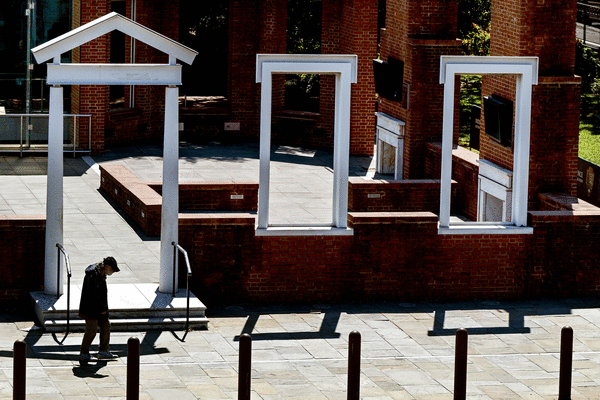
PHILADELPHIA — Philadelphia is asking a federal appeals court for a redo on the President’s House, saying the court’s June ruling that allowed President Donald Trump’s administration to swap the exhibit at the historic site limited the ability of courts to restrain the executive branch.
The city is seeking a new hearing in front of the entire Court of Appeals for the 3rd Circuit, or the same three judges who issued a unanimous ruling in June, which held the city has no rights over the displays at George Washington‘s Philadelphia home.
The ruling created a catch-22, the city’s attorneys said in Monday’s court filing, not only for the President’s House but for the ability of federal courts in the Philadelphia area to review government actions broadly.
The 3rd Circuit found that the abrupt removal of the slavery exhibit from the President’s House couldn’t be challenged under the statute that governs final actions by federal government agencies. The removal, the appeals court said, wasn’t an “agency action” or “final.”
“Both holdings are wrong, and both are of exceptional importance,” the city’s filing said.
Michael M. Hardiman, the judge who wrote the June opinion, said the removal wasn’t a “final” action because the government afterward proposed new panels for the site.
The city says the court supplied a road map for federal agencies to evade challenges in court. Under this precedent, the federal government can evade courts’ review by “announcing — even mid-litigation — that it might do something else later,” the city said.
The judges opened the door for federal agencies to defeat lawsuits over their conduct simply “by pointing to what it might do next,” according to Philadelphia’s filing.
It is rare for circuit courts to hold rehearings in front of the original or the full courts, which is known as en banc, said Adam Crews, a professor at Rutgers School of Law.
“The court will not grant rehearing en banc when the panel correctly states the law and the contested issue is simply the application of the law to specific fact,” Crews said.
Even if the entire court agrees to hear the case, the city might not find a sympathetic audience.
A majority of the court’s 14 members have been appointed by Republicans, and six were appointed by Trump.
The panel that issued the June ruling included Hardiman, a George W. Bush appointee; Luis F. Restrepo, a Barack Obama appointee; and Peter J. Phipps, who was appointed by Trump.
The city filed the request for reconsideration hours before the deadline to appeal the June order, and at a time that the Mayor Cherelle L. Parker’s law department is in transition.
City Solicitor Renee Garcia, who resigned last week, argued the case on behalf of the city in a January district court hearing. U.S. District Judge Cynthia M. Rufe issued a blistering opinion and an injunction ordering the restoration of the exhibits, which was later overturned by the 3rd Circuit.
Parker appointed Monique Galloway, who worked for the U.S. Attorney Office in Philadelphia, as the city’s next solicitor.
Monday’s filing still carried Garcia’s name.
The Trump administration swapped the President’s House exhibit under the shadow of darkness last month, in the early morning hours after the MLB All-Star game. The new panels have been criticized for their lack of focus on the experience of the nine people held in bondage by Washington in his executive mansion and whitewashing of the first president’s culpability in slavery.
The Department of Interior last month spent $181,430 on new mobile surveillance trailers for the site, citing “safety concerns” following the installation of the new exhibit.
The National Park Service and Department of Interior did not immediately respond to a request for comment.
Advocates for the original exhibit, including Avenging the Ancestors Coalition and city leaders, vowed to keep fighting to restore the removed panels to the site. Michael Coard, leader of Avenging the Ancestors Coalition, said last month the group was exploring new legal strategies.
“This site, Sixth and Market streets, is the only site where George Washington lived on federal property, that federal property was known as America’s first White House, and Black people were enslaved,” Coard said from the President’s House on the day the exhibit was swapped. “There’s only one place where that happened. Right here.”
_____
©2026 The Philadelphia Inquirer. Visit inquirer.com. Distributed by Tribune Content Agency, LLC.



Comments