Spain says 'vast majority' of Ceuta migrants have returned
Published in News & Features
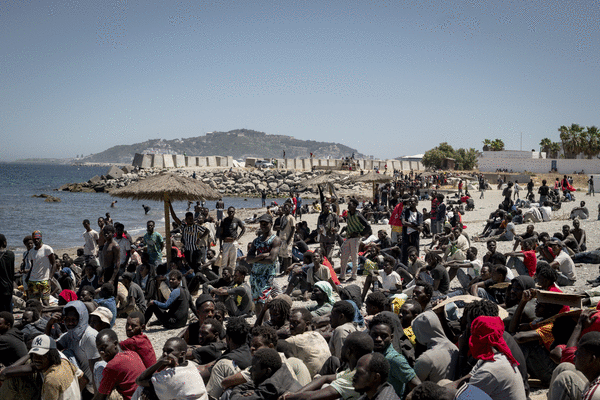
Spain’s foreign minister said nearly everyone who illegally crossed into the African enclave of Ceuta last week has left, pledging to return “every last” person to Morocco.
“The vast majority of those who entered have already returned to Morocco,” José Manuel Albares said in an interview Monday morning on TVE, Spain’s state-owned station. “Every last one of them will return.”
Spain is trying to assure its European Union neighbors that it is swiftly returning the roughly 50,000 undocumented migrants who arrived in Ceuta late last week. The incident sparked chaos at one of the E.U.’s two land borders with Africa and led to allegations that Spain’s more open immigration laws helped lure the migrants.
Spain and Morocco have attributed the sudden surge to misinformation being circulated about a July 8 Spanish Supreme Court ruling restricting the immediate returns of migrants intercepted at sea.
Ceuta and Melilla, another Spanish enclave in Northern Africa, are Spanish territory and once people enter either city they are officially on E.U. soil. That fact has turned the isolated incident in a Europe-wide issue, with numerous leaders going after Spanish Prime Minister Pedro Sánchez.
Several countries vowed to impose border checks if needed and suspend Spain’s participation in Europe’s free-travel zone, known as the Schengen Area, even though its unlikely any of the Ceuta migrants will make it to mainland Europe. Still, Italy said it was tightening certain border checks for non-E.U. citizens arriving from Spain.
Spain has bristled at the pile-on, accusing fellow E.U. members of lacking the solidarity it says the bloc must display in such moments. The country also insists it acted rapidly in response, halting the crisis before it spread.
European Commission President Ursula von der Leyen backed that assessment on Monday in a letter sent to Sanchez — a shift in tone from the concern she expressed on Friday. The E.U.’s top executive said Spain and Morocco had “managed this efficiently and effectively, successfully preventing illegal movement onwards to mainland Spain and Europe.”
She said the situation has shown “the returns system in place worked.”
That outcome has not prevented tensions from spilling over between E.U. members. Spain and Italy, in particular, have been trading barbs.
“There have been states that have not risen to the occasion, governments that have not risen to the occasion,” Albares said. “The Italian government has been one of them.”
Sanchez, who is now on holiday in Lanzarote, has also pointedly noted that more unauthorized entries occur through Italy, Greece and the Western Balkans than through Spain. Albares pressed that point in his interview.
“Ceuta and Melilla have never, ever posed a threat to the integrity of the Schengen Area,” the foreign minister said. “I have, however, seen such threats and porosity affecting the Schengen Area in other parts of Europe. We have witnessed that risk, and Spain has always shown solidarity.”
Again, Albares mentioned Italy, saying it “fails to manage” migration crises on Lampedusa, a Mediterranean island that serves as a common point of entry for migrants from northern Africa.
Albares argued Europe must now unite instead of fighting.
“This is a moment when I demand and call for unity — unity among all political forces regarding the two Spanish cities of Ceuta and Melilla, and unity among all Europeans regarding the two European cities of Ceuta and Melilla,” he said.
On Monday afternoon, E.U. ambassadors will hold an emergency meeting in Brussels to discuss the migration influx. The conversation will prepare the ground for a video conference of the bloc’s home affairs ministers on Tuesday.
While certain countries are likely to push for a stricter immigration approach, no specific decisions are expected.
In her letter, von der Leyen said the Ceuta situation showed “we must do more to further strengthen our borders at critical points,” suggesting heightened monitoring and even additional “physical barriers.”
She called on ministers to develop a plan in upcoming meetings. E.U. leaders will then discuss the issue at their next summit on Oct. 15, she added.
“We must take this recent incident as the impetus to assess, to take from it the lessons that all of Europe can learn,” she said.
©2026 Bloomberg L.P. Visit bloomberg.com. Distributed by Tribune Content Agency, LLC.






Comments