Maryland Democrats seek to change redistricting rules, avoid another court challenge
Published in News & Features
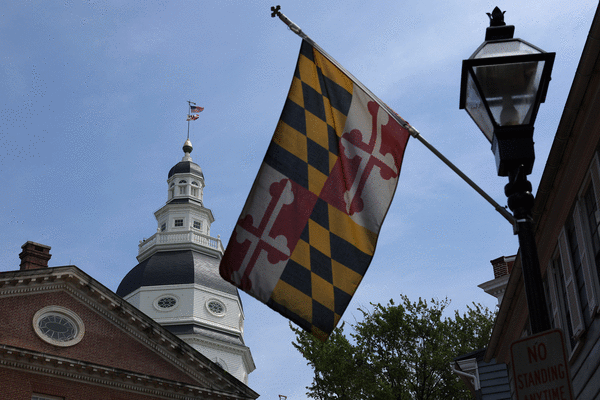
BALTIMORE — When Maryland Democrats tried to redistrict congressional seats five years ago, a judge struck the effort down, calling the map “extremely gerrymandered.” This week, lawmakers seek to change the law to clear the way for another try.
In 2021, Democrats pursued a redraw of Maryland’s congressional map with lawmakers seeking to eliminate the state’s only Republican-held seat. A judge threw out this attempt in 2022 after the GOP sued, ruling that the proposition violated the state constitution.
Now, as lawmakers return to Annapolis for a special session on Monday, Democrats are setting the stage to put a constitutional amendment on the ballot to give state lawmakers more authority over mapmaking. But critics warn this could reduce the courts’ ability to check partisan gerrymandering. Currently, Democrats hold seven of the state’s eight congressional districts.
The proposed amendment would not guarantee any particular congressional map or prevent future lawsuits, with litigation costs likely falling on Maryland taxpayers, according to previous news reports.
Instead, it would change the legal framework judges use when reviewing future challenges.
“The courts are a creation of the legislature,” said Guha Krishnamurthi, a constitutional law professor at the University of Maryland’s Carey School of Law. “If the legislature, with the governor, wanted to amend the constitution such that the courts couldn’t hear these kinds of [anti-redistricting] claims, they’ve got to get that amendment through.”
During the special session, lawmakers will consider legislation stating that the constitutional requirement to create legislative districts that are connected, reasonably shaped and drawn with consideration for existing geographic boundaries only applies to those used to elect state lawmakers, not congressional representatives. The bill also explicitly states that nothing in the state constitution provides criteria for the boundaries of a congressional districting plan.
The new statute, constitutional law professors and political analysts added, would also prevent Maryland courts from rejecting another map — unless lawmakers rewrite the constitution again in the future.
Mark Graber, a constitutional law professor at the University of Maryland’s Carey School of Law, ruled out federal action to reverse Democrats’ efforts, noting that the U.S. Supreme Court in 2019 barred federal judges from weighing in on perceived “partisan gerrymandering.”
“[Republicans] can take it to the Supreme Court, [but they will] lose,” Graber said.
What Democrats may lose through redistricting
Whether lawmakers’ plans will help the Democratic Party politically is unclear. Matthew Crenson, professor emeritus at Johns Hopkins University, said an amended constitution could “backfire.”
“The thing that presents a more subtle, but serious, danger is that in order to eliminate a Republican district, you have to redistribute the Republican voters among what have been solidly Democratic districts,” Crenson said. “That means that those districts are now no longer so overwhelmingly Democratic, and the chance of losing them in some future election has increased.”
Analysts added that the process used to approve mid-decade redistricting could be scrutinized to substantiate legal challenges if the upcoming special session ends in an amended state constitution.
John Dedie, a politics professor at the Community College of Baltimore County, said Gov. Wes Moore’s executive order announcing the special session could be used against him because he’s doing the very thing he opposes — “bending the rules for partisan gain.”
“[The constitutional amendment] is turning a lot of things on its head because [Moore is] basically saying that we’ve got to fight back against [President Donald] Trump doing this type of stuff,” Dedie said. “Last year, he talked about free and fair maps. The map is 7-1, Democratic to Republican. How is it free and fair when you go from 7-1 to 8-0?”
In his push to redistrict mid-cycle, Moore emphasized the need to counter the national Republican gerrymandering blitz and protect voting rights and fair representation. But faced opposition from Democratic Senate President Bill Ferguson earlier this year, who cited the 2022 court ruling could potentially cause the party to lose some of the seats it currently has.
Ferguson has since reversed course. During a recent podcast appearance, he reiterated Moore’s point — combating Republicans nationally. But added that he worries redistricting “will become this weapon of mass destruction where you’re mutually assured to just end it all.”
“If it’s every two years we’re fighting about a red map or blue map, and every election we’re redrawing the lines — that’s just a cycle that I think is very, very difficult [to see] how we’re going to sustain,” Ferguson said.
Moore’s office did not respond to multiple requests for comment.
©2026 Baltimore Sun. Visit baltimoresun.com. Distributed by Tribune Content Agency, LLC.






Comments