US embassies warn Americans as Iran threatens more choke points
Published in News & Features
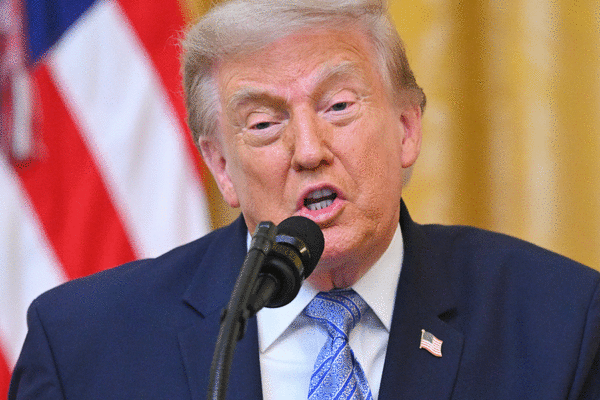
U.S. embassies across the Middle East urged Americans to exercise caution after President Donald Trump said he was considering new military strikes against Iran.
The warning came as Tehran’s Supreme National Security Council secretary, Mohammad Bagher Zolghadr, said Saturday that a continued U.S. naval blockade and any escalation would not only further restrict shipping through the Strait of Hormuz but also lead to the closure of other strategic choke points.
Already, the Iran-backed Houthis last week opened a new front in the war, targeting two Saudi Arabian oil tankers in the Red Sea with missiles and drones.
Zolghadr’s comments followed a Wall Street Journal report on Friday, citing unnamed U.S. officials, that Trump had ordered the military to carry out a new attack on Iran as soon as this weekend to force Tehran to surrender.
“We’ll be hitting them very hard,” the president said during a Cabinet meeting. “And at some point they’ll say we just can’t take it anymore.”
U.S. embassies across the Middle East on Saturday warned Americans that they should be prepared for flight cancellations, periodic airspace closures and other travel disruptions as tensions remain elevated.
The stop-start conflict between the U.S. and Iran, which has repeatedly disrupted traffic through the Strait of Hormuz, a key route for oil, liquefied natural gas and fertilizer exports, started Feb. 28. A brief truce collapsed last month, and the two sides paused exchanges of strikes at the end of last week in an attempt to give diplomacy a chance.
That lull ended Tuesday night when Tehran carried out what Trump described as a surprise attack, firing multiple ballistic missiles at a U.S. military base in Jordan. The latest escalation has driven sharp swings in energy prices, with Brent crude ending the week above $90 a barrel, up from below $72 a barrel at the start of last month.
The effects of the war have rippled far beyond the Gulf, driving up inflation worldwide while threatening to engulf more of the Middle East.
Overnight, an LNG vessel was hit in the Strait of Hormuz off the Omani coast, while a nearby tanker reported a near miss, according to the U.K. Maritime Trade Operations, which said no environmental impact had been reported.
Saudi Arabia and Iraq have also become more deeply embroiled in the war, with Riyadh joining the U.S. this week in striking Iran-backed militias in Iraq in response to attacks on Saudi oil facilities.
Egypt was drawn into the fray this week when two ships carrying LNG were struck by drones at the port of Damietta.
Kuwait continues to be targeted, saying on Saturday that its air defense had detected and destroyed Iranian drones.
CBS reported separately that the U.S. is considering striking energy infrastructure, including oil refineries and power plants, which would mark a major escalation in the military campaign. Deliberate bombing of civilian targets could be considered a war crime, according to advocacy groups.
White House Press Secretary Karoline Leavitt did not directly address reports about an impending assault, but said in a statement that “Iran will continue to pay until they come to the table in what President Trump deems a meaningful way.”
Trump has frequently threatened to sharply escalate the war only to shift his stance soon afterward. At the same time, the conflict has depleted US munitions, particularly air defense interceptors crucial to stopping attacks on bases. With control of Congress at stake in November’s midterm elections, polls show voters by a wide margin disapprove of Trump’s handling of the war and the economy.
———
(With assistance from Dan Williams, Valentine Baldassari and Rebecca Smith.)
©2026 Bloomberg L.P. Visit bloomberg.com. Distributed by Tribune Content Agency, LLC.






Comments