Ukraine aims to extend the 'kill zone' and turn up heat on Putin
Published in News & Features
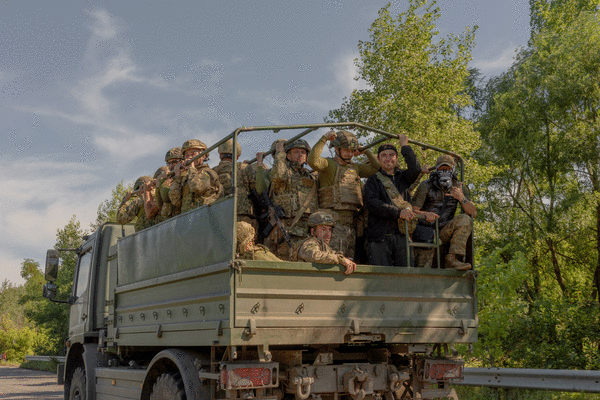
Ukrainian artillery crews are on track to have access to extended-range shells by the end of the summer — a high-tech tool Kyiv hopes will drastically expand the frontline “kill zone.”
The first wave of deliveries will stretch 155mm cannons’ range to at least 60 kilometers (37 miles) and include laser-guided shells, Ukraine has said. More advanced munitions equipped with small ramjets could more than double that distance. All the shells will be compatible with existing 155mm artillery batteries.
By piling battlefield setbacks atop waves of strikes deep inside Russia that have triggered fuel shortages and pushed up prices, Kyiv aims to increase the pressure on Moscow to end the war. Yet Ukraine itself is also vulnerable, and the Kremlin is exploiting its shortage of air defenses to hammer civilian populations, stirring fears of another brutal winter.
The kill zone on the front line, a contested area between Ukrainian and Russian forces where nearly anything can be quickly spotted and attacked by a drone, is about 30km wide, putting rear areas outside the range of conventional artillery. Longer-range shells could push Russia back, giving Ukraine ground forces space to safely advance and disrupting counterattacks and all but covering Crimea. Russia’s military does not have as many extended-range artillery systems as Ukraine’s western allies can provide, according to a person close to the Russian defense ministry.
Capturing territory in key areas at a time when Ukrainian missiles are hitting Russian oil infrastructure and other targets hundreds of kilometers from the border would provide Kyiv much-needed leverage in its efforts to end the war.
“If Russian forces have to move guns, depots and headquarters further back in the south, Ukraine gains time, space and survivability,” said Ruben Stewart, senior fellow for land warfare at the International Institute for Strategic Studies. “It also makes any future Russian offensive there harder.”
Extended-range artillery is likely to be most valuable in that region, especially Kherson and Zaporizhzhia, where open terrain and exposed supply routes give Ukraine more targets, Stewart said. But in Donbas around the well-fortified urban areas of Slovyansk and Kramatorsk, where Putin concentrated his military campaign, the distance between opposing armies is too short for such rounds to make a difference, he said.
Mikhail Degtyarev, a Russian military expert who runs a website focused on his country’s defense industry, said extended-range shells would cause “localized threats and problems” for Moscow. But larger effects might be hard to see, he said.
“It’s impossible to push the rear area farther back now, because the concept of the rear has effectively ceased to exist over last four years of this war,” Degtyarev said.
The recent military leadership shakeup does not seem to have changed planning, and Kyiv has said about $540 million has been allocated for extended-range shells through support from Norway, Denmark, Lithuania, Luxembourg and Spain, including via the Czech Initiative, which gathers rounds from donor countries and ships them to Ukraine. Germany has pledged €300 million, which Defence Minister Boris Pistorius said equates to roughly 50,000 shells. Rheinmetall AG CEO Armin Pappeger said Ukraine is seeking as many as 1.2 million such rounds per year.
Ukraine’s defense ministry said in June that it had purchased 15,000 extended-range shells from Denmark, without providing details. It also opened another tender for 155mm “artillery rounds of increased range,” saying such shells are hotly demanded at the front. Six manufacturers are already supplying similar shells for what the defense ministry in May called its largest procurement by value, and deliveries will finish this year.
Ukraine has been attacking deep inside Russia in recent months with propeller-driven cruise missiles and its allies agreed at a NATO summit to spend $50 billion to develop more advanced long-range weapons.
The U.K. is also overseeing the Brakestop program, which aims to create cheaper, smaller cruise missiles for Ukraine that do not rely on any U.S. components or data.
Extended-range artillery shells can use sabots — sleeves that fit around small projectiles to use them with propellant loads meant for larger shells — folding wings and other means to increase the distance they can fly. When guided by GPS, they can hit a target just a few meters wide; laser-guided versions home in on a beam shined on the target, often by a drone. The U.S.-made M127 Copperhead and Vulcano, a joint project of Italy’s Leonardo SpA and Germany’s Diehl Defence and Land Systems GmBH, are both laser-guided.
Some weaponsmakers have also been experimenting for years with fitting small ramjets into artillery shells, pushing their range past 150 kilometers.
Norway’s Nammo AS has one such project, the Ramjet 155 developed with Boeing Co., and reported tests flights as far back as 2023. The system may now be approaching production and delivery, according to a person familiar with the matter, speaking on condition of anonymity because of the sensitivity of the issue.m U.S. defense startup Tiberius Aerospace Inc. has a similar round, the Sceptre guided projectile, which may become available for Ukraine as well, the person said.
Nammo and Tiberius did not immediately respond to requests for comment.
Rheinmetall AG’s 155mm Assegai V-LAP projectile can reach 67 kilometers when fired from a PzH 2000 self-propelled artillery piece, which Ukraine operates. The company plans to deliver about 100,000 extended-range 155mm shells for Ukraine this year, Pappeger said on an earnings call in May.
But such exotic rounds “are not yet the mass answer to Ukraine’s immediate ammunition problem,” Stewart said.
“For the day-to-day war, volume at 40 kilometers-plus matters more than small numbers of experimental long-range rounds,” he said.
Other suppliers include Raytheon, BAE Systems and billionaire Michal Strnad’s Czechoslovak Group (CSG). CSG and UkrainskaBronetechnika established production facilities in Ukraine and have a target of making more than 300,000 155mm shells in this year, although CSG’s core artillery products have a maximum range of 43 kilometers.
“If Ukraine is able to shift some of its tactical needs to artillery again, it would reduce some of the dependency on drones, which would be welcome. Artillery is generally more reliable and usable in all weather conditions,” said Sam Cranny-Evans, a military analyst at the Royal United Services Institute in London. “With a 7 kilogram explosive charge, it will have a bigger effect on a bunker than a single FPV as well.”
—With assistance from Anand Mammen Katakam.
©2026 Bloomberg L.P. Visit bloomberg.com. Distributed by Tribune Content Agency, LLC.






Comments