Ebola vaccine race accelerates as Congo outbreak outpaces response
Published in News & Features
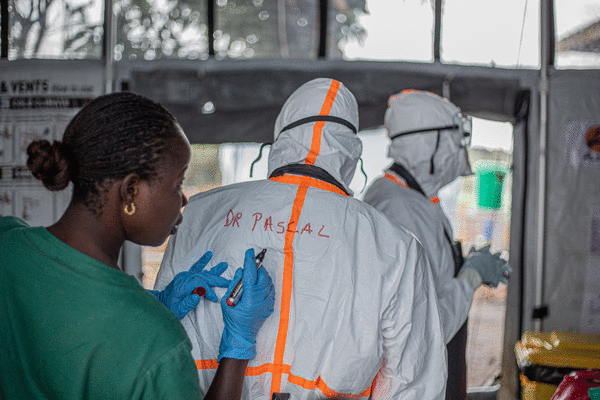
The race to develop the first vaccine against the Ebola virus driving the outbreak in eastern Democratic Republic of Congo accelerated Thursday, after a top United Nations official warned the epidemic is spreading faster than responders can contain it.
The Coalition for Epidemic Preparedness Innovations is funding production of the first clinical-trial doses of an experimental Bundibugyo Ebola vaccine, with manufacturing expected by the end of the year and human studies to follow soon afterward, the group and Merck & Co. executives said in a statement.
“The epidemic is fast becoming a humanitarian crisis,” CEPI Chief Executive Officer Richard Hatchett said. “This vaccine candidate could become an important tool for Bundibugyo outbreak control and response.”
The race for a vaccine comes as the epidemic has become the fastest-growing Ebola outbreak on record. It’s spreading through one of Africa’s most fragile regions, where conflict, displacement and overstretched health systems have complicated efforts to identify infections, isolate patients and trace their contacts.
Senior U.N. Ebola Coordinator Julien Harneis warned Wednesday that the epidemic is doubling in size about every 20 days and expanding faster than the international response.
“This is far faster growth than the growth in our response, and so the gap between the epidemic and our response is widening,” Harneis told reporters from Bunia, in eastern Congo. “We need to massively step up our response.”
Confirmed cases climbed to 3,360 on Monday from 1,406 at the end of June, while the death toll has almost doubled in the past two weeks to 1,487, according to Congo’s National Institute of Public Health.
Unlike Congo’s last major Ebola outbreak, caused by the Zaire strain, there are no licensed vaccines or approved therapies for Bundibugyo Ebola.
The experimental shot builds on the technology behind Ervebo, Merck’s licensed vaccine against Zaire. Scientists replaced the surface protein that triggers the immune response with one from the Bundibugyo strain, allowing them to build on a platform already proven in people.
The doses will be manufactured by Hilleman Laboratories, a Singapore-based vaccine developer jointly backed by U.S. pharmaceutical giant Merck and the Wellcome Trust, with as much as $8.5 million in funding from CEPI, the statement said.
©2026 Bloomberg L.P. Visit bloomberg.com. Distributed by Tribune Content Agency, LLC.





Comments