Florida executes 2 men Tuesday, a 1st in modern death penalty history
Published in News & Features



Florida executed two men Tuesday for separate murder cases from the 1980s amid a record-breaking surge in the state’s pursuit of capital punishment.
James Duckett and Dominick Occhicone both died by lethal injection at Florida State Prison, near the city of Starke, becoming the 11th and 12th prisoners the state has put to death this year.
Duckett, 68, convicted in the 1987 murder of a young girl near Orlando, was declared dead early Tuesday afternoon, following a brief delay as his lawyers unsuccessfully asked the nation’s highest court to spare his life.
Occhicone, condemned for the 1986 Pasco County murders of his former fianceé’s parents, was executed five hours later. At 80, Occhicone became the oldest person Florida has put to death since the state resumed capital punishment in 1979.
Duckett, a former police officer, long maintained he was innocent of the 1987 murder of 11-year-old Teresa McAbee.
He had no last words. His execution took 15 minutes. A doctor pronounced him dead at 1:19 p.m.
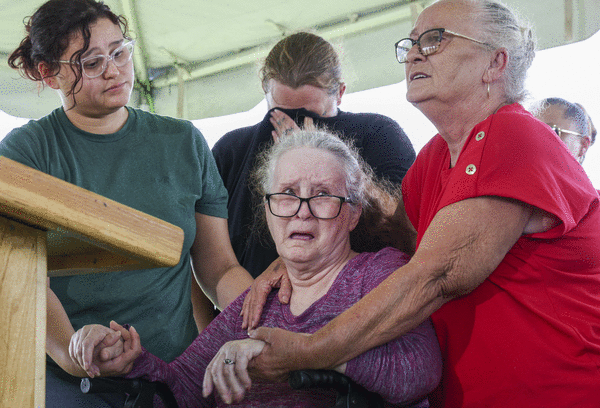
McAbee’s mother, Dorthy Tula, was among those who watched him die. At a news conference afterward, she sat on a walker, sobbing heavily.
“I’ve waited nearly 40 years to have him dead,” she said.
Occhicone apologized to the victims of his crimes before he died Tuesday evening.
“I know it don’t mean much, but I’m sorry,” he said. “I never meant to do what I did.”
He was pronounced dead at 6:13 p.m.
The executions mark the first time in modern history that the state has put two people to death on the same day.
They come amid an unprecedented period in the modern history of capital punishment in Florida. Gov. Ron DeSantis, since last year, has ordered more than 30 men to die.
As of Tuesday, DeSantis has authorized 40 executions throughout his time as governor, far more than any of his predecessors.
Pasco man committed family massacre
Occhicone was convicted in the 1986 murders of Raymond and Martha Artzner. He’d previously been engaged to marry their daughter, Anita Gerrety, but she ended what was described in court records and news accounts as a volatile relationship.
Bartenders at Shooter’s Lounge in Elfers said Occhicone was a regular, often showing up when the bar opened at 7 a.m. He drank between 10-15 vodka cocktails before lunchtime each day, they said. People heard him lamenting the demise of his relationship and voicing hostility toward the Artzners and Gerrety.
She later testified he’d threatened to kill her and her family.
“He would hurt whatever I loved the most,” she testified. “And he specifically mentioned my parents and my children, and how he was going to blow them away, starting especially with my children, starting with the kneecaps and leave me so I could watch them and suffer.”
In the early morning of June 10, 1986, Occhicone showed up outside the Holiday home Gerrety shared with her parents. He knocked at a sliding glass door. Gerrety woke, told him to go away and threatened to call police.
Occhicone left but returned with a gun. He disabled the home’s phone line, then banged at doors and windows. Raymond Artzner came outside, wielding a broomstick, and told him to leave.
Gerrety later said Occhicone looked at her and grinned. She saw a “flash of fire” before her father fell to the ground.
As Gerrety and her daughter fled the home, Occhicone broke through a locked door. When he saw Martha Artzner, he shot her four times.
At trial, Occhicone’s lawyers argued that his alcohol abuse and distraught mental state made him incapable of forming intent to kill. One psychologist testified he was “on a suicide errand, not a homicide errand.”
A jury convicted him. The same panel favored the death penalty by a vote of 7-5. Such a vote today would result in a life sentence; Florida law now requires a minimum of eight votes for the death penalty to be imposed.
Convicted ex-cop claimed innocence
Almost a full year later and 60 miles away in the small town of Mascotte, an 11-year-old girl named Teresa McAbee vanished.
She’d gone out late one night to a Circle K store near her home to buy a pencil to do her math homework.
Duckett, one of the town’s two police officers, saw her talking to an older boy outside the store. He warned the kids they were out after curfew. The boy left with his uncle while Duckett placed the girl in his patrol car.
He would later say he lectured her about being out late before letting her go. When McAbee’s mother later reported her missing, Duckett spoke with her and made a missing-person flyer.
The girl’s body was found the next morning in a lake less than a mile away from the Circle K. She’d been raped, strangled and drowned.
Suspicions quickly fell on Duckett. Tire tracks near the murder scene were similar to the treads on his patrol car’s wheels. McAbee’s fingerprints were identified on the car’s hood, intermingled with Duckett’s.
An FBI analyst testified that a hair found on McAbee’s underwear was nearly identical to Duckett’s, though another expert could not make a match. A jailhouse informant, who surfaced months later, claimed she’d been near the Circle K and saw Duckett drive off with McAbee.
He was convicted. A jury recommended death by a vote of 8-4.
Duckett’s case bore some of the hallmarks common to wrongful convictions. They include faulty forensics — the FBI hair analyst was discredited after he was found to have given false and misleading testimony in other cases. And the jailhouse informant who testified in Duckett’s trial later recanted.
Duckett had long sought DNA testing, but the science was not advanced enough until recent years. He again asked for DNA testing after DeSantis signed his death warrant earlier this year. A court allowed the testing, and his execution was temporarily stayed. That stay was lifted after the test results came back inconclusive.
Witnesses gathered for execution
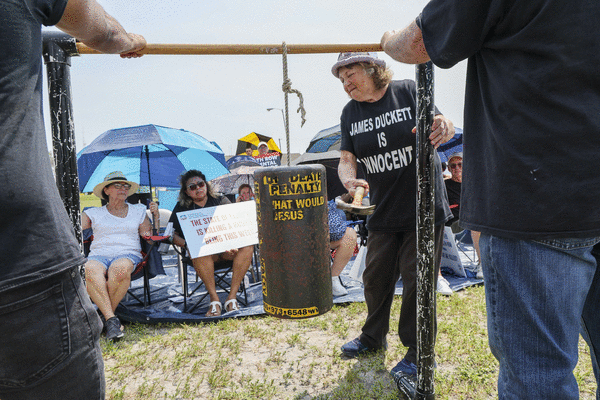
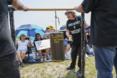
A crowd gathered Tuesday morning in a pasture outside Florida State Prison. Roughly 500 yards from the execution chamber, they sipped water amid the midday heat while clutching protest signs.
Some read: “Why do we kill people who kill people to show that killing is wrong?”
At noon, vigil attendees lined up to ring a large steel bell with a hammer. Many said “Not in my name” before striking.
“The death penalty continues to be a circus of choice,” said Fred Ruse, a retired Orlando priest who led the vigil.
Nearby, Bill Campbell blasted Queen’s “Another One Bites the Dust” and Michael Jackson’s “Beat It” from a set of speakers. A large live oak tree stood between him and the demonstrators.
Campbell, 71, said he respects the death penalty opponents, but believes that people who support capital punishment should have a voice, too.
“They make noise, I make noise,” he said. “The jury has ruled, there’s been all sorts of appeals, the guy’s getting what he deserves.”
Duckett met Monday for a final visit with four members of his family, according to the Florida Department of Corrections. Occhicone had no visitors Tuesday. His adult daughter told the Tampa Bay Times she met with him for the last time Monday.
Both men woke Tuesday morning in death watch cells at 4:45 a.m., a department spokesperson said. Duckett ate a last meal of eggs, grits, bacon, biscuits and chocolate milk. Occhicone had eggplant Parmesan, a salad, garlic bread and a Pepsi.
Duckett’s execution, set for noon, was delayed about an hour before the U.S. Supreme Court turned down his final appeals.
A spiritual adviser sat beside him, reading aloud from a prayer book, as he was put to death. Duckett breathed hard and appeared to convulse before going still. After four minutes, a prison official shook his shoulders and shouted his name, getting no response.
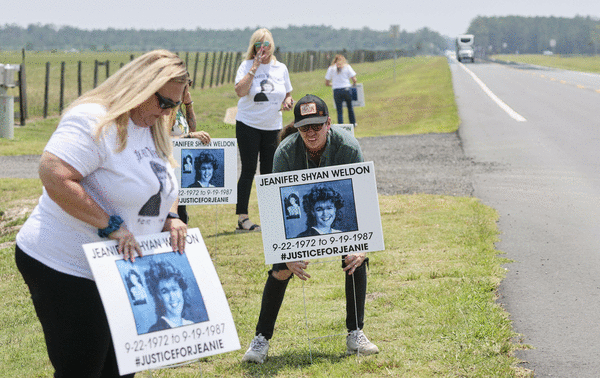
Thirty-five people watched. The witnesses included relatives of Jeanifer Weldon, a 15-year-old Polk County girl whose unsolved murder had long been tied to Duckett, though he was never charged.
Her family members said afterward the execution gave them a measure of closure. Amy Weldon, her sister, said the families have long supported each other.
“Our family has always prayed for their family and vice versa,” she said.
Bill Gladson, the state attorney whose office prosecuted Duckett’s case, asserted in a statement afterward that the evidence left no doubt about his guilt.
“While no legal proceeding can restore the life that was taken,” Gladson said, “this execution represents the final administration of justice for the young victim and her family, who have endured years of unimaginable loss while waiting for this case to reach its lawful conclusion.”
It was a similar scene as a window shade rose inside the execution chamber at 6 p.m. Strapped to a gurney, Occhicone said he was sorry to the victims “for the hurt I caused them.”
He thanked his attorneys. “I loved their friendship,” he said.
Twenty-seven witnesses watched. A spiritual adviser, clutching a rosary, prayed at his side. He closed his eyes within a minute. The warden shook him and shouted him name.
His death took 10 minutes.
Afterward, as rain began to pour and thunder blared outside the prison, officials read a statement from the Artzner family. They mentioned 40 years of sleepless nights, missed birthdays and lost conversations. The execution, they wrote, doesn’t erase the pain, but closes a chapter.
“The only history that matters here today is the history we lost with our parents,” they wrote. “And the events of today do not give us back that lost time together.”
_____
©2026 Tampa Bay Times. Visit tampabay.com. Distributed by Tribune Content Agency, LLC.






Comments