There were no appeals, so how is Bryan Kohberger essentially appealing? Could it work?
Published in News & Features
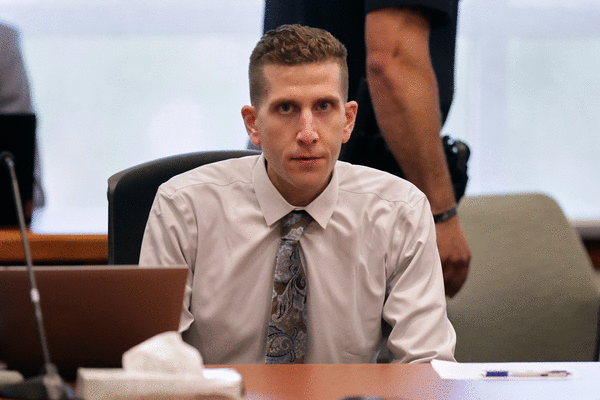
BOISE, Idaho — When Bryan Kohberger admitted to stabbing four University of Idaho students to death, he was asked by the presiding judge question after question to make sure all aspects of his plea were offered “voluntarily.”
The convicted murderer is now claiming that wasn’t the case, and despite the fact that his plea agreement included waiving his right to appeal, he is taking another legal avenue to try to get the same result: have his guilty plea tossed out so he can pursue a trial.
A Boise-based defense attorney told the Idaho Statesman that Kohberger’s claim doesn’t make a lot of sense, but how is it that Kohberger is allowed to go down this path to begin with?
Here’s how it breaks down:
Judge Steven Hippler, of Idaho’s 4th Judicial District, stressed during a hearing last summer that he wanted to be sure that Kohberger did not plead guilty unless he actually was; understood and agreed to the deal; was not threatened or coerced; was satisfied with his attorneys’ representation; and comprehended the consequences of pleading guilty.
Kohberger answered affirmatively, every time.
And when asked whether he “willfully, unlawfully, deliberately with premeditation and with malice aforethought” stabbed Madison Mogen, Kaylee Goncalves, Xana Kernodle and Ethan Chapin to death after breaking into their off-campus home on Nov. 13, 2022, Kohberger answered “yes” — four times.
Despite that, the former Washington State graduate student has now asserted that he’s innocent, and he wants to be let out of the plea agreement — which took the death penalty off the table. Kohberger, 31, has filed a petition for post-conviction relief, and the same judge who sentenced him will decide whether his claims have merit.
Among the consequences the judge asked Kohberger about was that he agreed to waive his right to appeal in the case. But that does not include the right to ask the court for post-conviction relief — something any incarcerated person has the ability to do, regardless of their case’s circumstances. The petition is a civil remedy that allows someone convicted of a crime to contend that their sentence was a violation of the law.
In fact, the U.S. Supreme Court addressed the possibility of challenging convictions even after a defendant signs away their rights to appeal in Garza v. Idaho.
“The fact that a defendant waives the right to appeal doesn’t mean they don’t have the right to appeal,” Hippler explained in court, referring to the 2019 ruling. “So it may affect the outcome of that appeal, and it may affect the underlying case and the plea agreement, but nonetheless, the right to appeal does not go away because of the waiver.”
Justice Sonia Sotomayor wrote in the Supreme Court’s majority opinion that “no appeal waiver serves as an absolute bar to all appellate claims.”
“Most fundamentally,” Sotomayor wrote, “courts agree that defendants retain the right to challenge whether the waiver itself is valid and enforceable — for example, on the grounds that it was unknowing or involuntary. Consequently, while signing an appeal waiver means giving up some, many, or even most appellate claims, some claims nevertheless remain.”
In a handwritten affidavit that was filed with Idaho’s court system, Kohberger alleged that he was “convinced to falsely confess” to the burglary and four murder charges by “coercion, disinformation, false promises and the withholding of exculpatory discovery.” He “was convinced that actual guilt was not an important factor” in accepting his plea deal, as he could have faced the death penalty, he wrote, and was “advised to lie.”
Those claims, which mainly fall under the umbrella of ineffective assistance of counsel, are hard to prove, Edwina Elcox, a Boise-based defense attorney, told the Statesman. Kohberger had a team of well-respected attorneys who filed dozens of motions covering many potential avenues, and were able to get the death penalty taken off the table — something she called an “incredible defense victory.”
“It just seems to be an incredulous claim to me,” she told the Statesman of Kohberger’s post-conviction relief move.
Elcox particularly pointed to one of Kohberger’s claims in the filing that his attorneys failed to inform him about a supposed clump of unknown hair found in Ethan Chapin’s hand — something that seemed unlikely to her. It was one of dozens of samples that were examined by investigators microscopically, according to a lab report from the FBI.
None of the samples matched Kohberger’s hair, but one of the defense’s own experts, Sy Ray, wrote in a report that the hair was “morphologically consistent” with Chapin’s own hair.
If there really was a “bombshell piece of evidence,” Kohberger’s attorneys would have chased it down and vetted it, Elcox said. She noted that some people might try to frame this as “exculpatory evidence,” but she doesn’t “agree with that at all.”
_____
Investigative reporter Kevin Fixler contributed.
_____
©2026 The Idaho Statesman. Visit idahostatesman.com. Distributed by Tribune Content Agency, LLC.





Comments