Immigration agents used racial slurs referring to Latinos in text messages, video obtained by ACLU
Published in News & Features
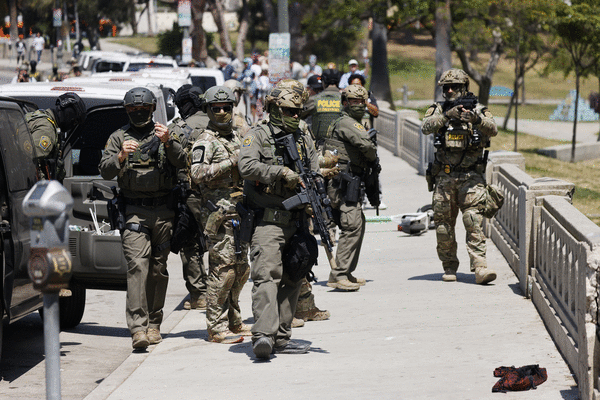
LOS ANGELES — Immigration agents who descended on Los Angeles last summer referred to Latinos using slurs like "tonk" and "wet," according to body camera footage and text messages detailed in a court filing asking a federal judge to bar agents from making stops based on racial profiling.
After a June raid at Home Depot in Hollywood, body camera footage captured an agent saying: "There was a guy, I'm pretty sure he's wet he was just sitting in that minivan." A text chain revealed an agent referring to "tonks everywhere selling food" — using a word reportedly derived from the sound an agent's utility flashlight makes when hitting a migrant's head. In a video, an agent said, "Yeah, just plug us in wherever you see some tonks and we'll jump out."
Body camera footage and forensically recovered texts, which provide a window into the mindset of agents who conducted raids throughout the L.A. area, were detailed in a motion for a preliminary injunction filed on Monday by the American Civil Liberties Union, Public Counsel, and other groups and private attorneys seeking to bar an "ongoing campaign of suspicionless and discriminatory detentive stops" in the Central District of California.
Mayra Joachín, an attorney at the ACLU of Southern California, said the language agents used underscores that "what's driving the way that immigration operations are being conducted now is a racist sentiment."
"What we've seen is only a fragment of what information there might be, because not all of the government records from phones have been turned over," Joachín said. "It's also possible that there are many other phone records that have not been turned over and could have even more detrimental evidence for the agency."
The Department of Homeland Security, which oversees Immigration and Customs Enforcement and Customs and Border Protection, did not immediately respond to a request for comment.
The evidence, pertaining to both Immigration and Customs Enforcement and Border Patrol agents, was turned over in expedited discovery ordered by U.S. District Judge Maame Ewusi-Mensah Frimpong after the Supreme Court stayed in September her previous order barring stops based solely on race or ethnicity, language, location or employment, either alone or in combination.
In a 10-page opinion, Justice Brett M. Kavanaugh said federal law says "immigration officers 'may briefly detain' an individual 'for questioning' if they have 'a reasonable suspicion, based on specific articulable facts, that the person being questioned ... is an alien illegally in the United States.'" He said such stops are reasonable and legal based on the "totality of the circumstances."
Plaintiffs' lawyers did not have this latest evidence when the Supreme Court granted the emergency appeal and it'll now presumably be harder for the courts to ignore that stops are motivated by racial bias.
Plaintiffs in the case, who filed their lawsuit last summer, argued that the discovery "flatly disproves" representations the government made in pursuit of the stay.
The evidence shows that "race is the predominant characteristic driving Defendants' stops, and that Defendants' ongoing stops — including of U.S. citizens — are neither brief nor unintrusive," the motion states.
The plaintiffs asked Frimpong to block agents from "relying on a person's perceived Latino ethnicity to conduct detentive stops, except in connection with a known target description."
"This is the most recent effort by plaintiffs to ensure that there is some transparency as to how immigration enforcement operations are being conducted and also some accountability from the officers engaging in these operations," Joachín said. "There are safeguards in place for how immigration agents should be conducting any operation and what we're seeing from the evidence is that they are driven largely by racial profiling."
A shift under Trump
For years, including during Trump's first term, ICE compiled target lists that would include the daily routines of the people they sought to arrest. Those operations focused on individualized investigations of specific people.
That changed last year, attorneys said in the motion, citing an email from ICE headquarters in late May 2025 instructing field offices to begin arresting "collaterals," or nontargets, en masse. Soon after, plaintiffs allege, agents "embarked on a coordinated campaign of suspicionless stops based on demographic profiling."
"These operations differ widely from operations that occurred before, when immigration agents would actually investigate and develop articulable facts enough to have reasonable suspicion for the person that they were to stop," Joachín said. "Now that's not what's occurring, it's rather racism that's really pervasive and underlying the way that the agency is operating."
Attorneys allege that one way the government executes its "policy of race-based profiling" is through "roving patrols," where they drive around without searching for a particular target. In text chains detailed in the motion, agents discussed "soft counts" of "possibles" based on location drive-bys and "roaming."
After Frimpong issued a temporary restraining order last year, the government "represented to this Court and the Supreme Court that these operations were based on "intelligence," the motion states.
"But discovery revealed that Defendants' paltry 'intelligence' was manufactured to justify operations at public access locations Defendants were already intent on raiding," according to the motion. The attorneys cited a deposition from a veteran ICE agent who was assigned to participate on the operations and said they were not "designed in good faith" to arrest the identified targets.
According to the motion, the government sent intelligence-gathering teams to Home Depots and car washes where "they ran checks until they identified an arbitrary number—typically a small number—of possibly unlawfully present individuals."
"Defendants then selected a day to raid the location, without regard to whether the previously identified 'targets' were present," the motion states. "Unsurprisingly, Defendants frequently did not arrest their supposed 'targets,' even as they arrested numerous others."
Attorneys referenced an agent who was captured saying "[G]et out and start grabbing people" right before detaining a lawful permanent resident.
The government asserted that ICE was trying to locate a target when they approached three men, lead plaintiffs in the lawsuit, at a bus stop in Pasadena, according to the motion. The intention that day, plaintiffs argue, "always was to arrest 'collaterals.'" In a text chain cited in the motion, the lead officer that day told a colleague to "bring extra cuffs."
When that lead officer was later asked in an deposition about the appearance of individuals he looks for, he answered "[o]lder Hispanic male," according to the motion.
"In sum, the record plainly establishes that Defendants are really looking for Latinos," the attorneys argued.
Text messages and footage
The motion contains several references to immigration agents using racial epithets such as the slur "tonk." Guidance from U.S. Customs and Border Protection in 2019 stated that "the term tonk is not appropriate" because it is "considered a derogatory term and CBP does not condone its use," the Huffington Post reported.
In one text chain, an agent referred to "snatch & grabs."
"I think [the Border Patrol agents] only know one way to operate," an agent said in a text chain. "See bodies, chase bodies."
It's unclear if agents texted any other slurs, as many phones have yet to be turned over.
At a hearing last month, Frimpong weighed whether to hold the government in contempt for not complying with a court order requiring them to forensically image any cellphone used by an agent present at any of 15 identified operations.
The Justice Department attorney told Frimpong that no personal phones had been imaged at that point, despite the fact that more than 800 officers indicated that they had used their personal phones during operations.
©2026 Los Angeles Times. Visit at latimes.com. Distributed by Tribune Content Agency, LLC.





Comments