Venezuela democracy talks backed by US to start despite division
Published in News & Features
CARACAS, Venezuela — U.S.-backed political negotiations in Venezuela that ultimately aim to set a course for future elections will begin later this week but without the full backing of either the opposition or the ruling coalition.
The early lack of consensus underscores the steep challenges faced by the oil-rich South American nation that was recently hit by a pair of deadly earthquakes.
On Sunday, opposition leader María Corina Machado announced she hasn’t participated in the design of the talks. Meanwhile, hardliners within the ruling coalition denounced them outright.
The administration of U.S. President Donald Trump sees the negotiations set to begin in Caracas on Saturday as the main vehicle for negotiating Venezuela’s political transition following the capture of former President Nicolás Maduro by U.S. forces in January.
In her statement, Machado said she won’t “stand in the way of any initiative that produces real progress,” while stopping short of endorsing the plan.
Machado has remained outside Venezuela since leaving late last year to accept the Nobel Peace Prize in Oslo. She has repeatedly vowed to return home, particularly after last month’s earthquakes, and recently said she had been blocked from doing so.
Although she remains Venezuela’s most influential opposition leader, at Washington’s request the negotiations will instead feature members of the opposition-led National Assembly who were elected in 2015.
Machado’s statement was also signed by fellow opposition leader Edmundo González, who ran for president in 2024 in her place.
The statement indicated they will judge the talks by whether they can deliver “concrete, verifiable” results, including the restoration of democratic institutions, the release of political prisoners and a timeline for new presidential elections.
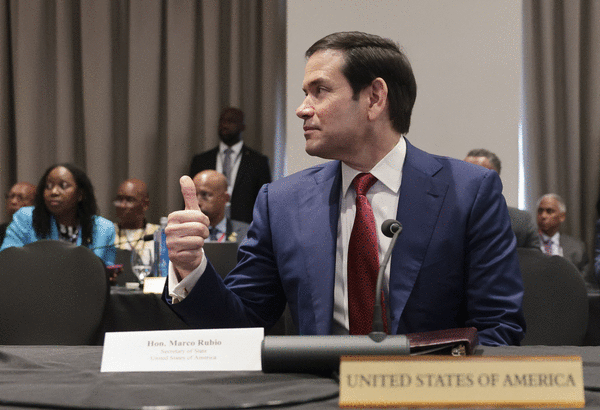
Last week, Secretary of State Marco Rubio called the looming negotiations “a really good development,” insisting that the U.S. was facilitating the process rather than dictating it. He also said he believed Machado could “have a role,” while 2015 National Assembly President Dinorah Figuera described that role as “very important.”
The talks have also exposed divisions within the movement founded by Maduro’s charismatic socialist predecessor Hugo Chávez. Hardline movement figures including Iris Varela rallied on Friday in the Venezuelan capital’s Plaza Bolívar, burning U.S. and Israeli flags to protest those countries’ post-earthquake presence. At the time, Varela dismissed the negotiations as “a falsehood” she doesn’t support.
Speaking later on Monday in televised remarks, Interior Minister Diosdado Cabello welcomed the talks, arguing they had further splintered the opposition while reaffirming the government’s support for the process.
Cabello said the government would advocate for peace, the lifting of sanctions and respect for Venezuela’s constitution. He added that “dialogue doesn’t mean capitulation.” While he didn’t refer to the criticism voiced by hardline critics, Varela could be seen seated along with other ruling party leaders during the meeting.
Once the talks kick off, negotiators are expected to discuss appointing new members of the National Electoral Council, overhauling the voter registry and the timing of elections, among other topics.
Last week, Trump said Venezuela was not yet ready for elections, even as he cited progress made with the country’s interim authorities.
Some analysts argue those divisions may ultimately matter less than Washington’s leverage over the process.
“The negotiations are largely a staged process,” Andrés Antillano, a professor at the Central University of Venezuela, said during an International Crisis Group webinar last week. “The real decisions are not in the hands of local actors, who lack the leverage to impose outcomes. That power rests with the U.S.”
©2026 Bloomberg L.P. Visit bloomberg.com. Distributed by Tribune Content Agency, LLC.





Comments