Experts at Miami forum propose ways to help Cuban economy in post-communist era
Published in News & Features
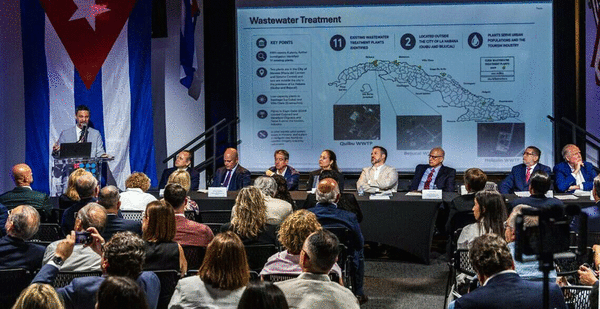



MIAMI — The question of how to help Cuba’s transition and reconstruction once there is a transition toward democracy brought together a group of Cuban American academics, businesspeople, engineers and architects in Miami, who proposed strategies to restore and rebuild the country.
Attracting private capital to promote development on urgent problems — such as the severe energy crisis and water shortages — was the common theme of the forum “Rebuilding Cuba’s Infrastructure as part of the Transition to Democracy”, held Wednesday, July 22 at Miami’s American Museum of the Cuban Diaspora.
A decaying, obsolete infrastructure that has seen no investment or maintenance would be the biggest obstacle to a new Cuba’s progress.
Besides the Cubans on the island who long for change, the greatest capital Cuba has is the those living abroad, which the Cuban regime has historically excluded from investing in the country, said experts who addressed the energy crisis, water scarcity and the neglect of roads, rail lines and airports.
At the same time, they highlighted Cuba’s potential to receive millions of tourists and the possibility of incorporating the most modern technology from the outset in industries and sectors that will have to start from scratch.
Rafael Romeu, president of the Association for the Study of the Cuban Economy, a nonprofit non-political organization founded with the mission of studying the operation and structure of the Cuban economy, emphasized the importance of creating a legal framework to stimulate private investment during the transition and reconstruction.
“A government is needed that allows the diaspora to get involved in the reconstruction,” said Romeu, who is also a senior associate at the Center for Strategic and International Studies, a bipartisan, nonprofit policy research organization and think tank analyzing global issues based in Washington D.C.
Cuba cannot turn to international organizations like the International Monetary Fund—from which it withdrew in 1964—for money to help its economy recover. Waiting for international organizations for help could lead to chaos and suffering for the Cuban population, which would face worsening conditions such as hyperinflation and dollarization in the black market and the collapse of essential services, Romeu said.
Romeu proposes a first phase of humanitarian aid to respond immediately to the urgency of the situation, such as the collapse of the electrical grid, the crisis in the water supply and the health system.
Financing to restore most sectors of the Cuban economy would come from a combination of public and private funds. The fundamental goal, however, should be to incentivize private investment to achieve the necessary changes that guarantee long-term development.
To achieve currency stabilization Romeu proposes dollarizing the Cuban economy.
Rebuilding Cuba would cost billions, and that’s when “the venture capital guys” would come into play, Romeu said.
Tourism, one of the most attractive sectors for investors, could draw 7 to 10 million visitors a year. That would be a huge leap for the island’s industry, which received only 359,491 visitors between January and May 2026, a 58% decrease compared to the previous year.
‘Zero hour’
The energy crisis is the most pressing issue in Cuba, which is at “zero hour,” said Jorge Piñón, senior research fellow at the the Austin Energy Institute of the University of Texas. Solving it is not only fundamental to Cubans’ daily lives, but also essential to attracting investment in the future.
“Without energy there is no country,” Piñón said. “Cuba needs reliable, clean energy. That is the foundation for the country to position itself in the 21st century.”
The scholar sees Cuba’s future in natural gas, an energy source the Cuban government already exploits in partnership with the Canadian company Sherritt International.
The extraction of natural gas at the Canasí and Puerto Escondido fields in Santa Cruz del Norte provides around one million cubic meters daily for electricity generation, official island media reported in May.
“Cuba should gradually eliminate crude oil refining operations and convert existing refining facilities into open-access, common-use petroleum terminals,” Piñón proposes in the study “Cuba’s Transition Toward an Open Access Fuels Distribution and Marketing System,” published by the New York University School of Law.
That would eliminate the cost of modernizing refineries and reduce the environmental impact that could affect the development of the cruise industry. At the same time, it would foster competition to achieve better fuel prices.
Cuba would not be starting from scratch in the transition from refineries to storage terminals because it already has a national network of oil ports such as Mariel, La Habana, Matanzas, Nuevitas, Moa, Santiago de Cuba, Cienfuegos and Nueva Gerona. There is also a precedent in Puerto Rico’s successful transition from closed refineries to fuel storage facilities, he said.
Piñón also proposes the use of renewable energies, such as solar, and producing ethanol from sugarcane, as Brazil does.
The water crisis
The long daily lines of desperate Cubans with containers to collect water could take up to two years to resolve, experts said.
The country has aquifer resources and 59 water treatment plants on paper, but most of them do not function or operate at low capacity.
There is a shortage of treatment chemicals and equipment, broken pump and, poor-quality filters. The main disinfectant used is chlorine gas, which has a high degree of toxicity, said engineer Josenrique Cueto, former director of the Miami-Dade Water and Sewer Department and former director of the Cuban American Association of Civil Engineers.
Cuba also has problems with wastewater infrastructure. Most of the country lacks a public drainage network and relies on septic tanks to dispose of wastewater, Cueto said.
The first phase to resolve the crisis would focus on restoring the treatment and pumping of potable water and improving the pipe network, prioritizing hospitals, densely populated cities and vulnerable communities.
At the same time, an assessment would be made of the scope of repairs and investments needed to make the system function.
Rehabilitation phases would take 2 to 5 years, modernization up to 10 years, and expansion—which would include enlarging treatment facilities in major cities and providing for industry and agriculture—would take more than 10 years, Cueto said.
Transportation headache
Transportation is one of the most serious problems Cubans have traditionally faced, though it has been overshadowed by more basic needs like electricity and water.
The island has two main roads, the Central Highway, built before the revolution, and the National Highway, which is unfinished. Fatal accidents on neglected roads are almost daily news, with horse-drawn carts sometimes sharing space with old—and scarce—automobiles.
Engineer Carlos Peñín, founder and president of the firm C.A.P. Government, Inc., which specializes in services for construction departments of government agencies, said at the forum that 70% of the roads in Cuba are in poor condition.
There is potential for transportation development in Cuba, but it would require a major investment to have an economic impact, said Peñín, former president of the Board of Directors of the Miami-Dade Expressway Authority and of the Transportation and Expressway Authority Membership of Florida.
Port needs
Cuba has 30 ports, including Mariel and the aging facilities in Havana and Santiago de Cuba.
The good news, experts say, is there is demand for cruise calls to Cuba, which was shown starting in 2016 following the diplomatic thaw promoted by the Obama administration.
Starting from scratch in transportation would be an advantage for the island, which could implement the most modern benefits from the outset, experts said.
To modernize airports, an investment of $8 to $10 billion over 15 years would be needed to bring them up to international standards, said architect Willy Bermello, chairman of the board of Bermello Ajamil & Partners Inc., based in Coral Gables.
A leap to 5G
For Cubans who walk blocks searching for a spot to get a good connection on their cell phones, the promise of bringing mobile networks to 5G would be music to their ears.
“Increasing coverage and transitioning to 5G would boost Cuba’s economy,” said Jesús Lebeña, senior vice president of corporate operations at MasTec Communications Group, based in Coral Gables.
Lebeña envisions a change in which all Cubans have access to voice, text and data with international connectivity without restrictions.
And the plan can be achieved in less than three years, he said, adding that Cuba must be connected to the United States and other countries via fiber optic cable. That could be accomplished by forming partnerships with telecommunications companies and having multinationals compete in bids to obtain better prices for consumers. Starlink, the internet satellite service, would be available on the island without prohibitions, not as it is now.
The influx of tourists that could come to the island once change occurs would represent a big business opportunity for telecommunications companies, he added.
“Cuba would position itself to be a data center in the Caribbean,” Lebeña said.
Marcell Felipe, president of the American Museum of the Cuban Diaspora, invited attendees to “visualize” the change. He pointed out that talent and capital to invest exist in exile.
“All of this depends on an essential issue, which is regime change,” he said. “That is not going to happen while the Castro family, the Díaz-Canel family are in charge of that system.”
©2026 Miami Herald. Visit at miamiherald.com. Distributed by Tribune Content Agency, LLC.





Comments