US calls Haiti a death trap while planning mass deportations
Published in News & Features
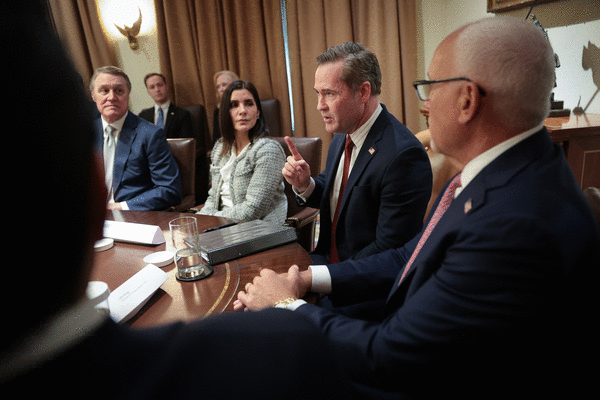
Haiti remains mired in a lawless miasma even as the U.S. is threatening to force hundreds of thousands of people who fled the Caribbean nation back home, after the Supreme Court ruled that President Donald Trump can terminate their special immigration status.
Mike Waltz, the U.S. ambassador to the United Nations, said this week that “wannabe dictators” have transformed Haiti’s capital, Port-au-Prince, into a “violent playground.” A power vacuum following the 2021 murder of President Jovenel Moise has left heavily armed gangs in control of roughly 90% of the city and large swaths of the countryside.
“I just cannot underemphasize the brutality that these gangs are imparting upon their own people,” Waltz told the U.N. Security Council. He said police have been “flayed alive” and that a person assisting a U.N. gang-suppression force was executed in the street.
The potential expulsion of Haitian migrants from the U.S. is emerging as another flashpoint in a larger debate about Trump’s immigration policies in the run-up to the midterm elections. Some members of Congress are especially concerned about the impact that a wave of deportations could have on U.S. health and elder care, where Haitian workers have helped fill staffing gaps.
Congress created the temporary protected status, or TPS, program in 1990 to provide sanctuary to foreign nationals in the U.S. who can’t return home because of conflicts or disasters. Last month, the Supreme Court decided that Trump can revoke TPS granted to Haitian migrants after an earthquake leveled much of the country in 2010.
Those protections were scheduled to lapse on Friday, but a federal appeals court in Washington extended Haitians’ TPS benefits for three days to July 27. Barring any last-minute changes, come Monday, more than 300,000 people will be on track for potential deportation.
While TPS didn’t offer its Haitian recipients a path to citizenship, it permitted them to live and work in the U.S., and was extended several times by previous presidents. The Trump administration argued that TPS was intended to be provisional and that the time had come to bring it to an end.
Lawmakers have been seeking a way to allow Haitian TPS holders to remain in the U.S. until the Caribbean country is more secure. They point out that the U.S. government sees travel to Haiti as so dangerous that it advises Americans who must go to prepare their will and establish a “proof of life protocol” in case they’re kidnapped.
Forcing TPS holders to return “is not just cruel, it’s contradictory, and it will only exacerbate instability in Haiti,” U.S. Representative Gregory Meeks, a New York Democrat and the ranking member of the House Foreign Affairs Committee, said at a hearing on Tuesday.
A Homeland Security spokesperson disagreed with the assessment of the country’s situation saying that “conditions in Haiti have improved sufficiently to support the return of Haitian nationals.”
Choosing to Return
Republican Representative Mike Lawler, whose suburban district north of New York City has a sizable Haitian population, said that he’s working with over a dozen care facilities that employ TPS holders to have their staff apply for visas, permanent residence or asylum.
“We’ve been working very closely with all of the nonprofits and the hospital systems to help anyone that is on TPS through the process and try to get an expedited review of their case,” Lawler said in an interview, adding that it was important to make sure that applicants could maintain their ability to work.
Lawler said he has had several conversations with U.S. Secretary of Homeland Security Markwayne Mullin about delaying the removal of work authorization for Haitian TPS holders, but declined to say how those talks are going.
Haiti’s economy has contracted for six years. More than 1.4 million people have fled their homes, and almost half the nation’s 12 million people are going hungry. The U.S. is supporting a U.N.-backed security force focused on neutralizing gangs and safeguarding vulnerable groups.
Michael Kozak, a State Department official, told Meeks’s committee that although gangs have a stranglehold on Port-au-Prince and have shut down the main international airport, most regions of the country are relatively safe. He said an influx of deportees into Haiti could aid efforts to calm the country and get the economy on its feet.
“Some of those very productive people that you’re mentioning could be very helpful in Haiti as police officers and as people working in business there,” he said.
Still, very few Haitians have returned, and those that have often blame an increasingly hostile environment in the U.S.
Ema, a 40-year-old lawyer and mother of an autistic child, returned in February after living in Miami since 2021. She said constant immigration raids, nasty rhetoric about Haitians in Washington and fear about the future of the TPS program drove her home.
“Every time I went to work I was scared I would get detained and not see my daughter again,” she said in a telephone interview. “That’s something I just couldn’t bear.”
Ema, who asked to be identified only by her first name to avoid becoming a target, said she’s lucky to reside outside of gang-controlled areas.
“Gangs control so much territory,” she said. “If they’ve taken your neighborhood, you’re not going to be able to go back.”
Fragile Economy
Haiti’s turmoil has disrupted access to healthcare and other services. Doctors Without Borders said one of the few maternity hospitals had been shut due to violence, and that entire communities are trapped, unable to seek medical care.
“These are not conditions to which people should be returned,” the group said.
Some observers fear returnees from the U.S. could also cause unintended damage to Haiti’s fragile economy. With unemployment officially at 15% — and informally far higher — work is hard to come by. Five months into her return, Ema still hasn’t found a job.
Additionally, remittances by Haitian workers account for 17% of the country’s gross domestic product. Disrupting that flow of money could create another potential shock.
“Poverty will worsen, inequality will worsen and insecurity will worsen,” said Joseph Harold Pierre, an economic analyst who lives in Cap-Haitien. “If we don’t sort out our security, there’s nothing we can do in Haiti.”
In South Florida, home to the largest Haitian community in the U.S., people are in shock, said Farah Larrieux, who was granted TPS in 2010 and is applying for asylum. The prospect of being sent back is so frightening, she said, that people are paralyzed, hoping for a last-minute fix.
“Going back to Haiti is not a choice anyone will make because we have no place to go to,” she said. “We are people who have built our lives here.”
____
(With assistance from Nacha Cattan and Pierre Paulden.)
©2026 Bloomberg L.P. Visit bloomberg.com. Distributed by Tribune Content Agency, LLC.






Comments