Baltimore school officials promise to protect students following ICE arrest on campus
Published in News & Features
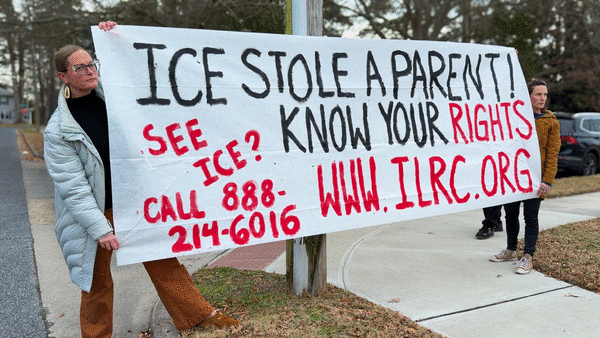
BALTIMORE — More than a month after a Baltimore father was arrested by federal immigration agents outside a pre-kindergarten graduation, Baltimore City Public Schools officials said Thursday they have changed district policies and are preparing additional guidance aimed at better protecting immigrant families when classes resume next month.
The changes come after the June arrest of Jesus Acevedo Sanchez outside Commodore John Rodgers Elementary/Middle School, where Immigration and Customs Enforcement (ICE) officers took him to the ground and handcuffed him while his partner was arrested nearby. The couple’s two young daughters watched from the back seat of the family’s vehicle.
A little over a month after the incident, Baltimore City Council’s Education, Youth, and Older Adults Committee called a hearing to discuss the impact public ICE arrests have had on students as they become more commonplace.
“What we’re talking about today, the well-being of immigrant refugee children and their families here in Baltimore, is part of a much broader attack on young people, [an] attack on diversity, [an] attack on people of color orchestrated by our federal government, deeply rooted in white supremacy.,” Mark Parker, City Councilman for District 1, said.
School district makes changes
Among the most significant changes, City Schools officials said the district has removed students’ place of birth from its definition of directory information, clarified that immigration and citizenship status are not required during enrollment and reaffirmed that school property is closed to the public during the school day and school-sponsored events.
The district also has expanded guidance and staff training on responding to ICE agents and protecting student information.
Tracey Durant, senior executive director of equity for Baltimore City Schools, said that the district is focused on what it can control, like employees following the proper protocol for interacting with ICE agents and protecting student information within the current federal framework.
“We are constantly engaging school leaders as they are telling us about the experiences they are having, that their students are having, that their families are having,” Durant said. “We are adjusting our guides and our training protocols to support them.”
Part of the problem, as the district sees it, Durant said, involves a recent decision by Homeland Security. The federal department rescinded long-standing “protected areas” guidance shortly after President Donald Trump began his second term, ending a policy that had generally discouraged immigration enforcement actions at schools, churches and hospitals.
Durant said another round of policy updates is expected before the new school year begins.
No impact seen yet on absence rates
While immigration enforcement has fueled anxiety among many families, district officials said attendance data do not yet show a widespread decline among multilingual learners.
Although chronic absenteeism remains high across Baltimore schools — mirroring a statewide challenge that emerged after the COVID-19 pandemic — multilingual learners have posted improving attendance trends over the past four years, even as ICE arrests have increased..
With ICE’s arrests not slowing down any time soon, Baltimore’s community leaders were concerned with the well-being of the children and families affected.
From parents absent from the home due to being arrested by ICE, to students avoiding school in fear of being detained by ICE, the effect on students was something everyone could agree on.
Dr. Tania Caballero, a pediatrician and assistant professor of pediatrics at Johns Hopkins School of Medicine, said traumatizing events like Sanchez’s arrest will have long-lasting effects on children in the City Schools system, whether they are directly affected or not.
“The experience of separation creates fear, anxiety and prolonged exposure to stress increases the risk for what is called toxic stress,” Caballero said. “It can affect development, metabolic and immune function in a growing child and it can even lead to physical and mental health problems in adulthood.”
_______
©2026 The Baltimore Sun. Visit at baltimoresun.com. Distributed by Tribune Content Agency, LLC.





Comments