SpaceX updates Starship progress in Florida ahead of next Texas launch
Published in News & Features
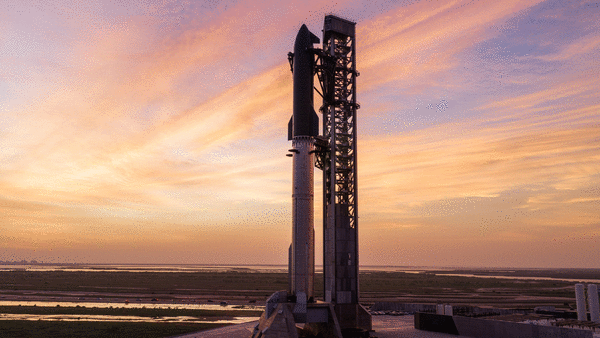
ORLANDO, Fla. — SpaceX is set for its next Starship and Super Heavy test mission from Texas now set for Friday because of poor weather Thursday from Tropical Storm Bertha. It’s the next step on Elon Musk’s company’s path to operational launches from Florida.
Now pushed by one day, it’s targeting what would be the 13th suborbital launch attempt from Starbase on the southeast Gulf Coast of Texas with liftoff slated during a 90-minute window that opens at 6:45 p.m. EDT.
When enough test missions have flown that the spacecraft is at an acceptable working level, it will then shift to Florida with the first missions flying from Kennedy Space Center’s Space Launch Complex 39-A.
“Teams are working through Starship system activations, performing initial tower chopstick motion tests, confirming the operation of the hold downs on the launch mount, and performing multiple integrated tests of the propellant farms, water farm, diverter and launch mount,” said Nathan Commissariat, a SpaceX Starship launch engineer.
The launch tower at 39-A has been nearing completion adjacent to the complex’s existing launch pad, now reserved solely for Falcon Heavy missions.
“The launch complex will soon have two operational pads for two very different rockets with Starship and Falcon Heavy,” Commissariat said. “It has been awesome to see the 39-A Starship program come to life over several years, and it’s going to be exciting to soon see a Starship launch from this historic pad.”
SpaceX had been using the launch site for Falcon 9 rockets until this year, shifting all of their flights over to Cape Canaveral Space Force Station’s Space Launch Complex 40 to allow more focus on completing the initial Starship launch infrastructure at KSC.
Two more towers, though, are under construction at Canaveral’s Space Launch Complex 37, which previously launched United Launch Alliance Delta IV Heavy missions.
“The first of two Starship launch pads at that site is quickly taking shape,” said SpaceX Quality Systems Engineering Senior Manager Kate Tice. “Pad 37A is targeted to be ready for flight operations early next year, which is very fast considering we only started construction on the pad in November.”
She noted teams have worked through ground preparations at the pad and fuel farms and already excavated the flame trench, which occurred last month.
“Stacking began of the launch and catch tower,” Tice said. “And we have plans to complete that stacking in the coming weeks.”
SpaceX ultimately is aiming for as many as 120 flights a year from across the three launch pads in Florida, a number that has raised criticism for its impact on commercial airspace. Also of concern has been its sonic boom potential during both booster landings and upper stage Starship return-to-launch-site flights that would bring it across Central Florida similar to how the space shuttle used to land back at KSC.
The rocket is the most powerful to ever launch to space with nearly 17 million pounds of thrust at liftoff, nearly doubling the power of NASA’s Space Launch System rocket.
Meanwhile, work continues on the massive Gigabay manufacturing plant that will pump out Starship upper stages and Super Heavy boosters right on KSC property, adjacent to the Hangar X where it preps Falcon 9 rockets for launch.
“Recently, teams finished erecting all of the building’s steel and are now working to finish the exterior of the structure,” Commissariat said. “In the coming weeks, SpaceX will complete activation of the first crane in the building, set up the first integration stands, and complete platform work to be ready for supporting the first Starship vehicles that will arrive in Florida.”
The first rocket hardware will be shipped over from Texas, but be processed at Gigabay before it gets into the manufacturing side of things.
Tice said it’s still possible that first Florida launch could come before the end of the year.
But first, Flight 13 has to get off the ground.
This latest mission already tried to launch once, but had issues with some of the 33 Raptor engines on the Super Heavy booster during an attempt on July 16 that scrubbed the attempt just as the countdown clock hit 0. It required at least two replacements, but with preflight testing checking out, the rocket is back at the pad.
Thursday’s delay came because of extreme cloud cover from Tropical Storm Bertha that made landfall farther up the Texas coast.
“A key objective for the flight test is to get clear imagery from the ground of Starship’s heatshield as it flies at a higher dynamic pressure during ascent, which won’t be possible with today’s weather conditions,” SpaceX posted Thursday afternoon. “Visibility is forecast to be ideal for a Friday attempt.”
When it does launch, the plan is to redo much of the flight plan from Flight 12 in late May, which was the debut of Version 3 of Starship and Super Heavy. That flight ultimately led to the Federal Aviation Administration grounding the rocket for two months because the Super Heavy booster made an uncontrolled landing in the Gulf after it sent the upper Starship stage on its way for a flight more than halfway around the world.
The FAA accepted SpaceX’s investigation and corrective actions to the mishap and cleared it for launch.
So Flight 13 will try again to complete a controlled landing of the Super Heavy booster over the Gulf and send Starship for a controlled landing over the Indian Ocean off the west coast of Australia.
New to the mission will be the deployment of 20 real Starlink satellites, which will have a short-lived time in space for about 20 minutes before following the Starship upper stage back into Earth’s atmosphere over the Indian Ocean.
These Version 3 Starlink satellites are what would be used on future Starship operational launches, much bigger than those that can fit in the smaller Falcon 9 rockets. SpaceX will use the 20 minutes to unfurl their solar arrays and test out communication with the existing Starlink constellation in space.
Six of the 20 satellites also have cameras on board to scan Starship’s heat shield, which continues to be modified for the rocket’s ultimate operational configuration.
SpaceX is aiming to get Version 3 to a reliability that would allow for the Super Heavy booster to be recaptured by the swiveling arms called “chopsticks” of the launch tower, a feat that was first accomplished in 2024 and repeated twice in early 2025.
It has stuck to Gulf landing attempts over water for the last four missions as it has made changes to the booster and its return flight trajectories.
The company also needs to get to reliable landing operations for the Starship upper stage as well as solidifying its heat shield.
Only after those boxes are checked will SpaceX gear up for launches from the Space Coast.
_____
©2026 Orlando Sentinel. Visit at orlandosentinel.com. Distributed by Tribune Content Agency, LLC.






Comments