Sacramento State to roll out new on-campus living requirement. Does it have the space?
Published in News & Features
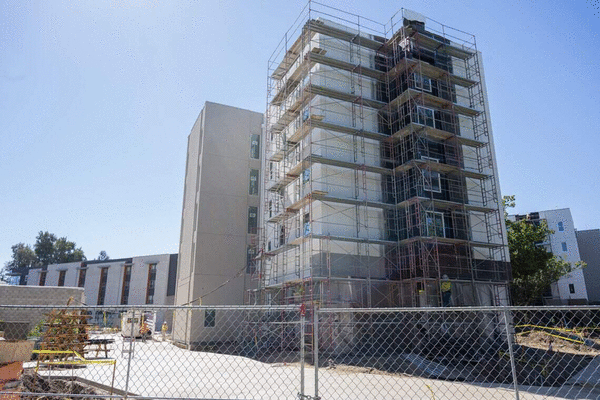
SACRAMENTO, Calif. — Sacramento State’s on-campus living requirement for first-year students kicks in for freshmen moving into their dorms Aug. 26, just in time to fill the school’s brand new 335-bed residence hall. Against concerns over the school’s ability to accommodate all the students affected by the new rule, five-story Mt. Whitney Hall promised to absorb the amplified housing demand.
But the $69 million project — partly funded by a state grant — has not been able to entirely erase Sacramento State’s housing waitlist. For years, the school’s student housing has been at capacity. In the 2025-2026 school year, the campus had enough beds for about 10% of its 31,000 students. Most students who applied for housing were accommodated. About 150, however, got left on a waitlist.
This year, per data from June 1, 151 students are still on the waitlist even after the addition of Mt. Whitney’s beds. The housing application deadline was June 15, meaning demand could have gone up since then. According to officials, all the waitlisted students are non-freshmen.
Sacramento State has managed to make space for all the first-years who were required to apply for student housing. For the 2026-2027 school year, a total of 2,081 freshmen submitted applications for student housing by the June 15 deadline. With 245 of those later canceled, the school is currently working to allot rooms to 1,836 first year students at its seven residence halls that have a combined freshman housing capacity of 1,870.
“We have enough space with the rollout (of the new policy),” said Nadine Kelley, executive director for housing services. “We haven’t really hit any hiccups.”
Not every first-year student
The new residential rule is not a blanket requirement on all first-year, non-transfer students. Local residents, that is students who live with immediate family within 50 miles of campus, are exempt from the policy. Other exemptions are offered to students who are 21 or older, have a medical condition or disability that cannot be accommodated on campus, married or are a parent, face financial hardship, or are active-duty members of the armed forces or veterans. Students can also submit an exemption request under “other special circumstances.” All exemption requests, the university said, must be supported with documentation.
This year, 2,158 students submitted exemption requests, of which 108 were rejected by the housing division. The total number of incoming freshmen for the 2026-2027 school year is around 3,900, which is fairly typical of the trend from the last few years. A little less than half these students — the first to be affected by the new policy — will be living on campus.
According to Kelley, about 80% of students who lived at least 50 miles away from campus lived in residence halls even before the requirement was implemented. The effect of the new policy, she said, was therefore limited to a small group of around 250 students who might have chosen to commute or find an apartment locally, but were now forced to live on campus.
But next year, this will change. The exemption for local students will shrink to those who live 30 miles or less from campus. This means students from cities like Auburn, Vacaville and Yuba City will not have the option of commuting to campus.
In addition, the policy will expand to a full two-year residential requirement in 2027-2028 when the initial cohort enters its sophomore year. From then on, all non-transfer, first- and second-year students will have to live on campus if they do not fit into any of the exemption categories.
Can supply keep up with demand?
To meet next year’s higher need, Sacramento State will unveil a new apartment complex called Hornet Place in fall 2027. Developed by the campus-affiliated nonprofit auxiliary organization University Enterprises, Inc., it will add another 355 beds to the school’s housing inventory. The apartment-style units will serve juniors and seniors, freeing up space in the residence halls for more freshmen and sophomores.
Hornet Place will serve as an extension of Hornet Commons, a 2017 project that added 1,100 beds for upper-division students just off campus on property owned by University Enterprises, Inc. It usually maintains full occupancy through the academic year. Like Hornet Commons, Hornet Place too will be run by South Carolina-based real estate company Greystar.
When Sacramento State requested approval from the California State University Board of Trustees for the project in July 2024, it noted that a 2023 market analysis confirmed demand among juniors and seniors for student housing. It added that the project was “not expected to impact the occupancy of on-campus housing offerings,” and would serve as an option for students who live in residence halls in their first and second years to continue living within the campus community instead of moving to the off-campus market.
Sacramento State’s housing expansion is part of the university’s desire to transform from a commuter campus to a destination campus. According to an October social media post, the campus has initiated a search for partners to provide more affiliated campus housing like Hornet Place and Hornet Commons.
____
©2026 The Sacramento Bee. Visit at sacbee.com. Distributed by Tribune Content Agency, LLC.






Comments