US allies in Persian Gulf exasperated as Iran war escalates
Published in News & Features
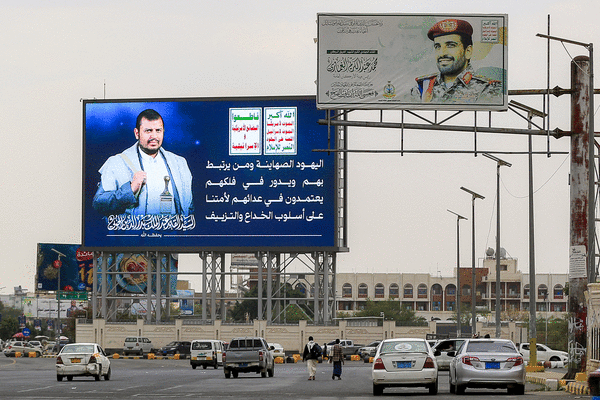
Washington’s Gulf Arab allies are increasingly frustrated as hostilities between the U.S. and Iran intensify, jeopardizing their national security and economies.
The Gulf states’ exasperation is underscored by their wide-ranging views on what the U.S. should do next.
Some officials believe President Donald Trump should escalate military operations by deploying ground troops in parts of Iran and perhaps even seizing its crucial oil export hub of Kharg Island, according to people familiar with the matter, declining to be named talking about sensitive matters.
These officials believe Iran’s leaders won’t back down and relinquish their grip over the Strait of Hormuz unless the U.S. takes more aggressive action, said the people. The alternative is a prolonged, even if low-level, conflict that could last months, one of the people said, deterring foreign investors and tourists from the region.
The view of many officials is that the U.S. needs to “escalate, to de-escalate,” said David Schenker, a U.S. diplomat for the Middle East during Trump’s first term and now a fellow at the Washington Institute for Near East Policy. “Something more needs to be done, because the current dynamic will not compel Iran to make any concession, whether on the strait or on the nuclear front.”
A U.S. official said Trump has extraordinary relationships with leaders in the region and that the administration has been in touch with Gulf states regularly since the beginning of the war. Iran’s attacks on its Gulf neighbors shows Tehran is reckless and can’t be allowed to possess a nuclear weapon, according to the official, who asked not to be identified discussing private deliberations.
On Tuesday, Trump hinted that the Middle East conflict may not end anytime soon. “If we left tomorrow, we had a big, we had a big success,” he told reporters during a meeting with Lebanon’s president. “But we’re not leaving tomorrow.”
Some countries, among them Qatar, the main conflict mediator along with Pakistan, disagree about the need for expanded military operations and want to see immediate deescalation, said the people. That’s with the aim of preventing the fighting reaching the levels of March and early April, when the U.S. and Israel were blitzing Iranian cities and Tehran was firing thousands of drones and missiles across the Gulf.
It marks a shift from the weeks leading up to a interim deal between the U.S. and Iran in mid-June, when Gulf Arab states were largely unified in urging Trump to use diplomacy and ease tensions with Tehran. That solidarity unraveled as hostilities worsened in the past two weeks, with Iran and the U.S. blaming each other for the breakdown of the so-called memorandum of understanding they signed.
Kuwait and Bahrain have come under heavy Iranian attack, as has Jordan.
Kuwait’s water and power plants have been hit by missiles and drones, and flights have been suspended frequently. Saudi Arabia, Qatar and the United Arab Emirates have seen their energy tankers attacked around the Strait of Hormuz, while Iran has also fired upon Oman and Iraq.
The war, which the wealthy Gulf Cooperation Council monarchies urged Washington not to start, has left them questioning the U.S.’s ability to protect its allies. Some are now looking to deepen defense ties with European nations as a result, said the people, who asked not to be named discussing sensitive matters.
Trump seems more and more frustrated with Iranian leaders, especially after three U.S. soldiers were killed in the past week in Jordan and Iraq, with a fourth missing. Iran has refused to stop attacking ships sailing through Hormuz, despite Washington’s threats to step up airstrikes until it does.
The U.S. president has no easy options.
Any move to send in troops or try to conquer Kharg Island would likely cause worse retaliatory attacks from Iran, and push up oil prices even more. It would also expose hundreds, possibly thousands, of U.S. soldiers to close-quarters Iranian strikes that would be hard to intercept.
Gulf states’ aggravation with Iran is building as traffic through the critical strait — which handled most of their oil flows before the war — slumps once again. Many officials from the region doubt the waterway will fully open anytime soon, another person said, declining to be named without permission to speak publicly.
“People are frustrated, angry,” said Michael Ratney, a former U.S. ambassador to Saudi Arabia. “But they don’t say much publicly because they’re all trying to manage their relationship with Trump. They want their oil flowing, their economies back to normal. This is now nerve-racking for them.”
The United Arab Emirates has been among the most vocal of the GCC states when it comes to keeping the strait open. The country has, along with the likes of Saudi Arabia and Kuwait, kept sending oil tankers through despite Iran’s threats, though often with satellite signals turned off to avoid detection.
Abu Dhabi wants European nations to be more proactive and start a de-mining mission they’ve said they will commence once it’s safe, according to a person familiar with the matter. UAE officials have spoken to counterparts in Europe about that in the past week, the person said.
In a July 18 statement, the UAE’s foreign ministry called for an “immediate halt to the escalation and to avoid exacerbating tensions and instability in the region.”
It added there should be a “swift return to negotiations” and stressed the “importance of ensuring safe, uninterrupted navigation through the Strait of Hormuz.”
Economic plans
The war has thrown into uncertainty the near-term business future of a region that’s used oil exports over the past half century to develop into one of the wealthiest in the world.
The main economic powers, Saudi Arabia, the UAE and Qatar, are diversifying further into sectors such as artificial intelligence, hedge funds and tourism, and see regional stability as crucial to that goal.
The conflict and the effective closure of Hormuz have already hit their economies, forcing them to halt many exports and causing their fiscal deficits to soar.
While Gulf leaders largely welcomed the MOU signed last month, they were concerned it could provide huge financial gains to Iran in the form of sanctions relief, the release of frozen funds and the creation of a $300 billion rehabilitation fund. None of the six Gulf Cooperation Council states is yet planning to contribute to that fund, some of the the people said.
Gulf officials have bristled at the suggestion they should effectively pay reparations to the Islamic Republic when their own countries suffered so much damage from Iranian strikes.
Gulf nations “are frustrated, but powerless in stopping either of the belligerents,” said Ali Vaez, director of the Iran Project at the International Crisis Group.
_____
With assistance from Andrea Palasciano and Jennifer A. Dlouhy.
_____
©2026 Bloomberg L.P. Visit bloomberg.com. Distributed by Tribune Content Agency, LLC.




Comments