Chaos in Venezuela's morgues fuels identification errors among Flight 164 victims
Published in News & Features
After days of searching hospitals and an improvised morgue, Daniely Hurtado believed she had finally found the body of her husband, one of the deportees from the United States on Flight 164 the same day two earthquakes devastated Venezuela.
She had already hired a funeral home to cremate him when, just two minutes before the body was taken away, a woman rushed in and pointed at the corpse.
“That’s my husband,” she said.
The tag bore a name similar to her husband’s, but a different identification number.
Both women asked Venezuela’s Scientific, Criminal and Criminalistics Investigations Corps to confirm the identity through fingerprint analysis.
The body did not, in fact, belong to Hurtado’s husband, Eduardo José Osal Mujica, 32, from Lara state in west-central Venezuela, one of the 146 Venezuelans deported from the United States on June 24, the day the earthquakes struck the country.
“I was about to take home a body that wasn’t his because there was no organization or control there. Someone would arrive, see a body with features similar to their relative’s, and take it away without any questions or tests,” Hurtado told el Nuevo Herald from Lara.
Hurtado’s experience illustrates the chaos that, according to relatives of the deceased deportees and a forensic medicine expert, marked the handling of bodies after the earthquakes.
Improvised morgue
Families who searched hospitals and morgues for their loved ones say that overwhelmed services, makeshift facilities and alleged irregularities in the identification of bodies may have led to mistakes that still leave some people uncertain about what happened to their relatives.
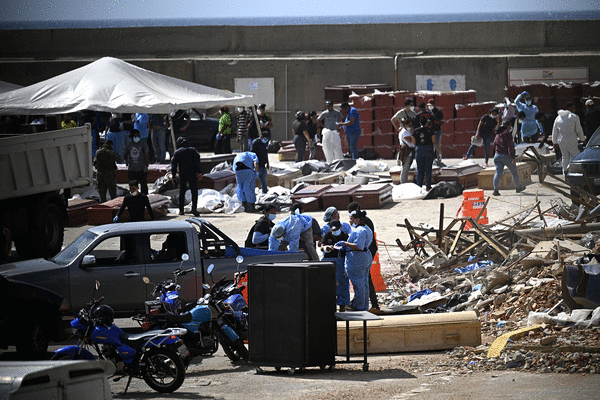
Relatives of some of the victims said that when they finally found the bodies, they were confronted with an improvised morgue, corpses in advanced state of decomposition and a forensic system overwhelmed by the disaster.
Hurtado traveled to La Guaira the day after the earthquakes in search of her husband. She went to the Santuario La Llanada hotel, where the deportees had been housed while undergoing medical examinations and processing of theirs identity documents.
The building collapsed, and Osal Mujica’s body was found beneath the rubble.
A commissioner from the Bolivarian National Intelligence Service, SEBIN, the agency responsible for transporting and guarding the deportees, informed Hurtado that her husband had died.
He later told her that the body had been transferred to the morgue at José María Vargas Hospital in La Guaira, but she had already been there and had not found it.
“I told him, ‘That’s not true. I just came from there, and I went into the morgue. In fact, you took several bodies away because they wouldn’t accept them. The pathologist said she couldn’t receive them because there were already too many,’” she said.
Bodies in refrigerated beef trucks
Authorities were transporting bodies in refrigerated trucks normally used to haul beef, according to Hurtado.
“Those trucks used to transport beef would arrive at the hospital full of bodies, and one pathologist refused to accept them because they were already overwhelmed with so many corpses,” she said.
She said that because many of the bodies were in an advanced state of decomposition, and because of the strong odor that permeated La Guaira, the government removed bodies that were not immediately claimed by their relatives.
According to her account, the bodies were taken away to be cremated, which, in her view, explains why several families of the deportees have still been unable to recover the remains of their loved ones.
Bodies left outdoors, on the ground
She resumed her search until she was told that her husband’s body was at Los Silos, an improvised morgue at the Port of La Guaira. This time, she was able to identify him because he still had the U.S. document related to his deportation in one of his pockets, as well as by his tattoos.
Hurtado had to search through white body bags labeled “repatriates” until she found him.
Chaos also prevailed there, she said, because the bodies were left outdoors on the ground and were exposed whenever people searched through them and left them outside the bags.
She said she received no assistance and that each family had to arrange the transportation of their deceased relatives on their own, even using private vehicles and without any sanitary precautions.
Recognizing a relative from a photo of an arm
Yesenia Méndez, sister of Kevi Alejandro Méndez Angulo, said her family learned of his death through a photograph shared on a WhatsApp group.
She said the image showed an arm in an advanced state of decomposition. The family was able to identify the body because it bore a tattoo with a very specific date: the date of the victim’s grandfather’s death.
“We saw the photo and recognized the tattoo. That’s how we knew it was my brother,” she told el Nuevo Herald.
She said the person who took the photograph had gone to claim the body of another relative and, after noticing the tattoo on the body lying next to it, decided to share the image in several WhatsApp groups.
The body was also at Los Silos, an improvised morgue at the Port of La Guaira.
“I feel that everything that happened was an injustice because so many of us were waiting for our relatives. My brother, for example, had not been to Venezuela in 10 years, and all he wanted was to come back and reunite with us. We had so much hope of seeing him,” Méndez told el Nuevo Herald.
José Repillosa, cousin of Juan Carlos Villegas Castillo, said the family had to travel by boat from Choroní, in Aragua state, to La Guaira to search for him after the earthquakes.
Villegas Castillo, 36, had also arrived on deportation Flight 164 from the U.S. and had been living in Chicago before he was sent back to Venezuela. His sister and another cousin found him in the improvised morgue three days after the earthquakes.
“They couldn’t find him, even though they kept searching. Then my cousin started praying and asking him to let himself be found. Two bodies later, they found him,” Repillosa told el Nuevo Herald.
The family identified him by his tattoos. His body was already decomposed.
He said that there was negligence not only in the handling of the Flight 164 deportees, but also in the response to the tragedy as a whole.
‘Utterly barbaric’
A forensic medicine expert described to el Nuevo Herald what he said was the horrifying situation surrounding the handling and identification of the bodies, not only of the deportees but also of the people who died in the collapse of hundreds of buildings in La Guaira.
The 7.2- and 7.5-magnitude earthquakes has left more than 3,800 people dead and more than 16,400 injured.
The specialist, who requested anonymity for security reasons, said people have been arriving at the improvised morgue carrying parts of their relatives’ bodies or the bodies they themselves managed to recover.
“It’s something utterly barbaric,” he said.
He recounted that a young woman arrived carrying her parents’ legs and arms in a bag and said she was returning to the collapsed building where her family had lived because her sister and several nieces and nephews were still trapped there.
Her sister had planned to leave Venezuela the day after the earthquakes.
“They bring entire families to the morgue, already in a state of decomposition, embracing one another, with the family pet in the middle,” he said.
The expert said the chain of custody for the bodies is being violated and accused the Venezuelan regime of ignoring forensic protocols established with the support of the Red Cross, the National Service of Forensic Medicine and Sciences and prosecutors’ offices.
“They have bodies lying there in high temperatures, in a state of decomposition, and on top of that they covered them with lime, something all international protocols say should never be done because it accelerates the decomposition process and undermines the work of individualization and identification,” he said.
The expert also lamented the lack of empathy toward people who have lost relatives and described the handling of the bodies as irresponsible.
______
©2026 Miami Herald. Visit miamiherald.com. Distributed by Tribune Content Agency, LLC.



Comments