Whitmer vetoes Democrats' long-litigated nine bills after high court order
Published in News & Features
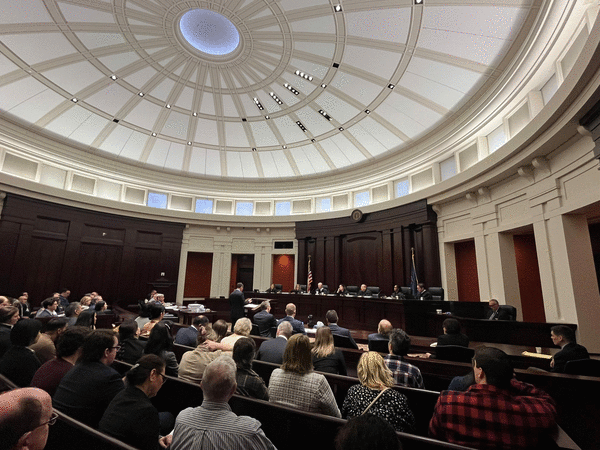
LANSING, Mich. — Gov. Gretchen Whitmer has vetoed nine bills that were the subject of litigation and 18 months of delay — legislation that was only presented to the governor Friday after a Michigan Supreme Court order required their presentment.
The legislation, which the then-Democratic-controlled Legislature failed at the end of 2024 to send to the Democratic governor, included bills affecting Detroit area museums, corrections officer pensions, debt collection efforts and government contributions to employees' health care.
Whitmer said the situation would have been different had the Legislature sent the bills to her in a timely fashion.
"House Republicans spent the last 18 months sitting on these bills, spending taxpayer dollars on costly lawsuits, and creating unnecessary uncertainty and preventing action on issues that matter to Michigan families," Whitmer wrote in her veto letter.
She noted that the effective date for the bills was April 2, 2025, and to implement them now would create "an insurmountable administrative burden" and "give rise to endless litigation."
House Speaker Matt Hall, a Richland Township Republican who delayed the presentation of the bills for roughly 18 months, presented the bills to the governor Friday after the Michigan Supreme Court order was released.
"My sympathies to the Democrats that they went through all of this work just for the bills to end up vetoed," Hall said in a statement.
Senate Majority Leader Winnie Brinks, D-Grand Rapids, sent out a statement earlier in the day celebrating the Supreme Court order mandating the presentation to the governor, calling it a "clear victory" for democracy. But on Friday afternoon, the leader said she was "extremely disappointed" with the governor's veto.
"Unfortunately, quality policy that would lower costs and improve life for millions of Michiganders met an end at the governor's desk," Brinks said.
State Rep. Will Snyder, a Muskegon Democrat who sponsored the legislation related to corrections officer pensions, expressed "profound disappointment" that the governor would side with House Republicans and veto the bills.
"She has always hesitated to take a supportive position, which could be why they were not transmitted to begin with," Snyder said in a statement. "This is a tragic result for Michigan’s democracy and the people of Michigan."
State Rep. Tyrone Carter, a Detroit Democrat who helped sponsor legislation related to the museums that was vetoed, offered a brief statement: “I am disappointed, but I am not surprised. And I don’t agree with the reasoning."
State Rep. Mai Xiong, a Warren Democrat who sponsored some of the legislation, said she respected Whitmer's decision.
"It isn’t what I would have wanted, and it isn’t what others who have been fighting so hard would have wanted," Xiong said. "And that’s what’s so disappointing.”
Secretary of State Jocelyn Benson, who is running in the Democratic gubernatorial primary, said she was "tired of these political games" and that, if elected, she would sign the bills into law.
"And I'll take on anyone, no matter how rich or powerful, who stands in the way," Benson said in a statement.
High court order triggers presentation to gov
The case dates back to January 2025, when the Michigan House, after coming under Republican control in the 103rd Legislature, refused to send to Whitmer for the signature the legislation passed by the Democratic majority in 2024 under the 102nd Legislature. The Senate sued over the House's refusal, arguing the lower chamber was constitutionally obligated to present the bills.
The Michigan Supreme Court early Friday morning declined to weigh in on the legal fight between the Democratic-led Senate and the Republican-led House, leaving in place a lower court order mandating the House's presentation of the bills.
In a brief order Friday, the high court, which heard oral arguments on the issue in May, said it was "not persuaded that the questions presented should be reviewed by this court." The language is what's typically used when justices decline to weigh in on an issue.
The order keeps in place an October Court of Appeals opinion that found the House had a constitutional obligation to present the bills. The appellate opinion ordered a lower court to set a deadline by which the Republican-controlled chamber must present them to the Democratic governor.
In a dissent Friday, Justice Brian Zahra, the only Republican-nominated justice on the 6-1 Democratic majority court, said he would grant the House's request for a full appeal to the Supreme Court.
There were several issues that the Court of Appeals skipped over in its opinion, he argued, including why it was the House's responsibility to transfer the bills.
"This case presents numerous difficult questions, often without parallel in our case law," Zahra wrote. "The Court of Appeals confidently breezed past several of these looming and potentially decisive issues in this case to reach the simplest conclusion."
In the October 2-1 opinion out of the Court of Appeals, Judge Thomas Cameron found that the state constitution "leaves no room for discretion" regarding whether the bills must be presented and clearly imposes that duty on the "Legislature as a whole" regardless of the session.
"It is beyond dispute that the duty of presentment falls to the Legislature, and that the only chamber of the Legislature capable of presenting these particular bills is the House of Representatives, because the House of Representatives currently possesses them," wrote Cameron, an appointee of Republican former Gov. Rick Snyder. "As such, the ministerial act of presentment must, by the facts of this case, fall on defendants."
Pensions, museums, debt collection bills killed with veto
The suit marked the first time in roughly 200 years that a legislative chamber has asked the judicial branch to resolve a purely legislative dispute, House attorneys have maintained.
In arguments before the high court in May, an attorney for House Republicans argued the current Legislature had no duty to send the bills to the governor in January 2025 after the Democratic lawmakers who passed them in 2024 failed to send them to the governor.
An attorney for Senate Democrats argued the House's failure to present those bills breached the chamber's constitutional duties and threatened the checks and balances on which state government relies.
The legislation at stake in the case would have allowed the Charles H. Wright Museum of African American History and Detroit Historical Museum to seek a property tax millage in Wayne, Oakland and Macomb counties; greatly increased government units' contributions toward state employee health care costs; allowed corrections officers to join the Michigan State Police's hybrid pension plan; and excluded disability, public assistance and worker's compensation from debt garnishments.
Charles Wright museum officials told Detroit officials in March that they faced an "extremely challenging" financial situation due to the stalled millage bill and cuts by the Trump administration and the state government. Officials sought $11 million in city aid at the time.
The City Council approved $3.3 million in city assistance for the Charles Wright museum's operations, up from $2.6 million the year before.
When the Legislature passed the budget last week, it approved $500,000 for the Charles Wright museum as part of $125.7 million in earmarks or pet projects by lawmakers. More than $4 billion worth of requests were submitted.
The employee health insurance change and pensions for corrections officers that may now be sent to the governor had been major legislative priorities for labor unions allied with Democrats.
The public employee health proposal awaiting presentation, specifically, would increase limits imposed during Snyder's administration on what public employers, such as schools and local governments, can pay toward their workers' health care. Currently, public employers participate in what's called an 80-20 plan, meaning a state department, local government unit or school district pays up to 80% of public employees' medical benefits plans and employees pay the other 20%. Alternatively, the public employer can pay an inflation-adjusted capped contribution.
Under the legislation awaiting presentation to Whitmer, the 80% contribution from public employers would become a minimum rather than a maximum, and the inflation-adjusted capped contributions would increase. For state workers, each percentage point increase in the employer contribution rate would increase costs by $5 million to $7 million, according to a nonpartisan House Fiscal Agency analysis.
_____
©2026 The Detroit News. Visit detroitnews.com. Distributed by Tribune Content Agency, LLC.



Comments