Trump denies role in María Corina Machado's failed return to Venezuela
Published in News & Features
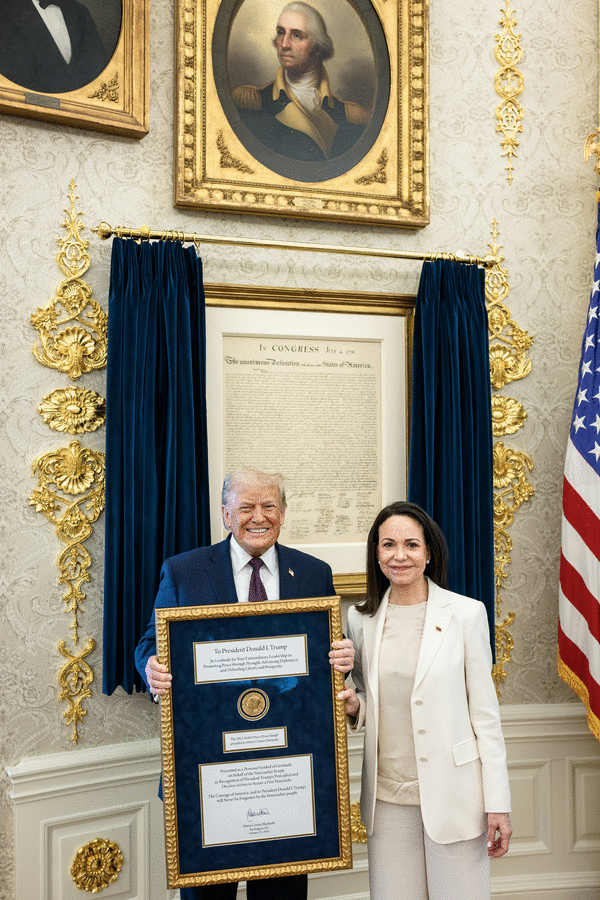
President Donald Trump denied this week that he had instructed Venezuelan opposition leader María Corina Machado not to return to her country after last month’s devastating earthquakes, distancing himself from reports that the administration had sought to block the opposition leader’s efforts to reenter the country.
“Oh, no, no, no, not at all,” Trump said when asked whether he had told Machado not to return to Venezuela. Calling the opposition leader “terrific” and “a wonderful person,” he added: “I did not tell anyone not to go back.”
Trump also recalled that Machado had dedicated her Nobel Peace Prize to him.
“She gave me the Nobel Prize. So how can I dislike her?” he said. “She said, the only one that should win it is Trump.”
The president’s remarks appeared to contrast with accounts from several anonymous administration officials who have portrayed Machado’s attempts to return as poorly timed and potentially disruptive to the massive humanitarian operation underway in Venezuela.
Those officials told the news website Axios that they feared her arrival could inject politics into relief efforts and complicate cooperation with the interim authorities coordinating rescue and reconstruction.
Machado’s unsuccessful efforts to return following the earthquakes have exposed growing tensions between the Trump administration and Venezuela’s best-known opposition leader, highlighting the increasingly delicate balance Washington is trying to strike between supporting the country’s democratic opposition and preserving stability during one of the worst humanitarian disasters in its modern history.
Over several days, Machado pursued multiple routes back to Venezuela, first through the Dutch Caribbean island of Curaçao and later through Panama, where she hoped to board a commercial flight to Caracas.
Each attempt ultimately failed amid diplomatic confusion, aviation complications and conflicting signals from U.S. officials, according to interviews with people familiar with the events, administration officials and public statements by those involved.
The setbacks offer one of the clearest indications yet of the changing relationship between Washington and Machado since U.S.-backed forces removed Nicolás Maduro from power in January and recognized Delcy Rodríguez as Venezuela’s interim president while pledging to support an eventual democratic transition.
People close to Machado tell a markedly different story.
Two people familiar with her efforts said the opposition leader sought to return to accompany earthquake victims, oversee humanitarian assistance and demonstrate solidarity with Venezuelans enduring a national tragedy that has claimed more than 3,800 lives and displaced tens of thousands.
The first attempt, the sources said, involved a private aircraft departing from the Washington area after Machado believed the necessary arrangements had been made for her transit.
While the aircraft was en route, organizers were instructed to turn back, the sources said. They said those coordinating the trip were warned that allowing the flight to continue could have consequences for those involved, prompting the pilots to reverse course before reaching the Caribbean. The Herald could not independently verify the precise nature of those communications.
That account partially overlaps with reporting that confusion inside the U.S. government contributed to Machado’s failed attempt to transit through Curaçao.
According to administration officials cited by Axios, Deputy Secretary of State Christopher Landau spoke with Dutch officials regarding Machado’s proposed travel, leading authorities there to initially authorize her arrival even though the administration’s official position was that it was neither facilitating nor opposing her return to Venezuela.
After other State Department officials clarified that position, Dutch authorities withdrew the authorization while Machado’s aircraft was already in flight, forcing it to return. Landau has denied misrepresenting U.S. policy.
After the Curaçao option collapsed, Machado shifted her efforts to Panama.
Two people familiar with the events said Panamanian officials received her and explored options for her to continue traveling on a commercial flight to Caracas.
The sources said Machado had already boarded the aircraft and was preparing for departure when the process was unexpectedly halted. Shortly afterward, airline representatives informed her that transporting Venezuela’s most prominent opposition figure could jeopardize the carrier’s ability to continue operating flights into Venezuela during the ongoing humanitarian emergency. The sources said Machado chose not to press the issue after learning that carrying her could affect the movement of humanitarian personnel and relief supplies.
The Herald could not independently verify communications between the airline and government officials, and the carrier has not publicly commented on the circumstances surrounding the aborted trip.
The unsuccessful attempt broadly aligns with previously reported accounts that Machado was ultimately unable to travel from Panama to Caracas after concerns emerged over the diplomatic implications of transporting her during the relief operation.
The repeated setbacks have unfolded as Washington has increasingly emphasized humanitarian assistance, restoring essential services and working with the interim authorities to stabilize Venezuela after the earthquakes, even as it continues to describe democratic elections as the country’s long-term objective.
That pragmatic approach has unsettled many members of Venezuela’s democratic opposition, who expected Machado — the overwhelming winner of the opposition’s 2024 presidential primary — to play a more prominent role in shaping the country’s political future.
Administration officials argue that immediate humanitarian needs must take precedence.
Machado’s allies counter that preventing the country’s most recognizable opposition leader from returning during its gravest humanitarian crisis sends precisely the wrong political message.
The controversy has also prompted public support from opposition leader Edmundo González, widely recognized by many Western governments as the winner of Venezuela’s disputed 2024 presidential election.
“There are principles that do not admit negotiation,” González wrote on X. “The right of every Venezuelan to enter, remain and return to his own country does not depend on authorization from those in power. It is a right recognized by the Constitution and by international human rights law.”
González said Machado, “like any Venezuelan, has the right to enter Venezuela,” arguing that defending that right means protecting a constitutional guarantee that belongs to all citizens regardless of political affiliation.
“A country cannot rebuild while its citizens depend on permission from those in power to return home,” he wrote. “Venezuela will once again be a republic, and at that moment Venezuelans will exercise their rights.”
His comments broadened the debate beyond Machado’s individual case, framing the controversy as one involving fundamental civil liberties rather than simply a political disagreement over the opposition leader’s role during the disaster response.
For now, the reasons behind Machado’s failed attempts to return remain the subject of competing narratives.
Administration officials insist the United States maintained an officially neutral position while privately expressing concerns about the timing of her return. Machado’s allies maintain she encountered repeated obstacles despite making good-faith efforts to reenter the country through lawful channels.
©2026 Miami Herald. Visit miamiherald.com. Distributed by Tribune Content Agency, LLC.





Comments