Mamdani unfurls plan to make NYC buses faster; here's how your ride will change
Published in News & Features
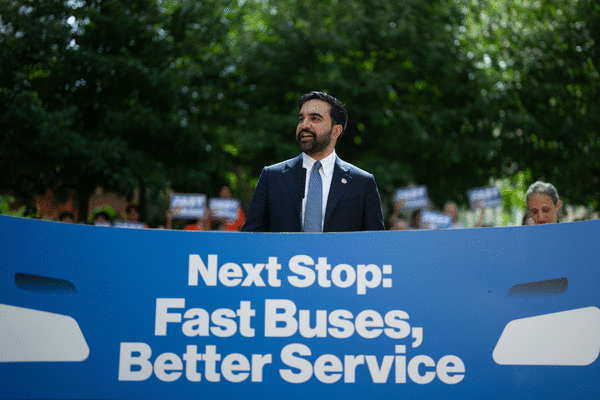
NEW YORK — Mayor Mamdani announced a sweeping plan for upgrades to the NYC bus network on Wednesday, highlighting 50 corridors on the slowest 25 bus routes for significant improvements, including at least five so-called “rapid” bus routes citywide.
“Too many New Yorkers walk faster to the bus stop than the bus they finally get on actually travels,” Mamdani said Wednesday at a press conference in Fort Greene, standing with Gov. Hochul and MTA chairman Janno Lieber.
The average speed of a bus negotiating the streets of NYC is about 5 mph, Mamdani said.
Wednesday’s Bus Action Plan, nicknamed “next stop,” is meant to speed bus traffic up by 20% on the 50 priority corridors, reducing the average bus trip by 6 minutes, the mayor said. To do this, the plan identifies 10 priority corridors in the Bronx, 12 in Manhattan, 12 in Queens, 13 in Brooklyn and three on Staten Island — all of which are slated for study and redesign.
Some projects in those corridors — such as the extension of the Madison Ave. bus lane in Manhattan — are already underway, while others are still in the planning stages.
Those corridors are expected to get bus lanes, with the lanes monitored by an expended automated camera enforcement program.
Five of them — Flatbush and Utica Avenues in Brooklyn, Northern Blvd. in Queens, a Tremont/Cross-Bronx route and a route connecting Kensington to Kennedy Airport — are slated to become “rapid bus corridors,” with center bus-only lanes, center bus stops, and potentially bus-priority signals.
The first of those projects, Flatbush Ave., is expected to be done by 2030. The other four are still in the planning phase.
In addition to those route designs, the plan calls for the MTA to adopt all-door boarding by the end of next year, letting passengers board at both the front and back of a bus.
Mamdani was elected last year after a campaign that put improvements to the buses front and center.
While the buses, like the subways, are operated by the state through the MTA, the streets on which the buses drive — and any bus-specific infrastructure like bus stops or bus-only lanes — are the city’s purview.
Mamdani promised voters on the campaign trail that as mayor he’d make buses “fast and free.”
He was asked about the latter half of that commitment Wednesday.
“I’ve been very clear with New Yorkers that my commitment is to make buses fast and free,” Mamdani told reporters. “Today we stand together on how we deliver the ‘fast.'”
MTA chair Lieber — who has expressed skepticism of the mayor’s fare-free bus plan amid his agency’s efforts to crack down on fare evasion — demurred.
“Not everyone agrees on everything,” he said, before lauding Mamdani’s support for last week’s expansion of the Fair Fares program, which offers half-off subway and bus fares to New Yorkers in need.
For its part, the MTA reiterated its plan Wednesday to purchase 2,500 new buses as part of its current five-year capital plan.
The joint city-state Bus Action Plan also commits the MTA to improving bus maintenance across the fleet.
“We need a partnership with the union to make sure that the maintenance that’s happening in the depots is happening on time,” Lieber said.
As first reported last year by the Daily News, hundreds of thousands of bus maintenance records across the MTA’s bus fleet have bee incomplete for several years.
________
©2026 New York Daily News. Visit at nydailynews.com. Distributed by Tribune Content Agency, LLC.






Comments